
How to clear cedar and keep cedar regrowth in check
Cedar regrowth after clearing usually comes from trees cut too high or from new seedlings. Here is how to clear Ashe juniper low and keep the land open for good.
Does cedar grow back after it is cut?
Cedar does not grow back from the stump when Ashe juniper, the common cedar of the Texas Hill Country, is cut below its lowest green branch. Cedar regrowth after clearing comes from trees cut too high, from new seedlings, or from redberry juniper, a sprouting species found mostly in West and Northwest Texas.
Cedar regrowth is the worry we hear most from Hill Country landowners. Nobody wants to pay to clear cedar and watch it come back in a few years. The good news is that Ashe juniper, the cedar that covers so much of the Hill Country, does not resprout from a stump cut low. Get the cut right, stay ahead of seedlings, and cleared ground stays open.
This guide explains why cedar comes back on some properties and not others, and how we clear it so it stays gone.
Does cedar grow back after cutting?
Ashe juniper is a non-sprouting species. Texas A&M research summaries note that Ashe juniper of any size can be killed by cutting at or slightly above the soil surface. Ashe juniper does not push new stems from a bud zone at the base the way mesquite does.
The working rule in the field is simple. Cut every cedar below its lowest green branch. A green limb left on the trunk can keep the tree alive. Take the tree below that limb and the tree is done.
Why cedar regrowth happens after clearing
When landowners see cedar come back after clearing, one of three things is usually going on.
Cedar cut too high
A cedar cut above its lowest green branch still has live foliage feeding it. Rushed chainsaw work, or a shredder riding over the top of small trees, can leave exactly that. The tree keeps growing from the limbs left behind.
New cedar seedlings
Berries that dropped before clearing can sprout once the canopy is gone and sunlight reaches the ground. Birds keep bringing more. Texas A&M research points to American robins as especially effective at carrying juniper berries out into open grassland. Seedlings are new trees, so they need their own follow-up plan.
A different juniper species
Redberry juniper, found mostly in West and Northwest Texas, behaves very differently from Ashe juniper. Redberry juniper resprouts from a bud zone at the base when the top is cut, shredded or burned. If cut cedars on your property send up new shoots from the stump, have the species checked. Redberry juniper has to be removed below the bud zone to stay gone.
How forestry mulching clears cedar low
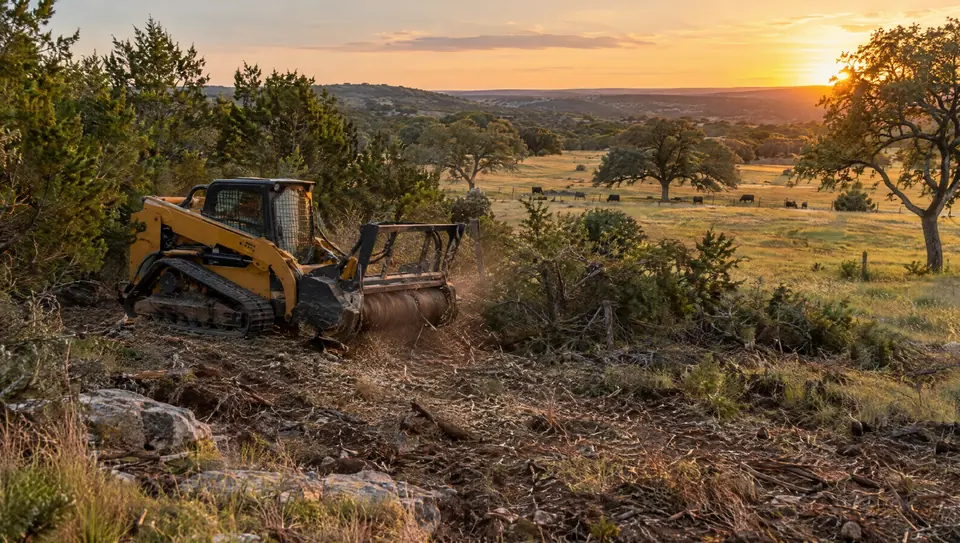
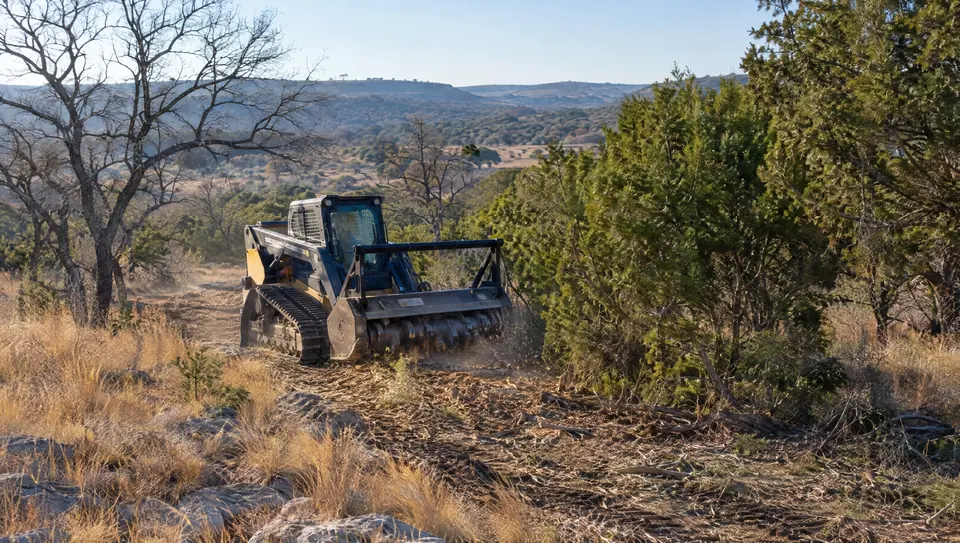
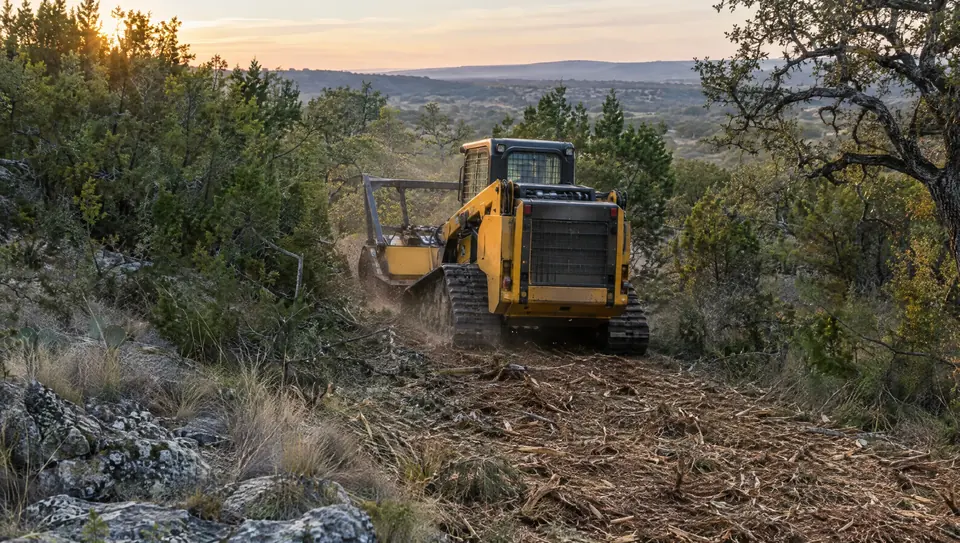
Forestry mulching is a strong fit for cedar. The mulching head grinds each tree down at the base, below the lowest green branch, so nothing is left to keep the tree alive. Dense cedar breaks come down in one operation, with no piles to burn and no trucks to load.
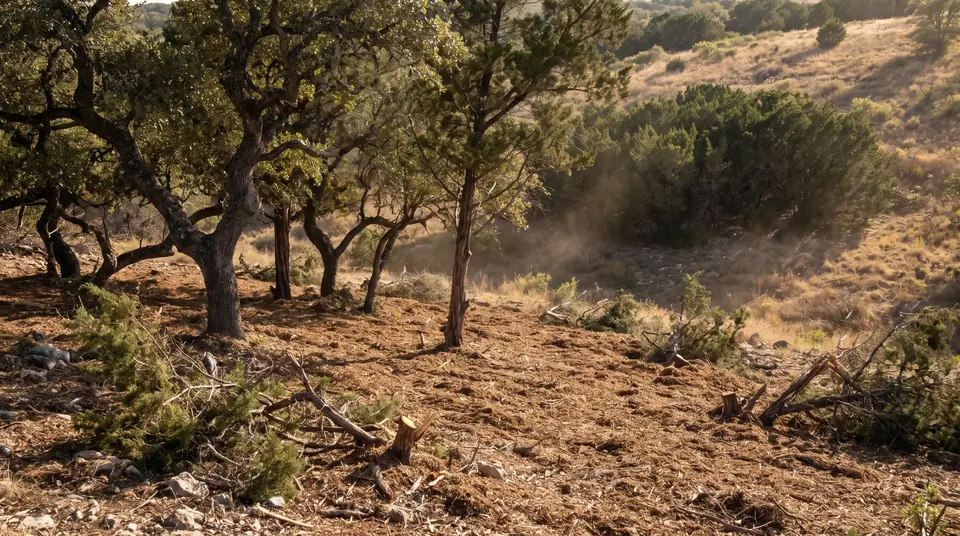
The mulch stays on the ground as cover, and the root balls stay in the soil to hold it. On Hill Country slopes, where thin soil sits over limestone, keeping the ground covered matters.
Selective work is where a skilled operator shows. We take the cedar and leave the oaks, elms and shade trees you flag. Learn more about our cedar removal in Texas, or see our local page for cedar removal in Spring Branch, TX.
How to check a cleared cedar job for regrowth risk
A few minutes on the ground tells you whether a cedar job will hold.
- Look at the stumps. A cedar stump with no green branches attached will not grow back.
- Look for cut trees with a low limb still green. Those trees are still alive and need a second cut below that limb.
- Look for stumps sending up new shoots. Ashe juniper does not resprout, so shoots point to redberry juniper or another sprouting species.
- Look at the ground. A fine finish lets grass take hold, and grass cover makes new seedlings easier to spot and control.
A follow-up plan for cedar seedlings
Even a clean cedar job will see seedlings. Texas A&M guidance on mechanical juniper control stresses follow-up control within a few years of clearing. A simple plan keeps that follow-up easy.
- Walk the cleared ground once or twice a year for the first few years.
- Pull or cut seedlings while they are small, below any green growth.
- Mow or shred open areas on a schedule so seedlings never reach branching height. Our grounds maintenance in Central Texas crew handles mowing and shredding.
- Keep grass healthy, since good grass cover competes with seedlings for light and water.
Seedlings pull or cut easily when they are young. Wait until they branch out and the job gets bigger every year.
Protect your oaks while clearing cedar
Cedar and oak grow side by side across the Hill Country, so cedar clearing often happens right next to trees you want to keep. Before any clearing, we walk the property with you and flag the keepers.
Oak wilt is the main risk to those oaks. Texas A&M Forest Service advises avoiding pruning or wounding oaks from February through June and painting any oak wound immediately. Oak wilt spreads in defined paths, and infected trees cannot be restored, so careful selective clearing protects the healthy trees around a problem area. Our post on the best time to clear land in Texas explains how to schedule cedar work around the oak wilt window.
What the land does after the cedar is gone
With the cedar gone, rain and sunlight reach the ground again. Research summarized by Texas A&M found that only about a fifth of annual rainfall reached mineral soil under Ashe juniper canopy, compared with most of the rainfall under grass cover. More water reaching the soil gives native grasses a chance to come back.
Grass recovery follows mulch depth. Under a light layer of mulch, grass can green up within days after a rain. Under a heavy layer, up to 12 inches deep, grass can take two to three years to push through.
Whether clearing changes the flow of a spring, creek or well depends on soils, geology and rainfall. We do not promise that result, and you should be wary of anyone who does.
For ranches dealing with mesquite as well as cedar, read about clearing cedar and mesquite on a Texas ranch. The two species need different plans.
Take your land back from cedar
Call (210) 247-8410 to set up a discovery call. We will mulch the cedar low, protect your oaks and give the grass a chance to come back.
Sources
- Juniper ecology, Texas Natural Resources Server, Texas A&M
- Juniper control and management, Texas Natural Resources Server, Texas A&M
- Biology and ecology of redberry juniper, Texas Natural Resources Server, Texas A&M
- How an increase or reduction in juniper cover alters rangeland hydrology, Texas Natural Resources Server, Texas A&M
- Prevent the spread of oak wilt in Texas, Texas A&M Forest Service