
What is forestry mulching, and how does it work on Texas land?
What is forestry mulching? One machine grinds trees and brush where they stand, with no burn piles and no hauling. Here is how forestry mulching works and what it leaves behind.
What is forestry mulching?
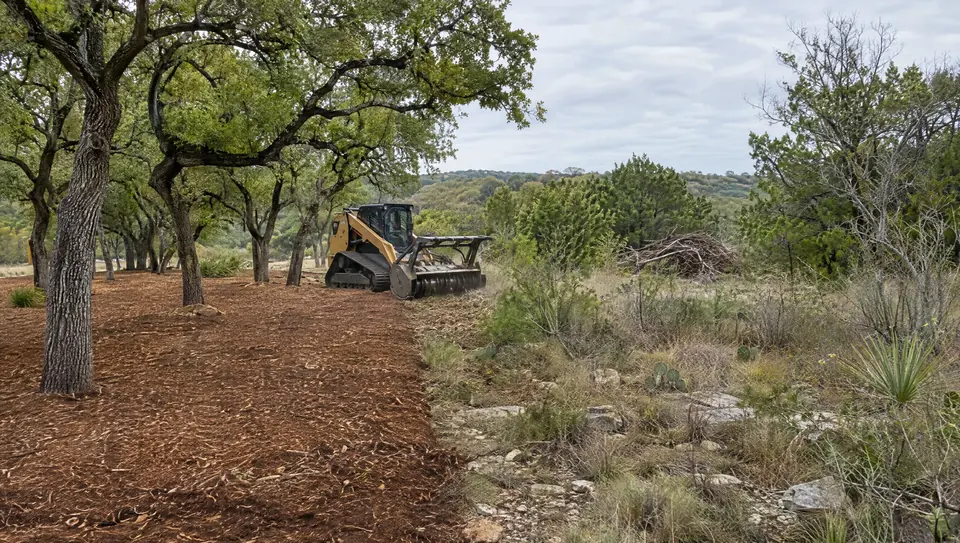
Forestry mulching is a land clearing method that grinds trees, brush and undergrowth into mulch where they stand. One machine handles the cutting and the cleanup, so there is no pushing, piling, hauling or burning. Root balls stay in the ground to hold the soil, and the mulch stays on site as ground cover.
What is forestry mulching? Forestry mulching is a way to clear land with one machine that grinds trees, brush and undergrowth into mulch right where they stand. Nothing gets pushed into piles, hauled off or burned. The mulch stays on the ground, the root balls stay in the soil, and you are left with open, usable land.
Forestry mulching is the core of what 9 Arrow does. John Wheelock came to it in 2014, on a project with a land developer and a surveyor, and it became the center of the business. This guide explains how forestry mulching works, what it leaves behind and when it is the right call for your property.
What is forestry mulching, machine by machine
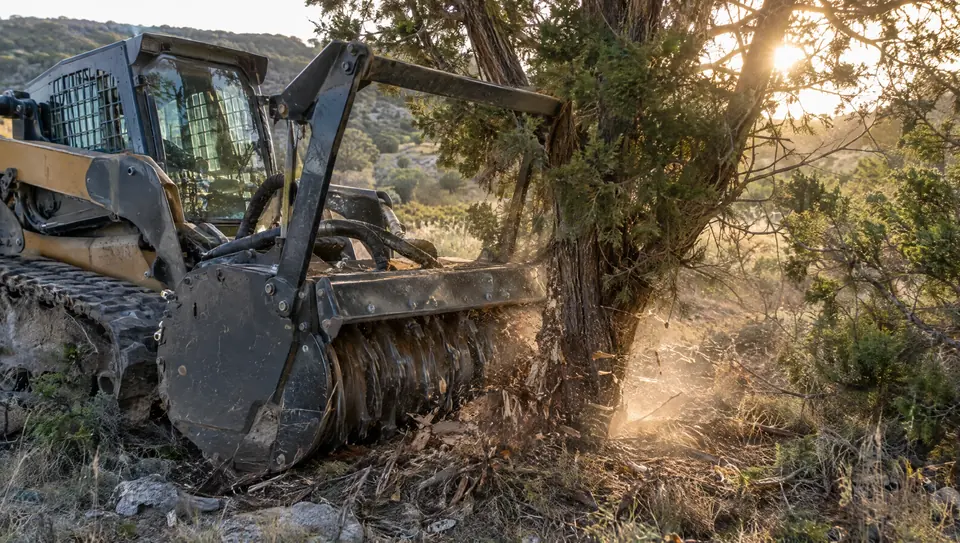
A forestry mulcher has two parts. The carrier is the machine that drives, on tracks or on wheels. The mulching head on the front holds a spinning drum lined with steel teeth. The operator walks the head into a standing tree or a wall of brush, and the teeth grind the wood into small chips down to ground level.
Clearing and cleanup happen in one step. There is no second crew with chainsaws, no loader stacking piles and no trucks hauling debris away.
The teeth take a beating, especially on rocky Hill Country ground. Crews grind and sharpen them to keep the head cutting clean.
The forestry mulching equipment we run
9 Arrow runs two classes of forestry mulching equipment.
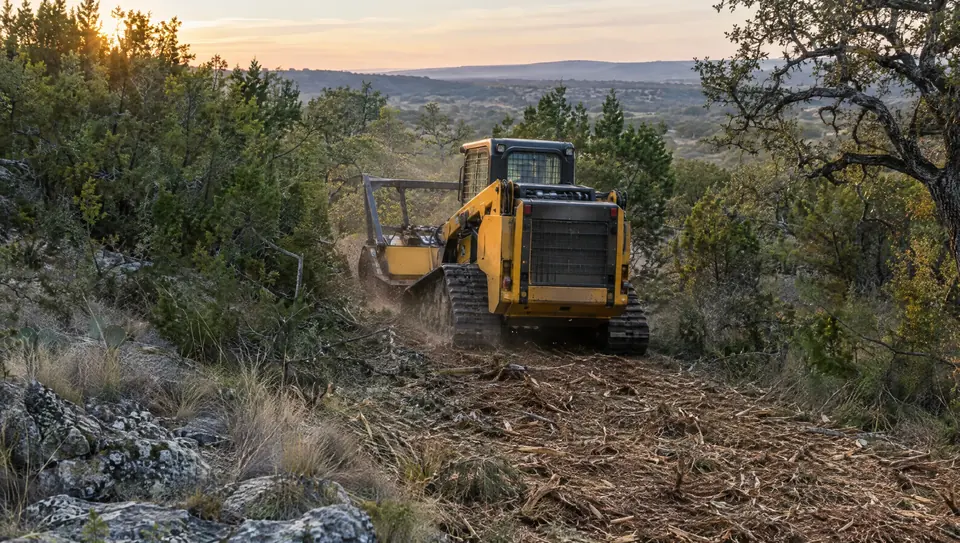
- Compact track machines. Built for tight access, slopes and uneven ground. Our setup pairs a CAT 275 compact track loader with a Weiler M860A mulcher. Compact machines work close to homes, fences and the trees you want to keep.
- Large articulated wheel machines. High horsepower and high production for big tracts and big trees.
Pace depends on the machine and the land. Smaller machines clear about half an acre to one acre in an 8-hour day. Larger machines clear about one to three acres a day with reasonable tree coverage. There is no tree size limit, and a tree that takes an hour on a smaller machine can take as little as 15 minutes on a large one.
What the ground looks like after forestry mulching
The finish is where forestry mulching earns its reputation, and where contractors differ most.
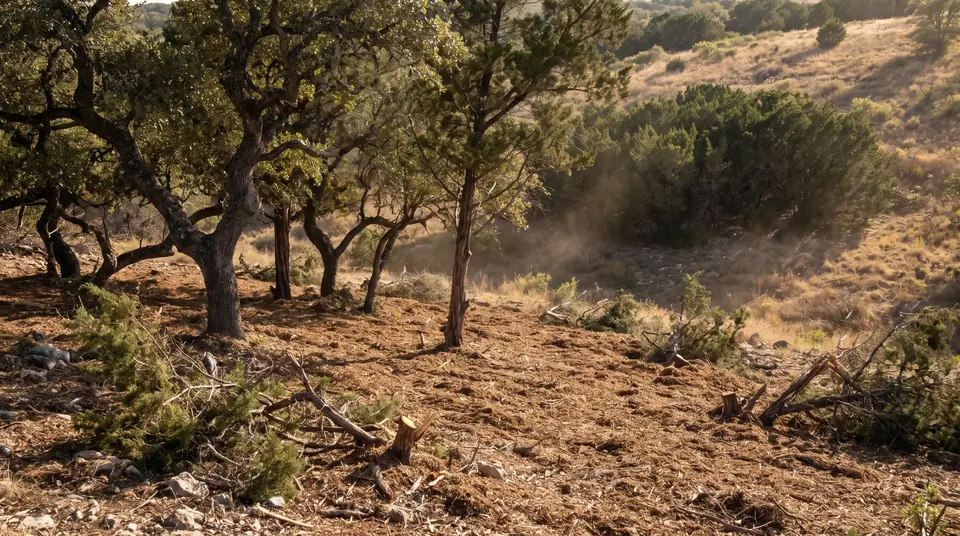
A 9 Arrow fine finish leaves small material, the kind we call toothpicks or hamster chips. Ground finished that fine is easy to walk and drive over, looks clean, and lets grass come back faster than coarse debris does.
Grass recovery follows mulch depth. Under a light layer, grass can green up within days after a rain. Under a heavy layer, up to 12 inches deep, grass can take two to three years to push through. If you need open ground sooner, the mulch can be stockpiled or hauled off.
Root balls stay in place with forestry mulching. Roots left in the ground hold the soil together, which matters on Hill Country slopes where thin soil sits over limestone. Bulldozer clearing rips out roots and disturbs the soil, which raises the risk of erosion.
What forestry mulching can clear
Forestry mulching covers a wide range of vegetation and site conditions.
- Light regrowth and overgrown lots
- Dense brush and cedar thickets
- Large hardwoods and mature trees
- Existing brush piles, including old bulldozer piles as large as a house
- Selective clearing around the trees you keep
- Mass acreage clearing on large tracts
For tall grass and light brush, we also mow with agricultural equipment, which suits lighter needs.
When forestry mulching is the right tool
Forestry mulching fits most clearing where you want the soil left intact and nothing to clean up afterward. Common jobs include the following.
- Cedar removal in Texas across Hill Country pastures and home sites
- Reclaiming overgrown pasture for grazing
- Opening trails, sight lines and fence lines
- Cutting survey lines and utility corridors
- Clearing home sites and staging land for sale
Some work needs more than forestry mulching. Ground under a foundation usually has to be free of roots, so we grub those spots with bulldozers and excavators and mulch the root balls on site. Many projects mix both methods. For a full side-by-side, read forestry mulching vs traditional land clearing.
Forestry mulching also helps with tree health. Drought stress and oak wilt are common in Central Texas. Oak wilt spreads in defined paths, and infected trees cannot be restored, so selective clearing is often the best way to protect the healthy trees nearby.
Forestry mulching on survey lines and corridors
Forestry mulching also opens long, narrow cuts through dense timber. Property lines between tracts, future road locations, subdivision street corridors and fence lines all start as a line through brush.
For that work, we mount Trimble geospatial receivers on the forestry mulching machines. The system loads the CAD survey files from your licensed surveyor and guides the operator along the certified line in real time. That can reduce or remove the need for a survey crew to pre-stake the line. 9 Arrow is not a licensed surveyor and does not replace one. Learn more about our survey line clearing in Texas.
Utility rights-of-way follow the same idea on a larger scale. Pipeline and powerline corridors typically run 30 to 120 feet wide and can stretch for miles, and 9 Arrow is often the first contractor on site, opening the easement ahead of grading crews.
What to expect on forestry mulching day
Before the machine starts, we walk the property with you and mark what stays. Flagged oaks, shade trees and boundary lines guide the operator through the day. Tell us about anything hidden in the brush, such as old fences, septic lines, wells or buried utilities, so the operator can work around them.
Expect noise and dust while the head is running, and expect the land to change fast. Brush that hid the terrain for decades comes down, and the shape of the ground shows again. There are no burn piles to watch and no waiting on a burn ban, since nothing gets burned.
When the crew packs up, the ground should look finished. We don't consider a job finished unless we're proud of the result.
Wondering what forestry mulching costs? Our guide to forestry mulching cost per acre explains how we build estimates by the day or by the acre.
Put forestry mulching to work on your land
See what our forestry mulching in Central Texas service covers, or call (210) 247-8410 to set up a discovery call.
It does not get better.