

Land clearing FAQ for Central Texas landowners
This land clearing FAQ covers common questions about how 9 Arrow prices a job, how forestry mulching works, what the finished ground looks like, rock crushing and roads, survey and right-of-way clearing, and scheduling. Ready to talk about your property? Request a land clearing estimate.
- Estimates by the day or acre
- No burn piles, no hauling
- Trimble GPS on the mulchers
- Road base crushed from on-site rock
How does 9 Arrow Land Service price land clearing?
9 Arrow Land Service prices land clearing after a discovery call, a site visit or both. The estimate depends on vegetation density, tree size and species, topography, access, maneuverability and soil conditions, and 9 Arrow shows it by the day or by the acre. 9 Arrow does not publish set prices, because every property clears differently.
Jump to a topic
Still have a question? Call (210) 247-8410.
Pricing
Does 9 Arrow price land clearing by the acre or by the day?
9 Arrow shows land clearing estimates by the day or by the acre. The number comes after a discovery call, a site visit or both, once the crew understands the vegetation, the terrain and the access. Density and terrain change how fast a machine moves, so the estimate follows the land itself.
What affects the cost of clearing an acre of land?
The cost of clearing an acre depends on vegetation density, tree size and species, topography, access, maneuverability and soil conditions. Thick growth on steep, rocky ground takes longer than light brush on flat ground. A tree that takes an hour on a smaller machine can take as little as 15 minutes on a large one.
Process
What is forestry mulching?
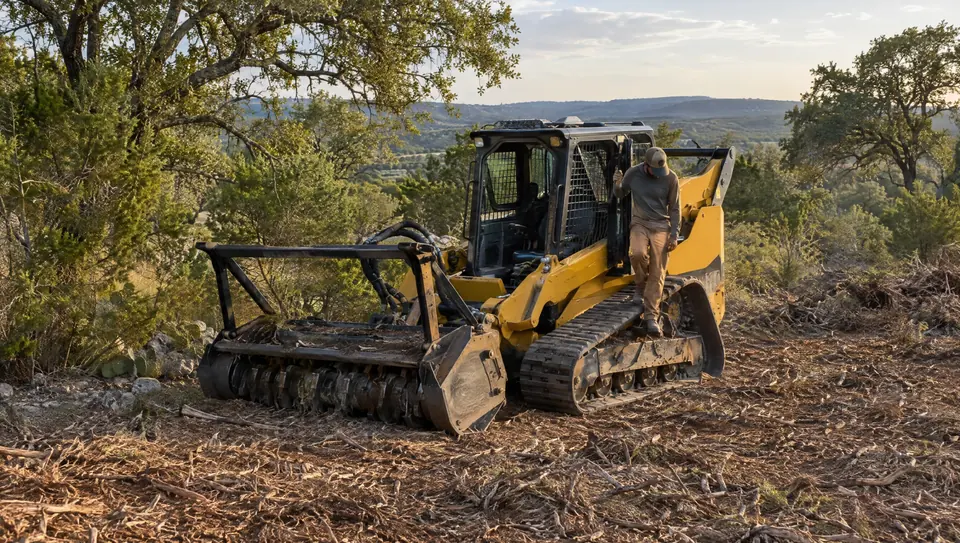
Forestry mulching is a land clearing method that grinds trees, brush and vegetation where they stand. 9 Arrow's forestry mulching handles light regrowth, dense brush, large hardwoods and mature trees with no pushing, piling, hauling or burning. The ground is left covered in fine mulch, and the soil stays intact.
Does 9 Arrow remove stumps and root balls?
9 Arrow leaves root balls in place during forestry mulching because they keep the soil stable. When full removal is needed, such as under a future foundation, the crew grubs with bulldozers and excavators. The pulled root balls are then mulched on site, which 9 Arrow prefers over hauling them away.
Can 9 Arrow get rid of old brush piles?
Yes. 9 Arrow mulches existing brush piles on site, including old bulldozer piles as large as a house. Mulching replaces burning, which is often prohibited during Texas burn bans. The pile is ground into fine mulch on the property, so nothing has to be loaded, hauled off or burned.
Can 9 Arrow clear around the trees I want to keep?
Yes. 9 Arrow offers selective clearing that removes brush and unwanted trees and leaves the ones you choose. Selective clearing also helps where trees are declining. Drought stress and oak wilt are common in Central Texas, oak wilt spreads in defined paths, and infected trees cannot be restored, so selective clearing is often the best way to protect nearby trees.
Finish
What does land look like after forestry mulching?
Land cleared by 9 Arrow's forestry mulchers is covered in a fine finish of small material the crew calls toothpicks or hamster chips. The fine finish looks better, is easier to drive over and lets grass come back faster. If a project needs bare ground, the mulch can be stockpiled or hauled off.
How long does grass take to grow back after mulching?
Grass grows back after forestry mulching on a timeline set by mulch depth. Under a light layer of mulch, grass can come back within days after a rain. Under heavy mulch, up to 12 inches deep, regrowth can take 2 to 3 years. A fine mulch finish helps grass regrow faster.
Is forestry mulching better for the soil than bulldozing?
Forestry mulching is easier on the soil than bulldozing. Mulching grinds vegetation and leaves root balls and soil in place, while dozing disturbs the soil and raises erosion risk. The mulch layer also covers the ground after clearing. 9 Arrow grubs with bulldozers where full root removal is needed, such as under foundations.
Rock & roads
What is on-site rock crushing?
On-site rock crushing is the process of breaking existing surface rock into a fine, compactible road base right on the property. 9 Arrow's on-site rock crushing uses crushing heads and attachments that bring rock down to a fine, consistent grade. Using your own rock eliminates imported material and reduces project cost.
Can 9 Arrow build an access road on my property?
Yes. 9 Arrow builds access roads starting with clearing and moving through rough grading, fine grading, road base preparation, culverts, drainage and erosion control. Roads are graded with proper crown and drainage, built to support heavy equipment and truck traffic, and made to stay usable through changing weather.
Survey & ROW
How does GPS survey line clearing work?
GPS survey line clearing at 9 Arrow works by loading your licensed surveyor's CAD survey files onto Trimble data collectors and receivers mounted on the forestry mulchers. Operators follow the certified survey data with real-time GPS guidance, which reduces or eliminates pre-staking. Learn more about survey line clearing. 9 Arrow is not a licensed surveyor.
How wide are the right-of-way corridors 9 Arrow clears?
Right-of-way corridors that 9 Arrow clears are typically 30 to 120 feet wide, often 90 feet or more, and routes can run for many miles. The work covers gas pipelines, powerline corridors and waterlines. 9 Arrow is often the first contractor on site, opening the easement ahead of grading crews, dozers and excavators.
Does 9 Arrow maintain rights-of-way after the initial clearing?
Yes. 9 Arrow maintains rights-of-way after the initial clearing with tractor and batwing equipment, which keeps aggressive regrowth such as mesquite in check. Grounds crews also handle gas pipeline ROW maintenance, signage clearing and access-corridor upkeep. 9 Arrow keeps a written Electrical Right-of-Way Safety Manual for utility clearing work.
Scheduling
How many acres can 9 Arrow clear in a day?
9 Arrow's smaller machines clear about half an acre to 1 acre per 8-hour day. Larger high-horsepower machines clear about 1 to 3 acres per day with reasonable tree coverage, and up to about 5 acres in lighter conditions. Vegetation density and terrain change the pace on every property.
How often should a Texas property be mowed?
A Texas property is best mowed monthly during the growing season. Every 2 to 3 months is the outer limit in peak growth, and one final mow usually carries a property through winter. 9 Arrow grounds maintenance offers recurring agreements for residential properties and schedules rural and ranch properties by season and conditions.
Ready to see what your land can become?
Book a discovery call. We'll talk through the property and your goals, walk it with you, and price the work by the acre or by the day.