
How much does land clearing cost in Texas?
Land clearing cost in Texas starts with the scope of work. Here is how mulching, grubbing, brush piles and access each shape an estimate, and how to compare bids fairly.
How much does land clearing cost in Texas?
Land clearing cost in Texas depends on the scope of work and the machine time it takes. Density, tree size and species, terrain, access and soil set that time, and grubbing, brush piles or hauling add to it. 9 Arrow does not publish flat rates and estimates each project by the day or by the acre.
Land clearing cost in Texas comes down to two questions. What work does your land need, and how long will that work take on the ground? A wooded Hill Country acre and an open acre of light brush can be priced very differently, even on the same property.
9 Arrow does not publish flat rates. We price land clearing in Central Texas by the day or by the acre after a discovery call and, when needed, a site visit. This guide covers what goes into that estimate, so you can plan a budget and compare bids on equal footing.
Why land clearing cost in Texas has no flat rate
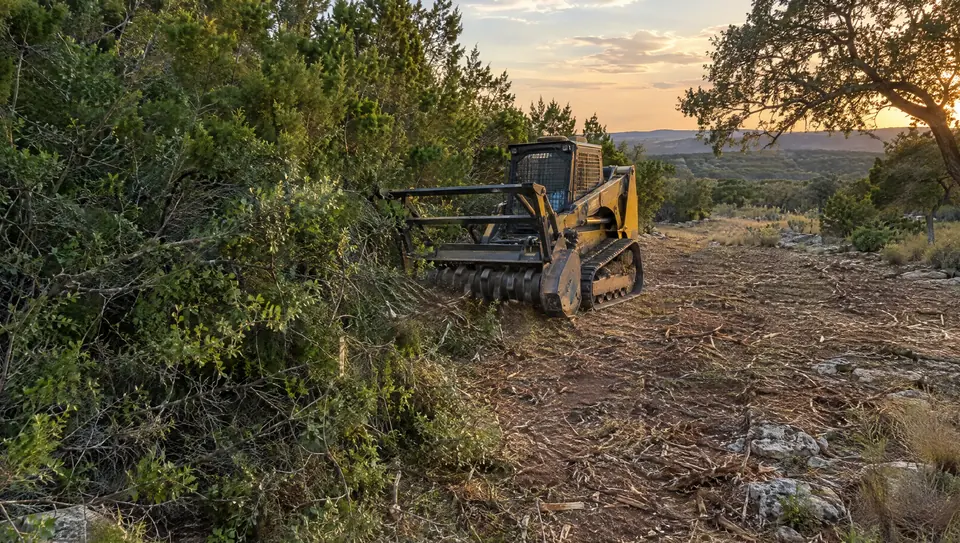
Two tracts of the same size rarely take the same time. Central Texas land runs from thick Ashe juniper on rocky slopes to open pasture with scattered brush to creek bottoms with large hardwoods. Each kind of ground calls for different equipment, different care and a different number of machine days.
A single per-acre sticker price would overcharge the easy acres and underprice the hard ones. When a bid looks far lower than the rest, check the scope and the finish before you check the total. We would rather walk your land and give you a number that fits it.
Start with the scope of land clearing work
The scope decides the method, and the method drives the price. Most land clearing projects include one or more of the following pieces.
Selective clearing and underbrush
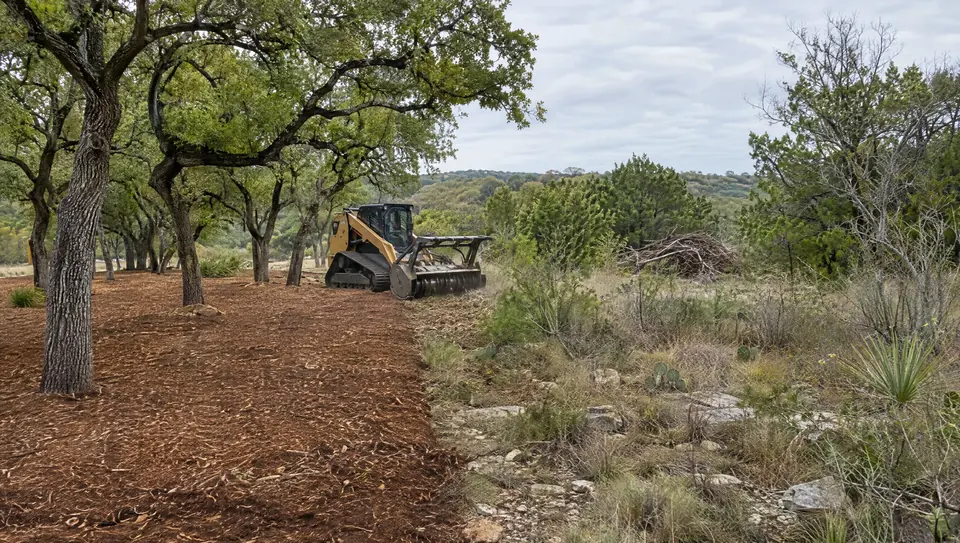
Selective clearing removes brush, cedar and small trees while keeping the oaks and shade trees you want. Careful work around keeper trees takes more time per acre than an open sweep. The payoff is a property that looks like a park instead of a thicket.
Full forestry mulching
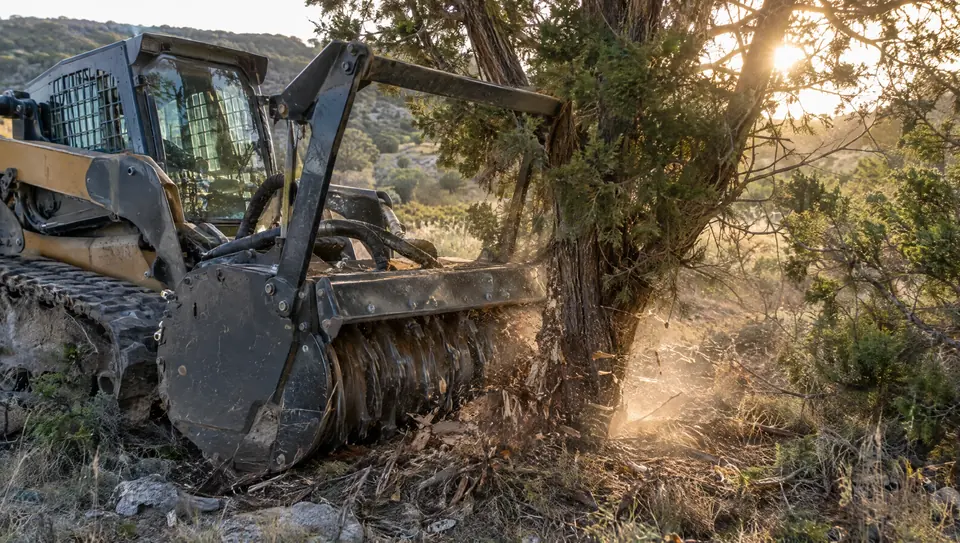
Full forestry mulching clears a tract wall to wall, grinding trees and brush where they stand. There is no pushing, piling, hauling or burning, so clearing and cleanup happen together. For a closer look at what sets mulching time, read our breakdown of forestry mulching cost per acre.
Grubbing and root removal
Forestry mulching leaves root balls in the ground to keep the soil stable. Some work needs those roots out, such as the footprint of a future foundation. Grubbing with bulldozers and excavators pulls the roots, and we prefer to mulch the root balls on site. Grubbing is a separate step with its own time.
Existing brush piles
Old bulldozer piles can be as large as a house, and burning them is often prohibited during burn bans. We mulch existing piles in place. Large piles take real machine time, so they belong in the scope from the start.
Mulch handling
By default, mulch stays on the ground as cover. If you need the mulch stockpiled in one spot or hauled off the property, plan for the added work.
Access and follow-on work
Some tracts need a way in before clearing can start. Others need a building pad, a driveway or a ranch road once the brush is gone. Grading, culverts and on-site rock crushing for road base are separate line items. Our access road building crew handles roads and drainage, and our land clearing for a building site work covers home sites and pads.
Site factors that change land clearing time
Once the scope is set, the land itself sets the pace. We look at the same things on every site walk.
- Density. More stems and brush per acre means slower going.
- Tree size and species. Large hardwoods take longer than light regrowth, and keeper trees need careful work around them.
- Topography. Steep slopes, ledges and loose limestone slow any machine.
- Access and maneuverability. Narrow gates, creek crossings and tight spaces add time.
- Soil conditions. Wet ground can rut, and rocky ground wears mulcher teeth.
How machine pace turns into a land clearing estimate
Production pace is the bridge between your land and your price. Smaller compact track machines clear about half an acre to one acre per 8-hour day. Larger high-horsepower machines clear about one to three acres per day with reasonable tree coverage, and up to five acres a day in lighter conditions.
That spread is why machine choice matters. Compact track machines fit tight access, slopes and selective work. Large articulated wheel machines fit bigger tracts where high production pays off. A 20-acre tract of moderate cedar is a very different number of days on each machine, and the estimate reflects the machine that fits the ground.
How 9 Arrow prices a land clearing project
Every project starts with a discovery call. We ask what you want the land to become, how many acres are involved, which trees stay and how equipment gets in. When the answers call for it, we visit the site and walk the land with you.
From there we write an estimate by the day or by the acre. You have the number before work starts, along with a clear picture of what the scope includes and what it leaves out.
Our standard is a finished job we are proud of. Properly cleared land is healthier, more valuable and more enjoyable to own, and that only holds when the work is done right the first time.
How to compare land clearing bids
Two bids are only comparable when they describe the same work. Ask each contractor to spell out these items in writing.
- Acreage or days included, and how the price is set
- The finish you will see when the crew leaves
- Which trees stay, and how they are marked
- Whether root balls stay in the ground or come out
- How existing brush piles and mulch are handled
- Any grading, pad or road work included
Finish is the line item people forget. A fine finish, the small material we call toothpicks or hamster chips, is easier to drive over and lets grass return faster. A rough finish can mean a second bill to clean up stubs, splinters and debris.
One of our developer clients, Zach C., wrote in a Google review, "We exclusively use 9 Arrow for all land clearings, lot lines, and site prep scopes for our Texas projects."
Get a land clearing number for your property
Tell us what you have and what you want it to become. Call (210) 247-8410 or request an estimate to start with a discovery call.