
How forestry mulching cost per acre is set in Central Texas
Forestry mulching cost per acre comes down to how many machine hours each acre takes. Here is what sets that time and how 9 Arrow turns it into an estimate.
How much does forestry mulching cost per acre?
Forestry mulching cost per acre depends on how many machine hours each acre takes. Vegetation density, tree size and species, slope, access and soil conditions set that time. 9 Arrow does not publish a flat rate. We estimate each job by the day or by the acre after a discovery call and, when needed, a site visit.
Forestry mulching cost per acre is the first question most landowners ask us, and it is a fair one. The honest answer is that every acre is priced by the time it takes a machine to grind it. An acre of scattered cedar saplings and an acre of mature oak and Ashe juniper are two different jobs, even when the survey says they are the same size.
9 Arrow does not publish a sticker price. We give you an estimate by the day or by the acre after we understand your land. This guide walks through what goes into a forestry mulching in Central Texas estimate, so you can read any number with clear eyes.
Why forestry mulching cost per acre comes down to machine time
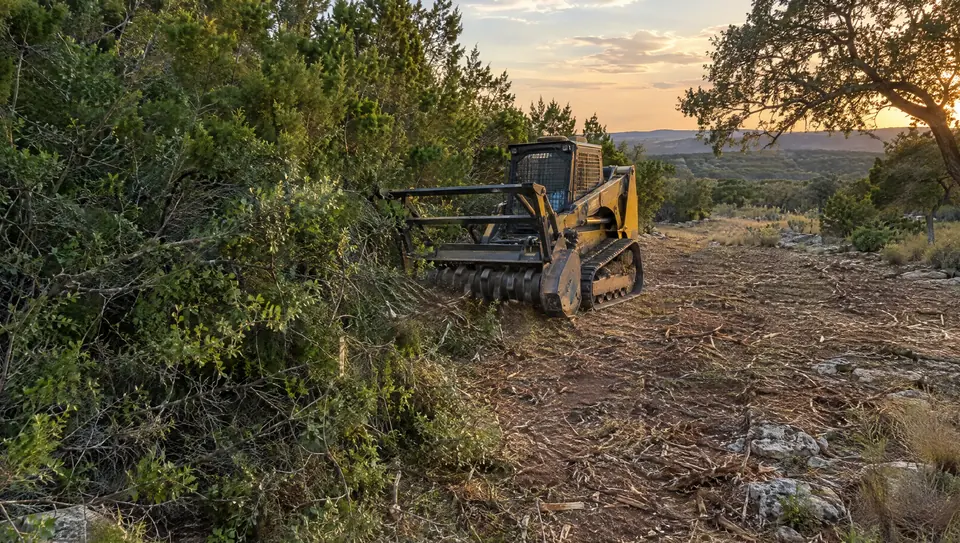
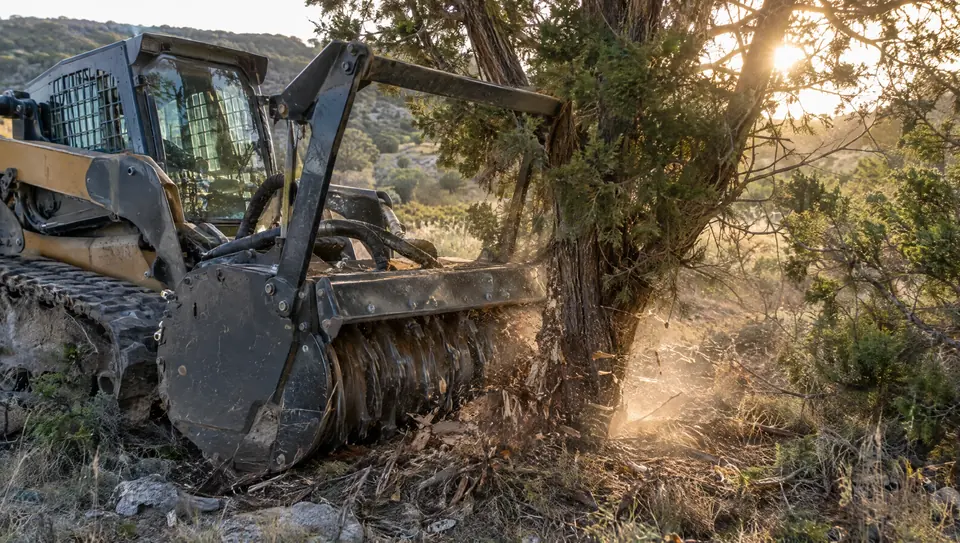
A forestry mulcher grinds trees and brush where they stand. There is no pushing, piling, hauling or burning afterward, so the hours the machine spends on the ground make up most of the job. More material per acre means more hours per acre.
Production pace gives you a feel for the range. Our smaller compact track machines clear about half an acre to one acre in an 8-hour day. Our larger, high-horsepower machines clear about one to three acres a day with reasonable tree coverage, and up to five acres a day in lighter conditions. Dense cedar on a rocky slope sits at the slow end. Open ground with light regrowth sits at the fast end.
Tree size matters as much as tree count. There is no tree size limit on what we mulch, but big trees take time. A tree that takes an hour on a smaller machine can take as little as 15 minutes on a large one.
The factors that set forestry mulching time per acre
Every forestry mulching estimate we write weighs the same set of site factors.
Vegetation density
Density is the amount of stems, limbs and brush on each acre. A thick cedar break or an overgrown fence line carries far more material than an open pasture with a few scattered trees. Heavier density means slower ground speed and more hours per acre.
Tree size and species
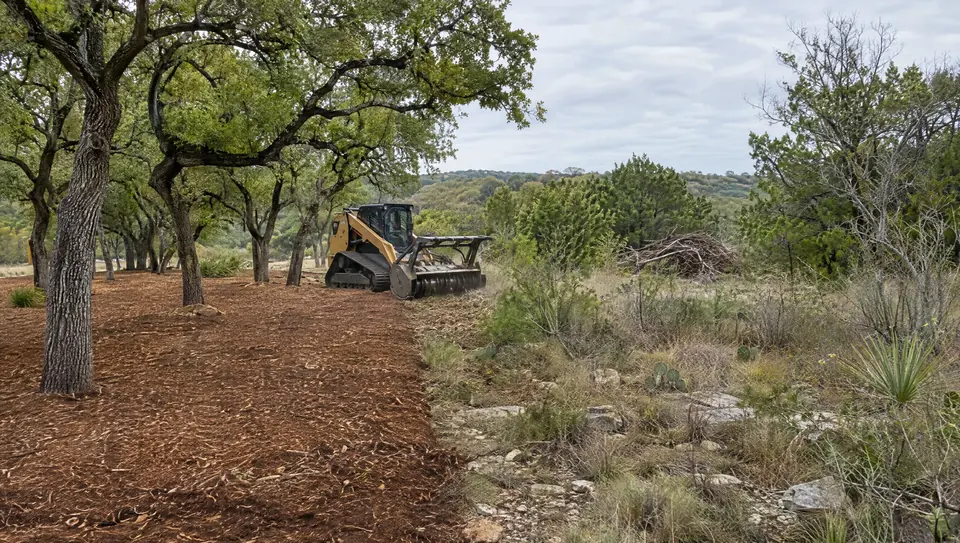
Large hardwoods and mature trees take longer to grind than light regrowth. Species also shapes the plan. Cedar may be cleared wall to wall while oaks are worked around one at a time, and careful work around the trees you keep takes longer than an open sweep.
Topography and slope
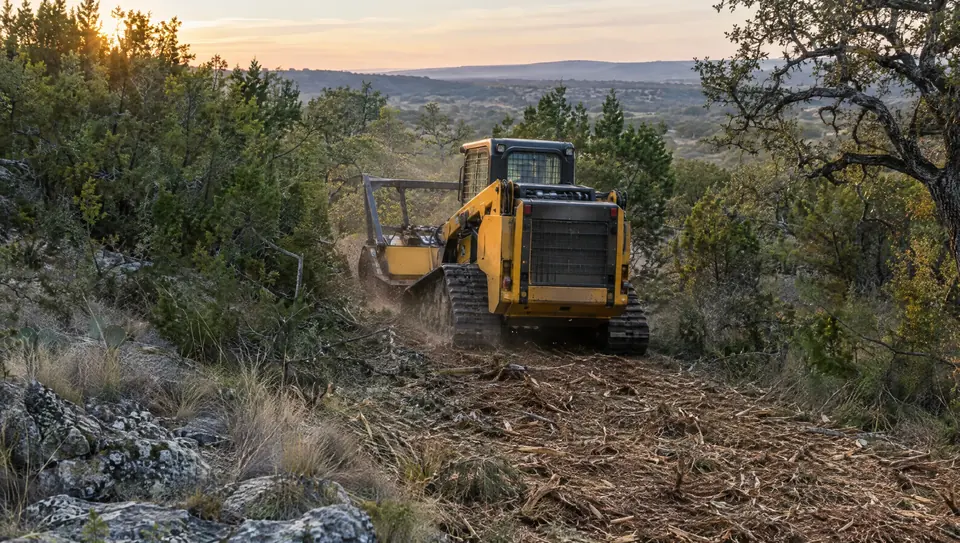
Hill Country slopes, ledges and loose limestone slow any machine. Operators work steep ground with care to protect the soil and the equipment, and that care takes time. Flat, firm ground runs faster.
Access and maneuverability
Access covers how equipment reaches the work and how freely it moves once there. A narrow gate, a creek crossing or a tract with no road adds time. Tight spaces between houses, fences and keeper trees call for a compact machine and a slower pace.
Soil conditions
Wet clay can rut and bog a machine down. Rocky ground wears mulcher teeth faster, and crews stop to sharpen and replace them. Firm, dry soil gives the best footing for steady production.
Compact track or large wheel mulcher
9 Arrow runs two classes of forestry mulching equipment, and the choice changes the time per acre.
Compact track machines handle tight access, slopes and uneven ground. Our own setup pairs a CAT 275 compact track loader with a Weiler M860A mulcher. Compact machines shine on selective work around trees, home sites and Hill Country slopes.
Large articulated wheel machines bring high horsepower and high production. On bigger tracts with room to move, a large machine covers more ground per day and gets through big trees faster.
Matching the machine to the land is part of every estimate. The right fit keeps the time per acre honest.
How 9 Arrow builds a forestry mulching estimate
Our estimates follow the same path every time.
- Discovery call. We talk through your goals, acreage, access, the trees you want kept and the finish you expect.
- Site visit when needed. We walk the land to see density, slope, soil and access in person.
- Estimate. We show the price by the day or by the acre, whichever fits the work, and you have it before we start.
A day rate tends to suit work with an open-ended scope, such as selective thinning around a homestead. A per-acre number tends to suit a defined tract with fairly even cover. Either way, you see the number before a machine comes off the trailer.
Scope items that change the total
Machine time per acre is the core of the price. A few scope items can add to the total.
- Existing brush piles. We mulch old piles, including bulldozer piles as large as a house, instead of burning them. Big piles take real machine time.
- Root ball removal. Mulching leaves root balls in place to keep the soil stable. Where a foundation is going, grubbing with bulldozers and excavators pulls the roots, and we prefer to mulch those root balls on site.
- Mulch handling. Mulch stays on the ground by default. Stockpiling the mulch or hauling it off is added work.
- Getting to the site. Moving machines to the property is a fixed part of every job, so a small tract carries more of that cost on each acre than a large one.
Why the lowest per-acre price can cost more
We're not the cheapest. We are the best. The difference shows up in the finish.
A 9 Arrow fine finish leaves small material, the kind we call toothpicks or hamster chips. Ground finished that fine is easier to drive over, looks better and lets grass come back faster. Under a light layer of mulch, grass can green up within days after a rain. Under a heavy layer, up to 12 inches deep, grass can take two to three years to push through.
A rough pass leaves stubs, long splinters and debris that someone has to deal with later. Paying twice to finish a job is the most expensive way to clear land.
When you compare forestry mulching bids, ask each contractor the same questions.
- What will the finished ground look like when you leave?
- Are root balls left in place or removed?
- Which trees are being kept, and how are they marked?
- What happens to existing brush piles?
- Is the price by the day or by the acre, and what does it include?
For the bigger picture across grubbing, roads and site work, read our guide to land clearing cost in Texas. If you are still weighing methods, compare forestry mulching vs traditional land clearing.
Get a real number for your acreage
Tell us about your land, and we will tell you what it takes to clear it. Call (210) 247-8410 or request an estimate to set up a discovery call.
It does not get better.