
Does cedar removal help water? What Texas research supports and disputes
Cedar catches a big share of the rain, and removing it lets more water reach the soil. Whether that adds springflow or aquifer recharge is far less settled.
Does cedar removal help water?
Cedar removal helps water reach the soil, a point Texas research supports well, because Ashe juniper canopy and litter catch much of the rain beneath them. Whether removal adds springflow, creek flow or aquifer recharge is less certain. Studies range from local gains and lower water loss to no measurable change, so no one can promise a result.
Does cedar removal help water? Cedar removal helps more rain reach the soil, and Texas research supports that part well. Whether clearing cedar revives springs, creeks and wells is where the research splits. Ashe juniper, the Hill Country cedar, catches a large share of the rain that falls on it, so taking it out changes where that water goes, but not always in the way landowners hope.
The water question comes up often with cedar removal in Texas, and it deserves a straight answer. Here is what the studies actually say, including the parts that do not fit a sales pitch.
Does cedar removal help water reach the soil?
Cedar removal does help water reach the soil, and that is the part of the story the research agrees on. Ashe juniper intercepts a large share of rainfall before it reaches mineral soil. In work summarized by Texas A&M researchers Thomas Thurow and Justin Hester, Ashe juniper canopy intercepted 36.7% of gross rainfall and the litter under the trees caught 43.0%. Only 20.3% of annual rainfall reached mineral soil under Ashe juniper, compared with 81.9% to 89.2% under bunchgrass and shortgrass.
Other measurements come in lower but still matter. A large rainfall simulation on juniper rangeland by a Texas A&M team that included rangeland hydrologist Bradford Wilcox measured canopy interception of about 20% of the water applied (Taucer and others, 2008). Numbers shift with storm size, tree density and method. The direction does not. Dense cedar keeps a real share of the rain off the ground.
The same simulation study pointed to more water entering the ground once the trees were removed, with more of it moving below the surface as subsurface flow. The authors were just as clear that the effect on streamflow and recharge remained unknown. That gap, between more water in the soil and more water in a spring, is the heart of the debate.
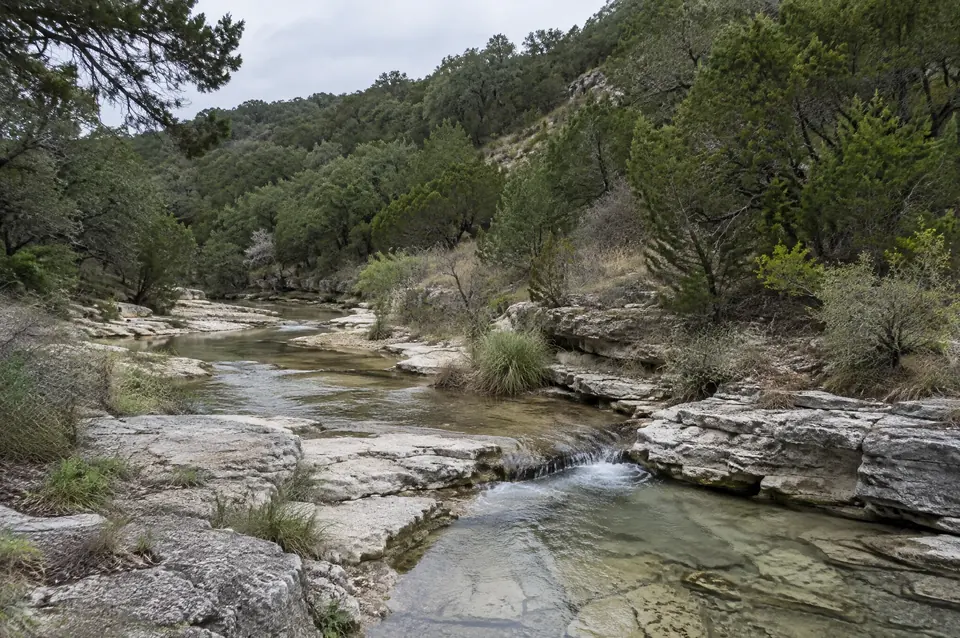
Does removing cedar increase springflow and creek flow?
Removing cedar has not reliably increased springflow and creek flow in the largest Texas studies so far. The closest test to home ran at Honey Creek State Natural Area in Comal County, near Spring Branch. The U.S. Geological Survey, with Texas Parks and Wildlife, NRCS and other partners, compared a cleared watershed with an untouched one from 2001 to 2010.
After the juniper came off, the streamflow-to-rainfall relationship did not change. The USGS did find that the gap in evapotranspiration, the water plants use plus what evaporates, between the cleared and uncleared watersheds grew after treatment. Any water saved that way did not show up as more water in the creek.
A larger test played out in the North Concho River watershed. Between 2001 and 2004, about 300,000 acres were cleared of brush with the expectation of tripling streamflow. Wilcox, Huang and Walker (2008) found "no evidence (through 2005) of increased streamflow" for the watershed as a whole. They did note reports of local increases in groundwater levels and streamflow in some tributaries. The same paper found that removing woody plants had little effect on overall evapotranspiration, because the grasses and forbs that replace the brush use water too.
Landowner experience and these big studies do not always line up. Thurow and Hester describe seeps and springs that quit as juniper cover increased as "a common occurrence in the Edwards Plateau of Texas." Citing earlier work by Hibbert, they list annual rainfall above 18 inches among the conditions where brush control is more likely to yield water. A small spring on fractured limestone can behave differently from a whole river basin, so one ranch's result does not predict another's.
Does removing cedar recharge the Edwards Aquifer?
Removing cedar did not measurably change recharge in the most direct Edwards Aquifer test so far. Texas A&M researchers Bradford Wilcox and Clyde Munster measured water dripping into shallow caves at Camp Bullis in northern Bexar County, on the Edwards Aquifer recharge zone, before and after juniper above the caves was removed in 2008. Their 2010 report to the Edwards Aquifer Authority states: "We see no evidence that tree removal changed the relationship between rainfall and recharge at any of the gauge locations."
The study also showed how recharge actually works on that ground. Significant recharge only occurred in storms over 60 millimeters, about 2.4 inches. Most of it came in three months with 250 millimeters, about 10 inches, or more of rain. Surface runoff more than doubled after removal, from about 3% of the water budget to as much as 10%.
The researchers were careful about the limits. The post-removal record covered only 1 to 1.5 years, and they called for a longer record before ruling out a link. The honest summary is that cedar removal has not been shown to boost aquifer recharge, and it has not been ruled out either.
Why do some scientists say cedar is not the main culprit?
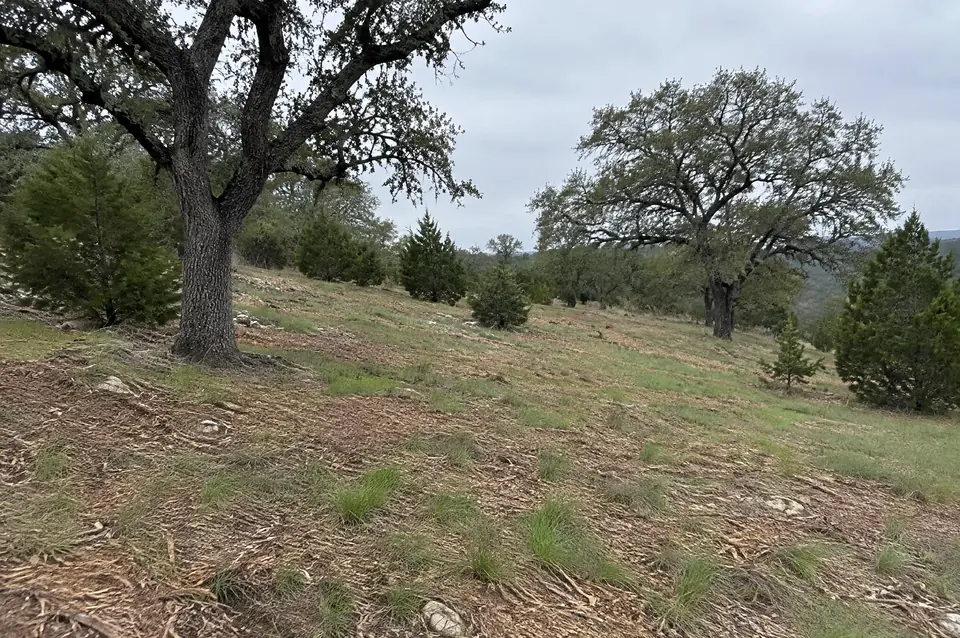
Some scientists say cedar is not the main culprit for lost water because Hill Country springflow rose while woody cover spread. Wilcox and Yun Huang studied the Nueces, Frio, Guadalupe and Llano rivers on the Edwards Plateau. As summarized by the American Geophysical Union in 2010, they found spring contributions to those rivers had about doubled since the mid-1900s, even as trees and shrubs replaced grassland.
Their explanation points to the soil. From roughly 1890 to 1960, heavy grazing by cattle, sheep and goats degraded soils across the region, and less water soaked in. As plant cover thickened and soils recovered, more rain soaked in again. "The trees are actually allowing the water to infiltrate," Wilcox said.
That finding does not mean cedar is good for water everywhere. It means the condition of the soil and ground cover matters as much as what grows on it. Bare ground after clearing can shed water as runoff, as the Camp Bullis caves showed. Healthy grass on intact soil is what lets cleared land take in the rain.
How should you clear cedar if water is a goal?
Clear cedar with water in mind by keeping the soil covered and in place. The research points to a few practical rules:
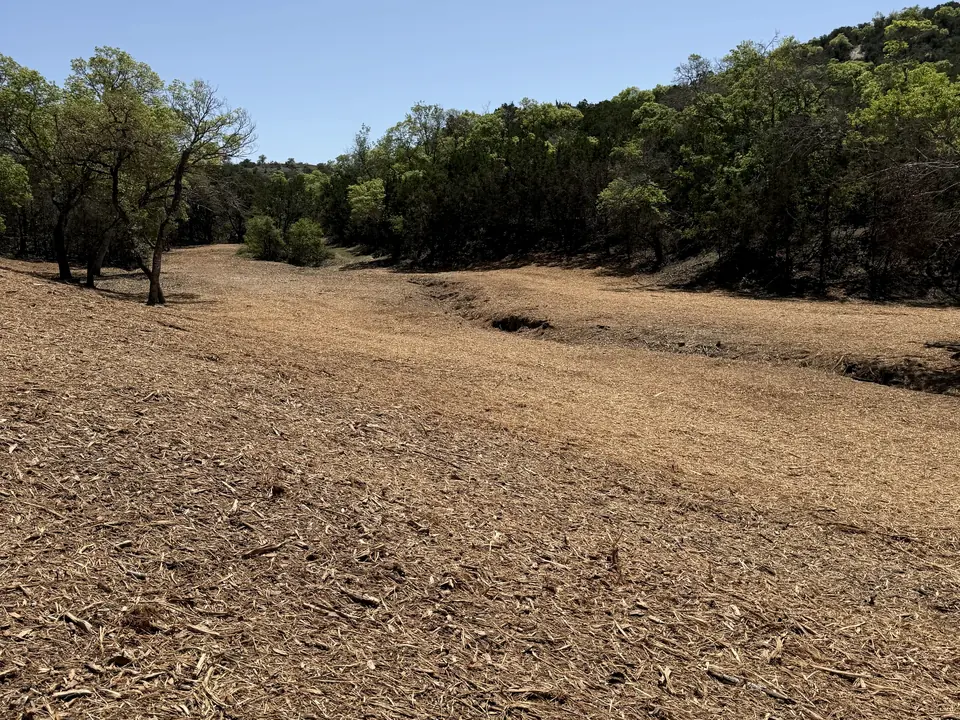
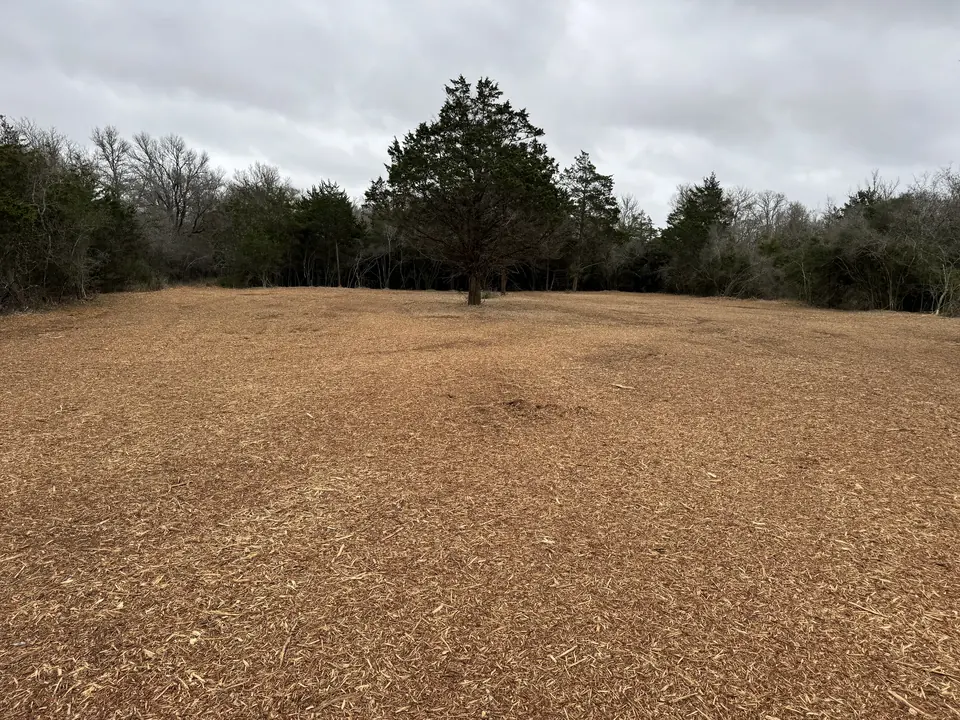
- Keep the ground covered. Forestry mulching grinds cedar where it stands and leaves root balls in the soil. The mulch shields the ground while grass returns. Dozer clearing disturbs soil and raises erosion risk.
- Get grass back fast. Under a light layer of mulch, grass can green up within days after a rain. Under a heavy layer, up to 12 inches deep, recovery can take 2 to 3 years.
- Go easy along creeks. A Texas A&M study of Pedernales River catchments by Li Shen (2009) advised against complete removal of Ashe juniper in riparian zones because of the potential loss of grass cover.
- Think in watersheds. The Texas State Soil and Water Conservation Board funds brush control for water only where a feasibility study projects a water yield increase.
- Check for warblers. The U.S. Fish and Wildlife Service notes the endangered golden-cheeked warbler nests only in mature juniper-oak woodlands of Central Texas.
Clearing cedar pays off in ways that are not in doubt: more grass, easier access, open views and less fuel near the house. Follow-up matters too. Our post on keeping cedar regrowth in check covers seedlings, and clearing cedar and mesquite on a ranch covers keeping pasture open once the grass is back.
Clear cedar with realistic expectations
Properly cleared and maintained land is healthier, more valuable and more enjoyable to own, whatever the springs do. Our cedar removal in Texas starts with a walk of your land, including cedar removal in Spring Branch and across the Hill Country.
Sources
- How an increase or reduction in juniper cover alters rangeland hydrology, Thomas L. Thurow and Justin W. Hester, Texas Natural Resources Server, Texas A&M
- Large-scale rainfall simulation experiments on juniper rangelands (2008), Taucer, Munster, Wilcox, Owens and Mohanty, Transactions of the ASABE, via Texas A&M
- Effects of brush management on water budget and water quantity, Honey Creek State Natural Area, U.S. Geological Survey
- Effects of brush management on the hydrologic budget and water quality in and adjacent to Honey Creek State Natural Area, Comal County, Texas, 2001 to 2010 (Scientific Investigations Report 2011-5226), U.S. Geological Survey
- Long-term trends in streamflow from semiarid rangelands (2008), Wilcox, Huang and Walker, Global Change Biology
- Augmenting Groundwater Recharge Through Brush Control, Phase II (2010), Bradford Wilcox and Clyde Munster, Texas A&M University for the Edwards Aquifer Authority
- Texas surprise: When trees, shrubs replace grasses, water flows can increase (March 2010), American Geophysical Union
- Influence of woody plant on spring and riparian vegetation in central Texas (2009), Li Shen, Texas A&M University
- Water Supply Enhancement Program, Texas State Soil and Water Conservation Board
- Service's review recommends downlisting golden-cheeked warbler (January 2025), U.S. Fish and Wildlife Service