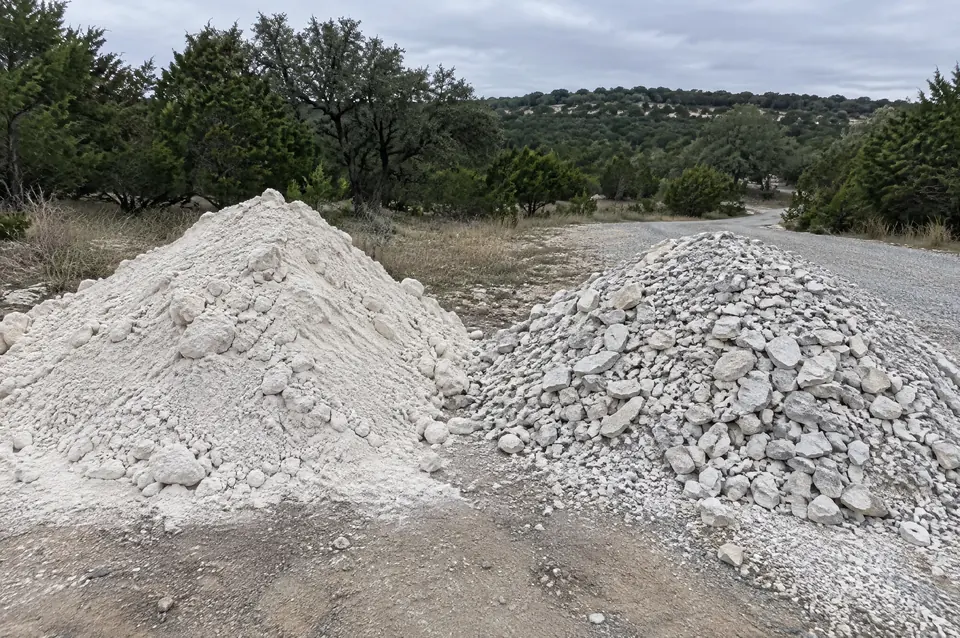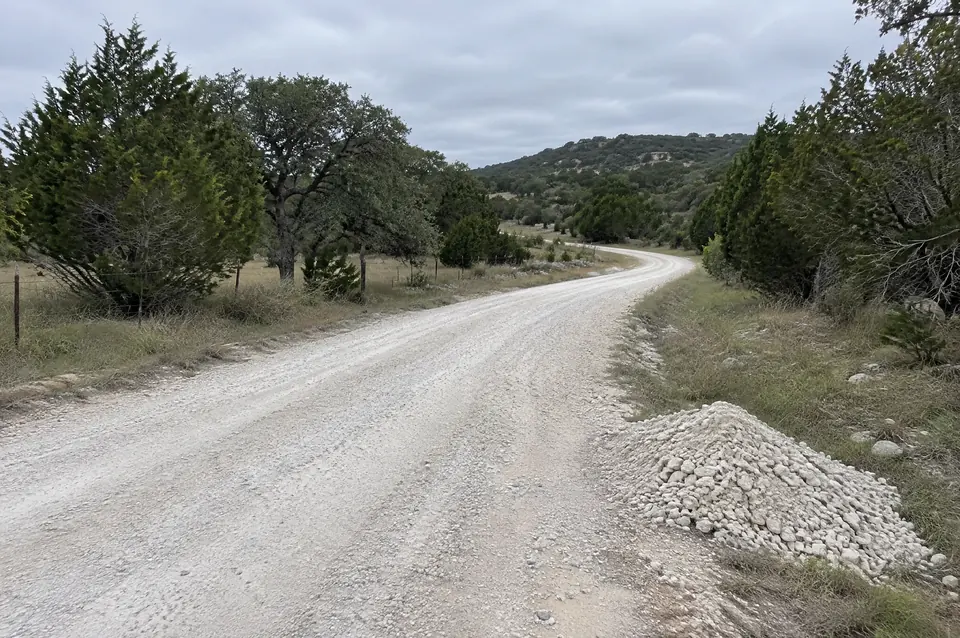

What is flex base, and when does a Texas road need it?
Flex base is the graded rock layer under a road, and in Texas the spec is TxDOT Item 247. Here is what it requires, how it compares with gravel and caliche, and when you need it.
What is flex base?
Flex base is a granular, unbound road base of graded stone and fines placed under a road's surface. In Texas, spec flex base meets TxDOT Item 247, which sets five material types, four grades and lab tests for gradation, plasticity, wear and strength. Flexible refers to the layered, flexible pavement it supports, which yields slightly under traffic loads.
What is flex base? Flex base, short for flexible base, is a layer of graded stone and fines compacted under a road's surface to carry traffic. In Texas, spec flex base is material that meets TxDOT Item 247, which sets the rock types, grades and lab tests a base has to pass before it counts as spec material.
Crushed rock that has never been near a lab can still make a good private road, but it is not the same thing. On Hill Country land, the rock for a strong private road base is often already on the property, and our on-site rock crushing for road base breaks it down to a fine, compactible base where it lies. Here is what flex base is, what Item 247 requires, how flex base compares with gravel and caliche, and when a road needs the certified material.
What is flex base, and what does it do?
Flex base is a granular, unbound layer that sits between a road's surface and the ground beneath it. TxDOT's Flexible Base Selection and Information Guide (February 2026) defines flexible base as "a granular, unbound material placed as a base course in the pavement structure." Unbound means no binder such as cement or asphalt holds the stone together. Item 247 handles base that is treated with cement, emulsion, foamed asphalt or lime as a separate case with its own waivers.
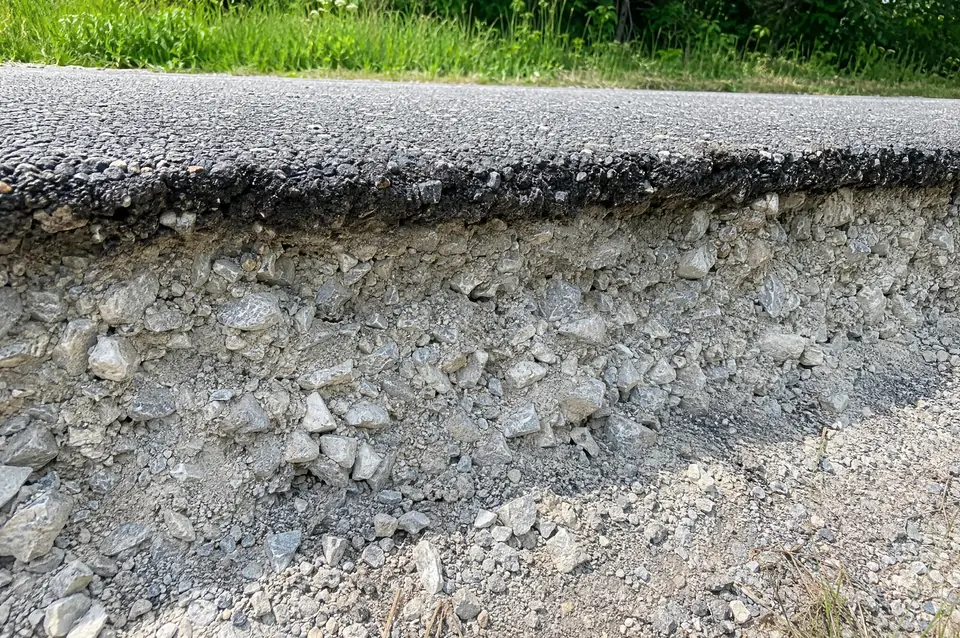
Flex base does the structural work under a thin surface. The TxDOT guide says flexible base spreads the stress from traffic down into the subbase and subgrade to minimize the potential for rutting. When a seal coat is the only surface, the TxDOT Pavement Manual says the base is generally the layer that "contributes most to the structural stiffness."
The rules for flex base live in Item 247 of TxDOT's 2024 Standard Specifications. Its description is one line: "Construct a foundation course composed of flexible base." The rest of Item 247 covers which rock qualifies, how flex base is graded and tested, and how it is placed, compacted and accepted.
Why is it called flexible base?
Flexible base is the base course of a flexible pavement, a layered road that gives slightly under a wheel load and spreads that load out, unlike a rigid pavement. The TxDOT Pavement Manual says a true flexible pavement yields "elastically" to traffic loading. It adds that the pavement's strength is derived from "the load-distributing characteristics of a layered system" designed to protect each layer below it, including the subgrade.
The layers in a flexible pavement are stacked on purpose. TxDOT's manual describes better quality materials placed on top, where stress from traffic is highest, and lower quality materials at the bottom, where stress is low. TxDOT calls load distribution over the subgrade "the fundamental difference" between flexible, semi-rigid and rigid pavements.
For a landowner, the practical meaning is that the rock in the base matters as much as the thickness. TxDOT's guide notes that "The structural capacity, drainage, and frost susceptibility of the base can be affected by the gradation." That is why Item 247 tests the rock itself, not just the finished road.
What does TxDOT Item 247 require?
TxDOT Item 247 requires flex base to come from an approved material type, fit one of four grades and pass lab tests on gradation, plasticity, durability and strength. The TxDOT guide says Item 247 "designates flexible base grades as 1–2, 3, 4, or 5." The grades are not a simple quality ladder:
- Grade 1-2 is intended for pavements with low confinement or low lateral support, such as a seal coat or thin hot-mix asphalt placed directly on the base.
- Grade 3, per the guide, is "generally not recommended for base courses in pavement structures."
- Grade 4 has its properties shown on the plans, so an engineer can customize the spec.
- Grade 5 is recommended where stability is provided by the pavement structure.
The guide also notes that Grade 1-2 will not necessarily perform better than Grade 5. Each flex base sample then goes through these lab tests:
- Gradation. A sieve analysis against a master gradation running from the 2-1/2 inch sieve down to the No. 200.
- Plasticity index (Tex-104-E, 105-E and 106-E). These tests measure the plasticity of the fine material. TxDOT warns that fines with a high plasticity index can make a base unstable and deform under traffic.
- Wet ball mill (Tex-116-E). The sample is tumbled with water and metal spheres to measure "the ability of the base to withstand degradation." The guide says the test detects soft aggregates that may be subject to weathering.
- Compressive strength (Tex-117-E). Samples are tested in compression at confining pressures of 0, 3 and 15 psi. Under the 2024 spec, unconfined strength is waived when the base meets the No. 200 sieve requirement.
How does flex base compare with gravel and caliche?
Flex base can be made from gravel or caliche, and TxDOT's guide rates the gravel types below crushed quarried stone. Item 247 sorts flex base into five material types, and the TxDOT guide says "Type A and D materials are generally considered high-quality base" while it calls Types B and C marginal base:
| Item 247 type | What it is | TxDOT guide's rating |
|---|---|---|
| Type A | Crushed stone graded from oversize quarried aggregate of a single, naturally occurring source | High-quality base |
| Type B | Crushed or uncrushed gravel; blending sources is allowed | Marginal base |
| Type C | Crushed gravel with at least 60% retained on a No. 4 sieve with two or more crushed faces | Marginal base |
| Type D | Type A material or crushed concrete | High-quality base |
| Type E | Caliche, iron ore or as otherwise shown on the plans | See our caliche comparison below |
The word "gravel" on a delivery ticket tells you little about which of these you are getting. When a spec matters, ask the supplier for the Item 247 type, the grade and current test results, not just the product name.
Caliche is its own type. Our side-by-side of caliche vs crushed limestone covers Type A against Type E and why caliche can turn slick when wet.
When does a road need spec flex base?
A road needs spec flex base when the rules or plans that govern it call for Item 247, as on TxDOT work, Comal County subdivision roads and engineered pavements. Item 247 is written as a contract specification. It says "The Contractor and the Engineer will sample flexible base from completed stockpiles in accordance with Tex-100-E."
Counties can adopt the spec too. In Spring Branch's home county, the Comal County Subdivision Regulations set these rules for subdivision roads:
- "Roadway base material shall conform to the requirements of the TxDOT Specification Item 247."
- The standards apply to roads in Comal County subdivisions "whether public or private."
- Minimum compacted base is 6 inches on collector and secondary streets and 8 inches on arterial streets.
- Test reports from a certified laboratory go to the County Engineer, at least one per 500 cubic yards of base and one per project, at the owner's expense.
A private ranch road or driveway that is not in a subdivision, not a public road and not on an engineer's plans is a different case. We found nothing in Item 247 or the Comal County subdivision rules that requires spec base on it. Ask your county engineer before you build, especially if the road may someday serve lots that are sold off. This is general information, not legal advice. Our crew works across Comal County on land clearing and road work, so we see these questions often.
Is rock crushed on your land the same as flex base?
Rock crushed on your land is not certified flex base, even when it is hard limestone that makes a strong, compactible road base. Item 247 accepts base through sampling and lab results: the contractor must notify the Engineer of proposed material sources, samples come from completed stockpiles, and the people sampling "must be certified by the Department-approved soils and base certification program." Rock crushed in place along a ranch road has not been sampled, tested or accepted that way, so calling it flex base would be wrong.
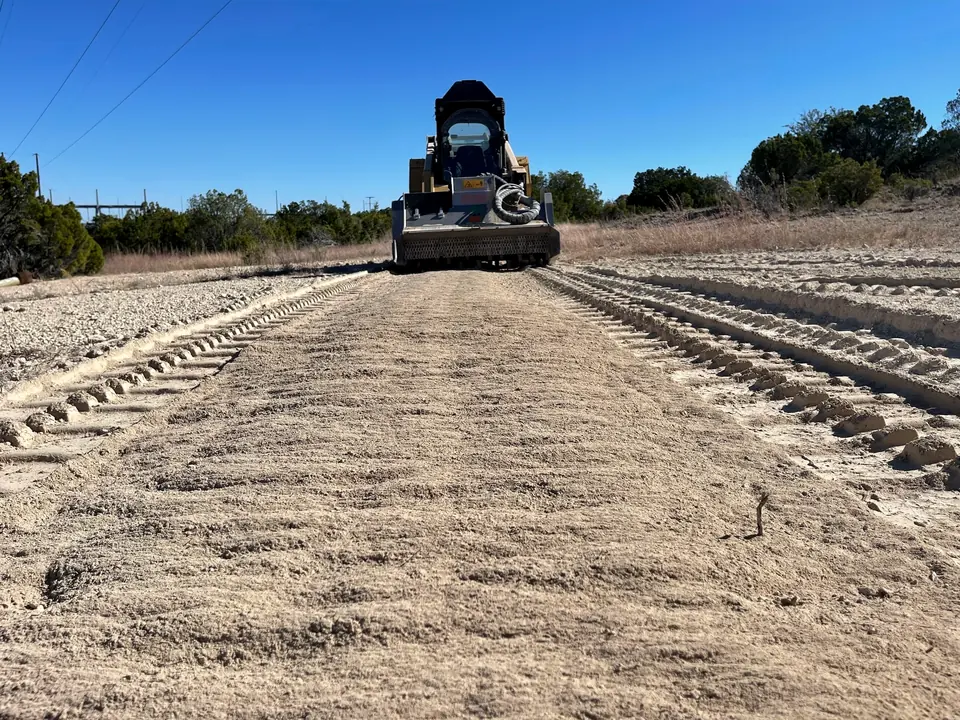
What on-site crushing does make is a good base for private roads and drives. 9 Arrow processes existing surface rock into a fine, compactible road base on site, using crushing heads and attachments that break rock down to a fine, consistent grade. We grade our roads with proper crown and drainage and build them to carry heavy equipment and truck traffic. 9 Arrow runs a large, dedicated rock crushing machine built to work far deeper than the skid-steer attachments most crews use. As far as we know, no other crew in the Hill Country runs one.
If plans call for tested Item 247 base, buying base already tested to that spec can be the simpler path. Our breakdown of crushing your own rock vs hauling in crushed limestone road base covers when hauling still makes sense.
Build on the rock you already have
If your road is private and your land has rock, a site visit shows what that rock can become. See how our on-site rock crushing service turns Hill Country rock into road base, and how the full road comes together on our access road building page.
Sources
- Flexible Base Selection and Information Guide (February 2026), Texas Department of Transportation
- Item 247, Flexible Base (2024 Standard Specifications), Texas Department of Transportation
- Pavement Manual, Section 4.2 Flexible Pavement, Texas Department of Transportation
- Pavement Manual, Section 2.1 Definition of Flexible Pavement, Texas Department of Transportation
- Subdivision Regulations, Comal County Engineer's Office