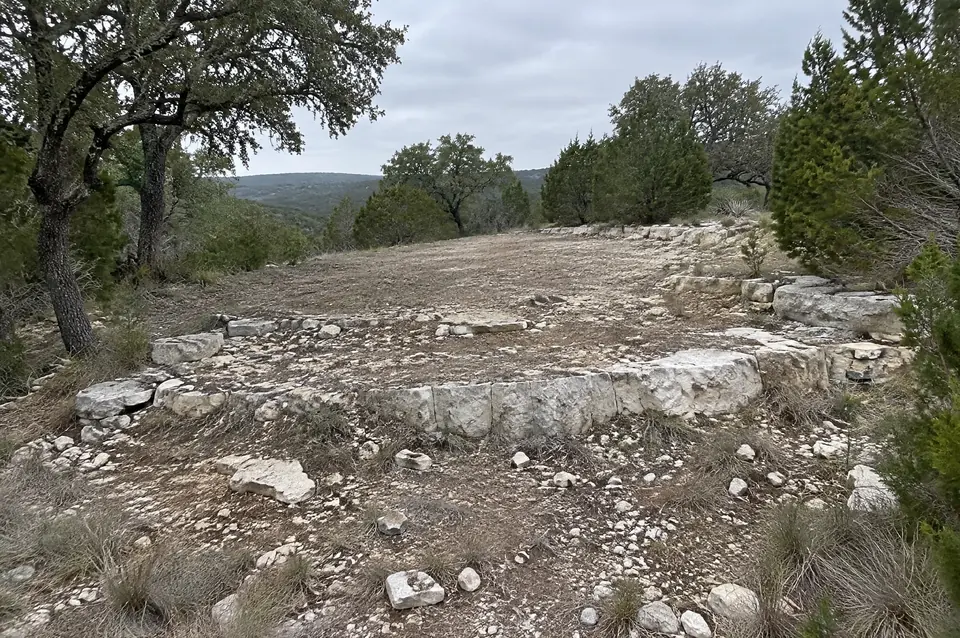

Crushing your own rock vs hauling in crushed limestone road base
A mile of ranch road can take 150 or more truckloads of crushed limestone road base. Here is how crushing your own rock compares, and when hauling still makes sense.
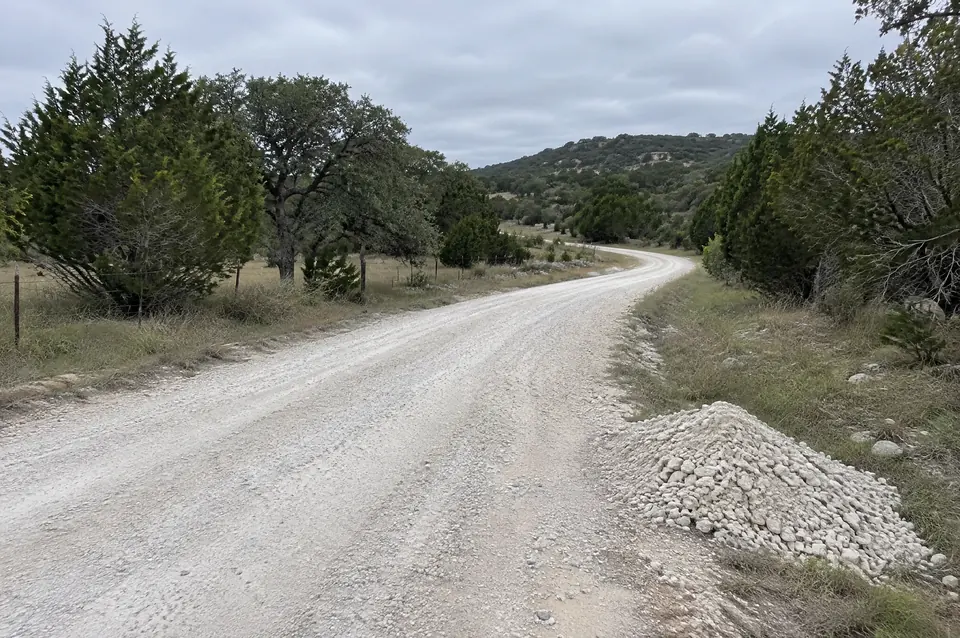
Is it better to crush your own rock or haul in crushed limestone road base?
Crushing your own rock is usually better than hauling in crushed limestone road base when the route already holds enough usable rock. A mile of 20-foot road at 6 inches compacted takes about 3,750 tons of base, roughly 150 to 190 truckloads. Hauling still makes sense on rock-poor ground or when plans call for tested, certified material.
Crushed limestone road base can come from a quarry, one truckload at a time, or from the rock already on your land. When the route holds enough usable rock, crushing it in place is usually the better choice: no imported base, no line of loaded trucks on your roads, and a road built from the ground it sits on. That is what our on-site rock crushing for road base does across the Hill Country.
Hauling still has its place. This side-by-side covers the volume math, the truck traffic, how your own rock compares with quarry base, and the cases where trucking base in still makes sense.
How much crushed limestone road base does a mile of road take?
A mile of road 20 feet wide with 6 inches of compacted crushed limestone road base takes about 1,956 cubic yards, or roughly 3,750 tons. That math uses the target density in TxDOT's worked example, 142.1 pounds per cubic foot (TxDOT Flexible Base Selection and Information Guide, 2026), which comes to about 1.92 tons per compacted cubic yard. Ohio DOT converts crushed stone at a similar 4,000 pounds per cubic yard (Ohio DOT Item 304).
Texas limits a truck to 34,000 pounds on a tandem axle group and 80,000 pounds gross without a permit (Texas Department of Motor Vehicles). At an assumed 20 to 25 tons per load, here is what common ranch roads take, by our arithmetic:
| Road | Compacted base | Approx. tons | Approx. truckloads |
|---|---|---|---|
| 1/4 mile, 12 ft wide, 6 in deep | 293 cu yd | 560 | 23 to 28 |
| 1/2 mile, 16 ft wide, 6 in deep | 782 cu yd | 1,500 | 60 to 75 |
| 1 mile, 20 ft wide, 6 in deep | 1,956 cu yd | 3,750 | 150 to 188 |
| 1 mile, 20 ft wide, 10 in deep | 3,259 cu yd | 6,250 | 250 to 313 |
Loose base weighs less per yard than compacted base, so the volume measured in the truck runs higher than the finished volume. Smaller dump trucks mean more trips.
What do loaded haul trucks do to ranch and county roads?
Loaded haul trucks wear roads far out of proportion to their weight. A 1979 report by the U.S. General Accounting Office found that an 18,000-pound truck axle, "only 9 times heavier" than a 2,000-pound car axle, "does 5,000 times more damage." In 2012, TxDOT estimated that the nearly 1,200 trucks needed to bring one gas well into production do road damage equal to nearly 8 million cars (StateImpact Texas, NPR).
On a ranch, the haul route is your gate, your existing drive, any cattle guard or low-water crossing, and the county road out front. Every load of road base crosses them twice, full and then empty. Texas forestry best management practices also advise restricting hauling in wet conditions (Texas Forestry BMPs, 2004), so a wet spell can stall a job that depends on deliveries.
Crushing in place takes most of those loaded trips off the road, because the base material is already on the route. Nobody waits on a supplier's schedule, which speeds completion.
Is road base crushed from your own rock as good as quarry base?
Road base crushed from your own rock can hold its own against quarry base when the rock is sound and the product is tested, shaped and compacted. Quarry base is not one uniform product either. TxDOT calls crushed stone such as limestone the most common rock available in Texas, and adds that "crushed stone can have variable hardness and quality" from source to source (TxDOT Flexible Base Guide). Crushing itself helps: the FHWA Gravel Roads Construction and Maintenance Guide (2015) says broken stone embeds into a gravel road surface much better than rounded, natural stone.
Your rock decides the product. Hard Glen Rose ledge and Edwards limestone crush into strong, angular base, while soft marl crushes into fines. Too many fines weaken base. Texas Transportation Institute research found that "fines contents of 5 to 10 percent appear to be optimum" for typical Texas base (TTI 0-4358-S, 2007), and TxDOT says base with more than 20 percent passing the No. 200 sieve has lower strength and poorer drainage. Our guide to building on rocky land in Texas covers which rock sits where.
Depth helps on thin soil, because a deeper pass reaches ledge and turns more of your own rock into base. 9 Arrow runs a large, dedicated rock crushing machine built to work far deeper than the skid-steer attachments most crews use. As far as we know, no other crew in the Hill Country runs one.
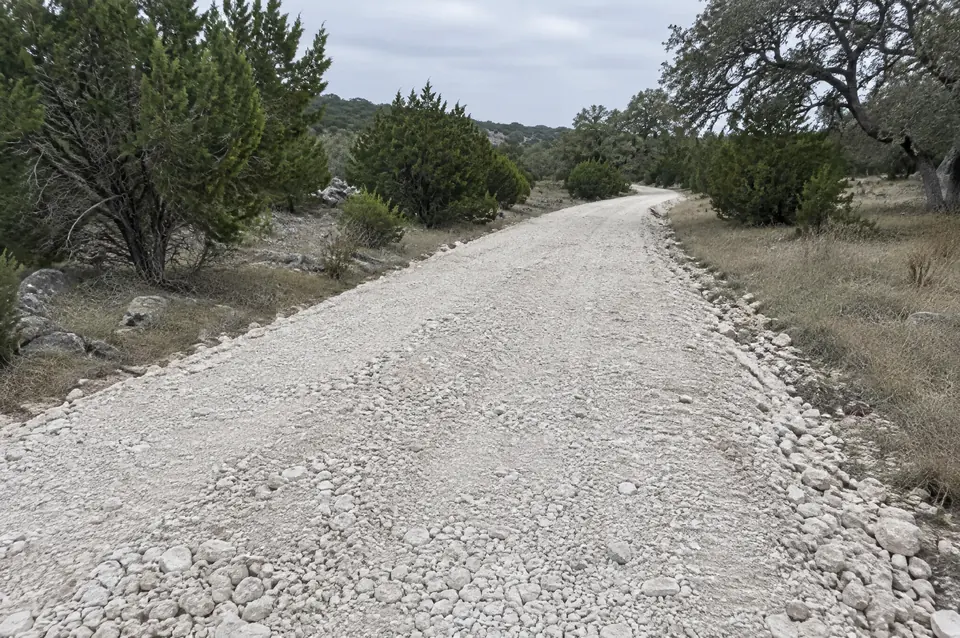
Crushing on site vs hauling in road base, side by side
Crushing on site and hauling in road base each fit different ground, and the trade-offs line up like this:
| Factor | Crush rock on site | Haul in road base |
|---|---|---|
| Material source | Rock already on your route | Quarry or supplier |
| Loaded trucks on your roads | Few or none for base | About 150 to 190 per mile of 20 ft road at 6 in |
| Waiting on deliveries | No | Yes |
| Surface rock on the land | Becomes the road | Stays where it is |
| Consistency | Depends on your rock; test it | Depends on the source; ask for tests |
| Works on rock-poor ground | No | Yes |
| Spec material for engineered plans | Only after lab testing | Buy base tested to the spec |
Rules apply either way. Building a road disturbs soil whether the base is crushed or trucked in, so an Edwards Aquifer plan (recharge zone at any size, contributing zone at 5 acres or more), the TCEQ construction stormwater permit at 1 acre, and Texas811 notice for mechanized digging 16 inches or deeper can all come into play (TCEQ Water Pollution Abatement Plan; TCEQ construction stormwater; Tex. Util. Code §251.002). Confirm with each agency before work starts. This is not legal advice.
When does hauling in road base still make sense?
Hauling in road base still makes sense when the land cannot supply enough good rock or the plans call for certified material.
- Deep valley soil. Krum soils in Hill Country valleys run 40 to more than 80 inches deep with no bedrock in the profile (USDA NRCS, Krum series). There is nothing to crush.
- Mostly soft marl. Doss soils sit on marly limestone with a Mohs hardness of about 1 to 2 (USDA NRCS, Doss series). Rock that soft crushes to fines and may not stand alone as base.
- Engineered plans. When an engineer specifies a tested base such as TxDOT Item 247 Grade 1 to 2, buying base already tested to that spec can be simpler (TxDOT Item 247, 2024).
- A better driving surface. Strong base and a good driving surface are different materials. The FHWA guideline for surface gravel is 4 to 15 percent passing the No. 200 sieve with a plasticity index of 4 to 12 (Jones, UC Pavement Research Center, 2016). If your rock will not make that topping, crush the base and haul in the cap.
A mixed approach is always an option: crush what your land can give and bring in only what it cannot. For how caliche fits into that choice, see caliche vs crushed limestone.
See what your rock can become
A site visit shows how much usable rock sits along your route and whether crushing, hauling or a mix fits the job. Our crew is based in Spring Branch and pairs rock work with land clearing across Comal County and the Hill Country. Start with our on-site rock crushing service, and see the full road build on our access road building page.
Sources
- Flexible Base Selection and Information Guide (February 2026), Texas Department of Transportation
- Item 304, Aggregate Base (2013 Construction and Material Specifications), Ohio Department of Transportation
- Texas size and weight limits, Texas Department of Motor Vehicles
- Truck weight and its effect on highways (1979), U.S. General Accounting Office
- As drilling operations continue, Texas roads suffer (2012), StateImpact Texas, NPR
- Texas Forestry Best Management Practices (2004 reprint), Texas Forest Service, Texas Forestry Association and Texas State Soil and Water Conservation Board
- Gravel Roads Construction and Maintenance Guide (2015), Federal Highway Administration
- Materials, specifications and construction techniques for high performance flexible bases, Project Summary 0-4358-S (2007), Texas Transportation Institute
- Water Pollution Abatement Plan, Texas Commission on Environmental Quality
- Stormwater permits for construction sites (TXR150000), Texas Commission on Environmental Quality
- Texas Utilities Code §251.002, Definitions, Texas Public Law
- Krum series, Official Soil Series Description, USDA Natural Resources Conservation Service
- Doss series, Official Soil Series Description, USDA Natural Resources Conservation Service
- Item 247, Flexible Base (2024 Standard Specifications), Texas Department of Transportation
- Making Better Gravel Roads (Jones, 2016), University of California Pavement Research Center