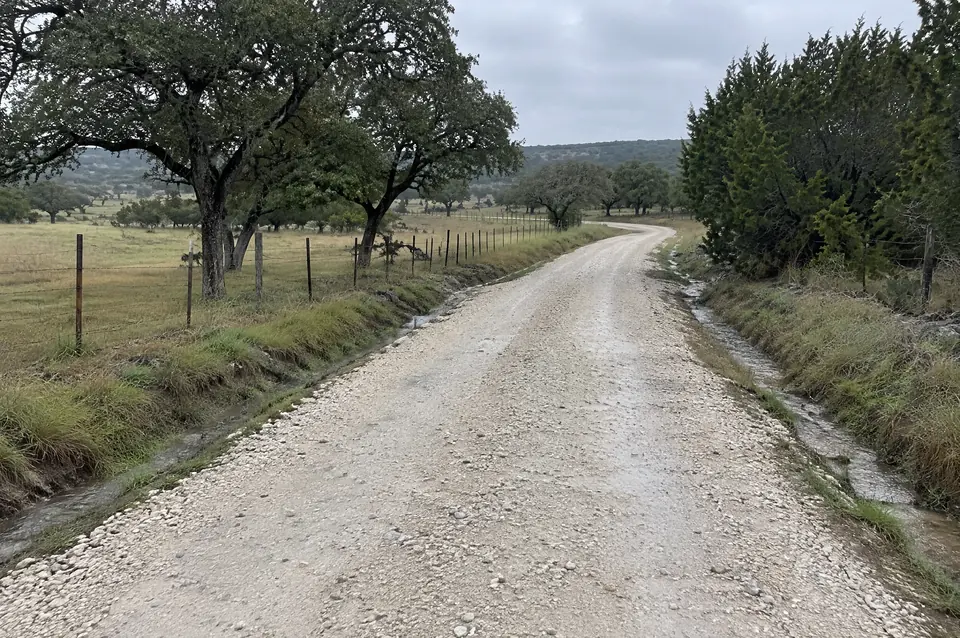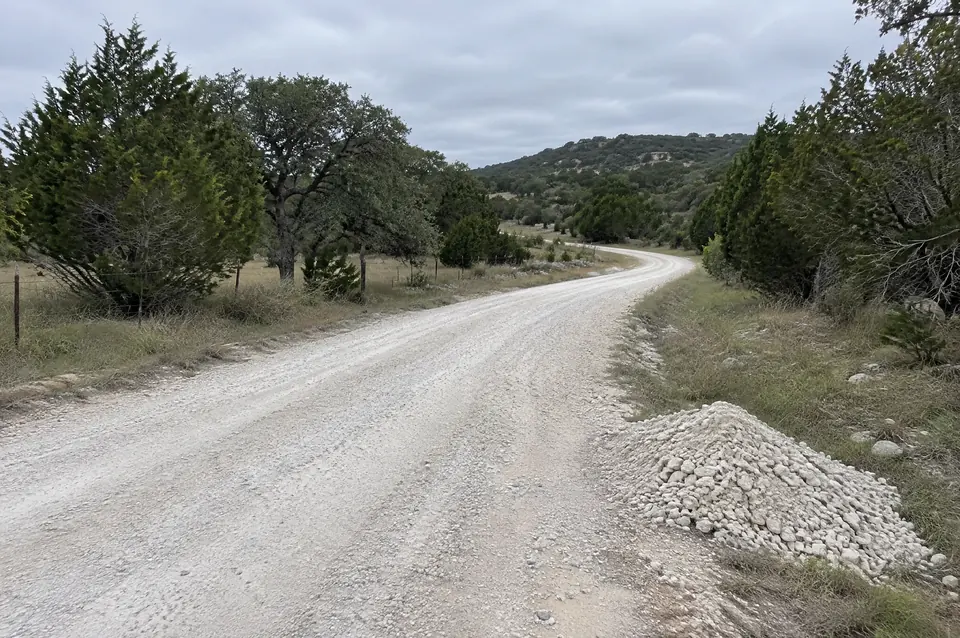

Caliche vs crushed limestone: which makes the better road base?
Caliche and crushed limestone look alike and both get called road base. Here is how they differ, how TxDOT rates each one, and which holds up better on Hill Country roads.
Is caliche or crushed limestone better for a road base?
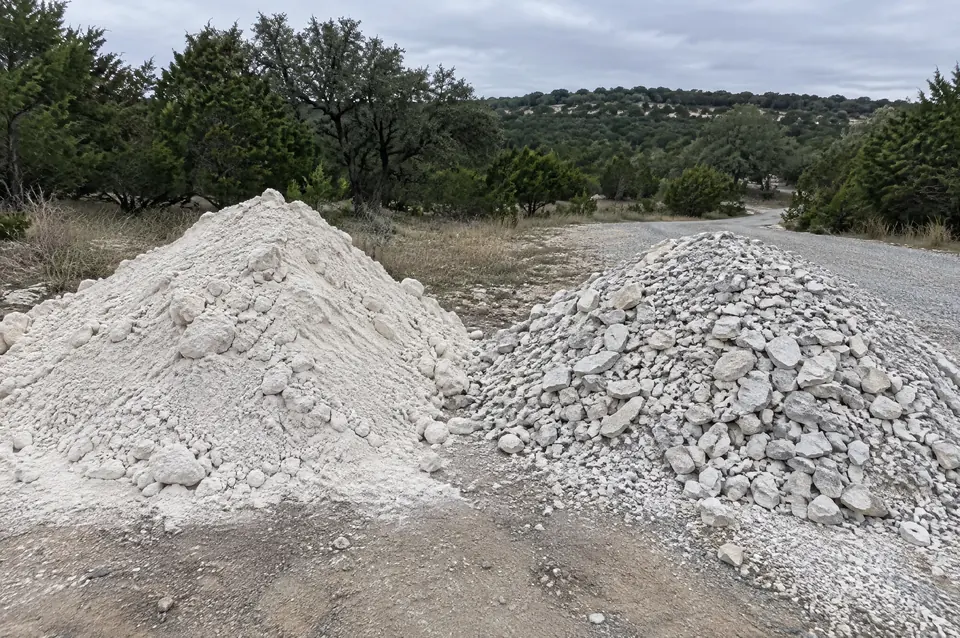
Crushed limestone usually makes a better road base than caliche. TxDOT ranks crushed quarried stone among its strongest base types, while caliche is softer, breaks down faster and can carry expansive clay linked to fast failures once water gets in. Caliche can serve lighter-traffic drives, but only with good drainage and compaction.
Caliche vs crushed limestone is the first material question on most Texas road and driveway jobs. Crushed limestone usually wins as a base because it is harder and drains better, while caliche is softer and can hold clay that turns slick when wet.
On Hill Country land, the better rock is often already under your feet. Our on-site rock crushing for road base turns ledge limestone into base material where it lies. Here is how the two materials compare.
What is caliche?
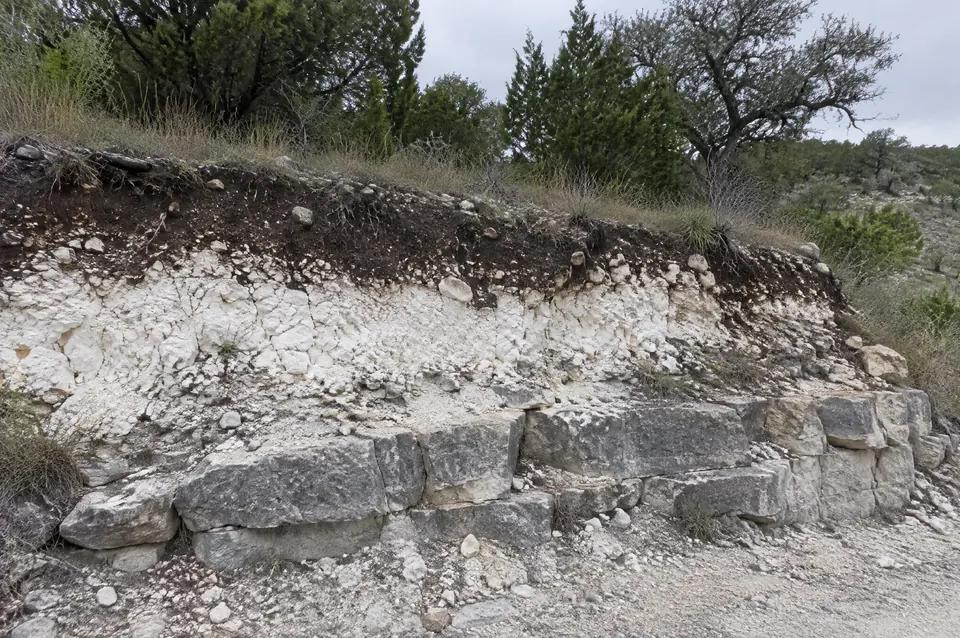
Caliche is a layer of soil or sediment cemented together by calcium carbonate, and it forms mostly in arid and semi-arid climates, per Geology.com. Carbonate leaches out of the upper soil and hardens again lower in the profile. Well-cemented caliche can be hard and durable. Poorly cemented caliche is weak and crumbly.
Much of what Hill Country owners call caliche is probably a different material: weathered Glen Rose marl or chalky limestone. The USDA description of the Doss soil series describes the layer under the soil as weakly cemented marly limestone with a Mohs hardness of about 1 to 2. We found no agency that says outright Hill Country "caliche" is marl, and one peer-reviewed chapter calls soils weathered from Glen Rose limestone "caliche soils" (Wilding et al., 2012). The names overlap. For a road, what counts is how hard the material is and how much clay it carries.
Both materials are white for the same reason. Caliche is mostly calcium carbonate, "the same mineral that makes up limestone," notes the Bureau of Economic Geology at UT Austin.
What is crushed limestone road base?
Crushed limestone road base is hard limestone broken into angular pieces and graded from coarse rock down to fines. The TxDOT Flexible Base Selection and Information Guide calls crushed limestone the most common base rock in Texas and rates crushed quarried stone among the strongest base types, though hardness varies by source.
Angular rock locks together. The FHWA gravel roads guide says fractured stone embeds into a road surface much better than rounded stone, and bank-run gravel is nearly always improved by crushing.
In the Hill Country, the hard ledges are the raw material. The Glen Rose limestone around Spring Branch formed in a shallow subtropical sea about 113 to 108 million years ago, per the National Park Service, and it alternates hard limestone beds with soft marl, according to USGS mapping. Rock crushed on your own property is crushed limestone, but it is not TxDOT-grade base until a lab tests it against the spec.
Caliche vs crushed limestone: how do they compare?
Caliche vs crushed limestone comes down to hardness, clay content and behavior in wet weather. TxDOT Item 247 even files them under different material types.
| Caliche | Crushed limestone | |
|---|---|---|
| What it is | Soil layer cemented by calcium carbonate | Hard bedrock limestone, crushed and graded |
| TxDOT Item 247 type | Type E (caliche, iron ore or as shown on plans) | Type A (crushed stone from a single quarried source) |
| Breakdown | Exceeded wet ball mill limits in TxDOT's example | Varies by source |
| Clay | TTI sample held 2.3% fine clay, mostly expansive smectite | Set by fines content; TTI puts the optimum at 5 to 10% |
| When wet | Clay-rich caliche can soften and fail | Low-fines base drains well |
| Best fit | Lighter-traffic drives with strong drainage | Structural base for trucks and equipment |
| On Hill Country land | Often marl or chalky layers called caliche | The ledges under thin soil |
TxDOT's guide treats caliche as usable "in specific circumstances" where traditional rock sources are scarce. On most Hill Country land, hard limestone sits only inches down.
Why does caliche get muddy and break down?
Caliche gets muddy and breaks down because it is softer than hard limestone and can carry fine, expansive clay. In Texas Transportation Institute research for TxDOT, the caliche tested held 2.3 percent fine clay, mostly smectite, "a highly expansive clay mineral." A granite base held under 0.06 percent. That fine clay explained rapid, severe base failures once water got into the base.
Water is the trigger. The same TTI work found Texas base materials perform well when kept dry. It also found many Texas bases run over 20 percent fines, while 5 to 10 percent appears optimum. TxDOT's guide adds that bases over 20 percent fines lose strength and drain poorly.
Dust is the dry-weather side of the same problem. A long-standing rule of thumb holds that one vehicle a day for a year blows about one ton of fines off each mile of unpaved road (Wisconsin Transportation Bulletin 13). Our post on how long a gravel road lasts covers what that wear means for upkeep.
Which is better for a driveway or ranch road?
Crushed limestone is the better choice for a driveway or ranch road that carries concrete trucks, trailers or equipment, with a binding surface course on top. Caliche can work on lighter-traffic drives when it is crowned, drained and compacted.
A few rules hold for either material:
- Size thickness to the heaviest truck, not the pickup.
- Keep base fines low, and give the surface layer more fines and a little clay binder.
- Crown the road about 4 percent so water leaves it.
- Test the material. TxDOT's Grade 1-2 base allows 5 to 15 percent fines, a plasticity index of 10 or less and a wet ball mill loss of 40 or less.
Lime is a documented fix for weak limestone or caliche base. TTI Report 1287-2 found 1 to 2 percent lime raised base strength by "50 percent or better" while the base stayed flexible.
Can you make crushed limestone road base from your own land?
You can often make crushed limestone road base from the rock on your own land, because most Hill Country uplands have limestone close to the surface. USDA soil descriptions put bedrock within 4 to 20 inches for the Eckrant series, one of the most common upland soils.
On-site crushing breaks that surface rock into a fine, consistent, compactible base with no imported material. It also keeps loaded dump trucks off your roads, and our breakdown of crushing rock vs hauling road base runs the numbers. 9 Arrow runs a large, dedicated rock crushing machine built to work far deeper than the skid-steer attachments most crews use. As far as we know, no other crew in the Hill Country runs one. We work out of Spring Branch, clearing land and building roads across Comal County and the Hill Country.
Get the right base under your road
If you are weighing caliche against the limestone already on your property, start with a site visit. See how on-site rock crushing for road base works on Hill Country ground.
Sources
- Caliche, Geology.com
- Doss series, USDA Natural Resources Conservation Service
- Hydropedology in Caliche Soils Weathered from Glen Rose Limestone (Wilding et al., 2012), Penn State
- Geologic Wonders of Texas glossary, Bureau of Economic Geology
- Flexible Base Selection and Information Guide, Texas Department of Transportation
- Gravel Roads Construction and Maintenance Guide, Federal Highway Administration
- NPS Geodiversity Atlas, Lyndon B. Johnson National Historical Park, National Park Service
- Geologic map of the Anhalt, Fischer and Spring Branch quadrangles (SIM 3333), U.S. Geological Survey
- Item 247, Flexible Base (2024 Standard Specifications), Texas Department of Transportation
- High Performance Flexible Bases, Project Summary 0-4358-S, Texas Transportation Institute
- Dust Control on Unpaved Roads, Wisconsin Transportation Bulletin No. 13
- Report 1287-2, lime treatment of calcareous bases, Texas Transportation Institute
- Eckrant series, USDA Natural Resources Conservation Service