
How to cut shooting lanes from a blind without wrecking deer cover
Good shooting lanes fit your range, dodge the low sun and leave the brush deer travel through. Here is how to lay them out and cut them with a forestry mulcher.
How do you cut shooting lanes for deer hunting?
You cut shooting lanes for deer hunting by placing the blind first, then mulching lanes out from it no longer than you can shoot accurately. A Texas A&M brush sculpting paper caps hunting sendero legs at 250 yards. Keep brush strips deer travel through, avoid aiming lanes at the rising or setting sun, and finish before season.
Knowing how to cut shooting lanes starts at the blind, not the brush. Set the stand first, then open a few lanes out from it that fit your range, the light and the wind, and leave the brush deer use to move. A good lane gives you a clean, safe shot without turning a hunting pasture into an open field.
The cutting itself is selective forestry mulching and land clearing: cedar and brush ground where they stand, no burn piles, and the soil left in place. This guide covers layout, length, cover, the cut and timing. It is not a guide to hunting law, so check TPWD's Outdoor Annual for your county.
Where should shooting lanes go from a deer blind?
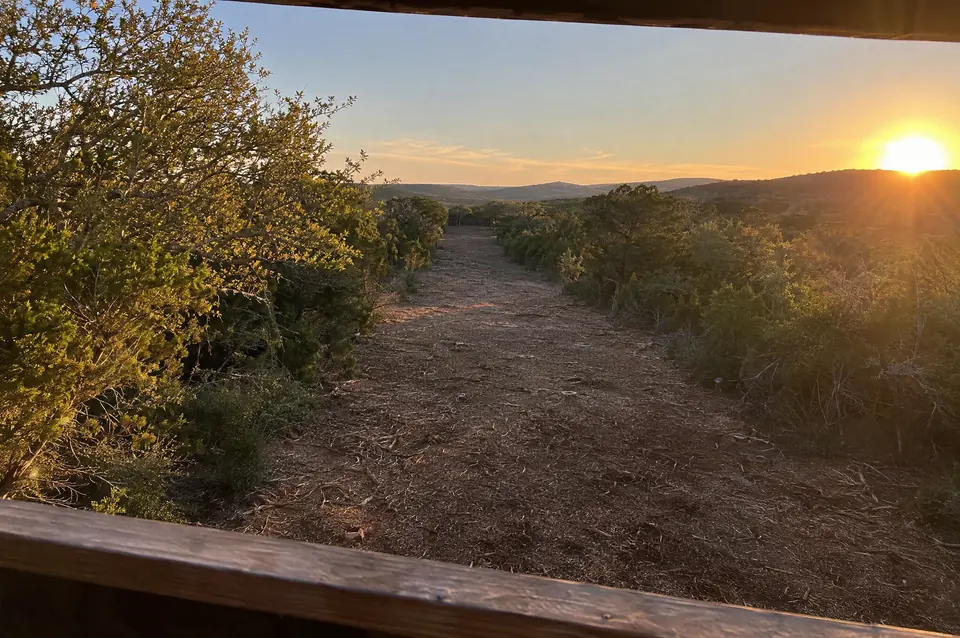
Shooting lanes should run from the blind across the places deer already move, such as a brush edge, a draw, or the gap between thick cover and a feeder or food plot. Pick the blind site before any brush comes down, and lay out every lane from that seat.
Light comes next. TPWD defines legal shooting hours for game animals this way: "The period from one-half hour before official sunrise to one-half hour after official sunset." The hunting day starts and ends around sunrise and sunset, so a lane aimed straight at the rising or setting sun can put glare in your scope at the wrong moment. Check where the sun comes up and goes down from the blind during season before you flag a lane.
Wind matters as much as light. Set the blind so the wind you see most during season carries your scent away from the lanes and the cover deer step out of.
Safety sets hard limits. TPWD's hunter education course defines a safe zone-of-fire as the area or direction in which you can safely fire a shot, and tells hunters, "Determine that you have a safe backstop or background." No lane should point toward a house, a road, livestock pens or a neighbor's line. The same course warns against shooting at game on the crest of a hill, and at flat, hard surfaces such as rocks, because of ricochets. On Hill Country ground, check the far end of each lane for bare limestone ledge.
How long and how wide should shooting lanes be?
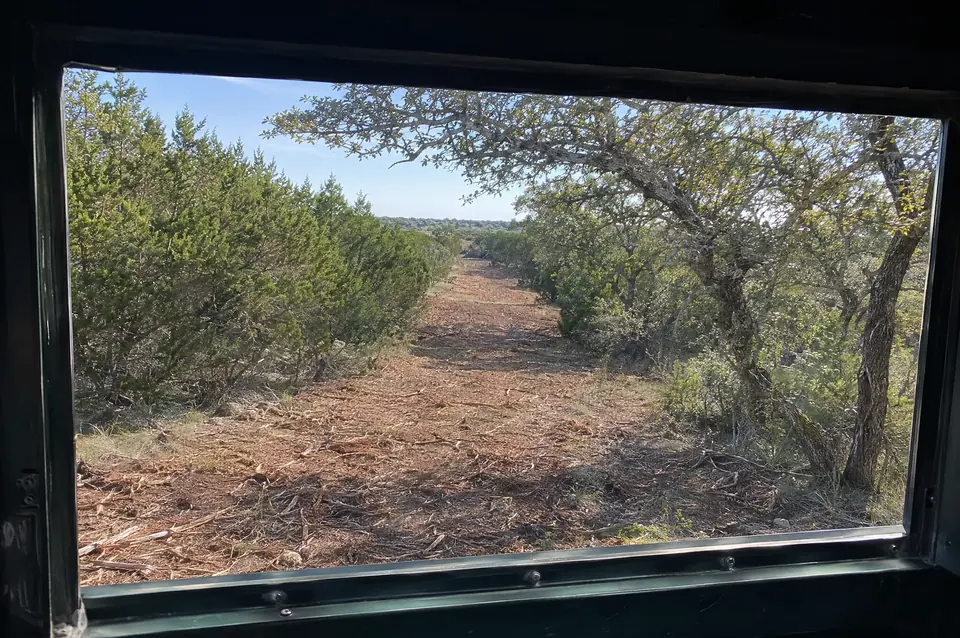
A shooting lane should be no longer than the distance you can shoot a deer accurately, and only as wide as a clean look requires. In a paper for Texas A&M's Brush Sculptors symposium, Dale Rollins wrote, "Senderos can also be installed strictly for hunting purposes." One layout he describes cuts two senderos in an X, with legs no longer than 250 yards, which he called the maximum distance most hunters could be expected to shoot a deer accurately.
Treat 250 yards as a ceiling, not a target. Size each lane to the range you shoot well with the weapon you hunt, and expect an archery lane to be far shorter than a rifle lane.
Width is a judgment call. Make a lane wide enough that a crossing deer takes a few steps in the open, and narrow enough that it does not open up the whole pasture. Consider letting a lane widen toward the far end, where it takes longer to find a deer and settle the crosshairs.
The edges do not have to be ruler-straight. Rollins noted that straight lines look unnatural, that contoured or feathered edges look more natural, and that long, straight clearings should be broken with doglegs of brush. Keep the line of sight straight and let the edges wander.
How do you keep deer cover and travel corridors when cutting lanes?
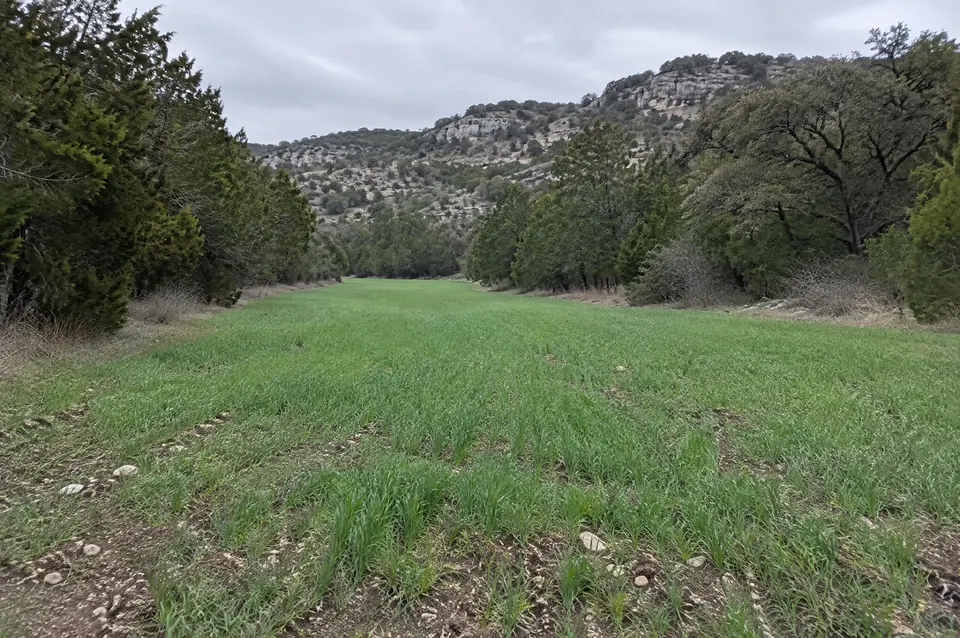
You keep deer cover and travel corridors by cutting lanes across brush strips instead of down them, and by leaving most of the woody cover standing. TPWD's white-tailed deer recommendations for the Edwards Plateau describe the best deer cover as a mosaic of brush and trees within open areas, at roughly two parts open ground to one part woody cover. The same guidance sets two tests for the brush you leave:
- Clumps or strips of brush should be wide enough that an observer cannot see through them from one side to the other.
- "Cover strips should be as continuous as possible to provide travel lanes."
A TPWD guide to deer habitat on the Edwards Plateau adds that, in general, deer should not be more than a quarter mile from cover, and that most biologists in the region recommend brush strips of mature cedar. Rollins advised preserving brush along feeder draws that serve streams, since those are important travel lanes, and normally not clearing within about 25 yards of a stream course.
In practice, a lane should cross a travel strip, not follow it. A lane cut down the length of a brush strip removes the strip. If a feeder anchors the lanes, the TPWD recommendations call for one feeder per 300 to 600 acres, next to adequate escape cover. If the lanes lead to a plot, our guide to food plot land clearing covers plot size and placement.
How to cut shooting lanes with a forestry mulcher
To cut shooting lanes with a forestry mulcher, flag the lane edges and every tree you want kept, then grind the cedar and brush inside the lines where they stand. Nothing gets pushed into piles, hauled off or burned. No burn piles. No hauling. No mess.
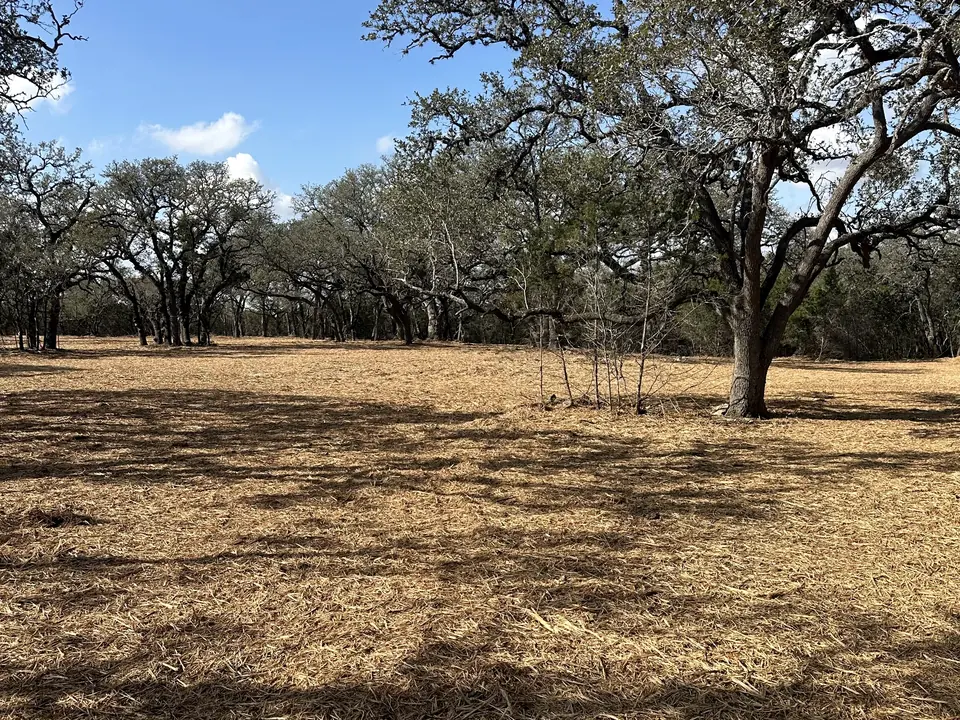
Selective clearing lets the operator take cedar out from under an oak and leave the oak standing. Our compact track machines work tight spots, slopes and uneven ground near a blind, and our large articulated machines bring more horsepower to long lanes. Root balls stay in the ground, which keeps the soil stable, and the finish is fine mulch that is easy to drive over when you fill a feeder.
Mulch depth decides how fast a lane greens up. Under a light layer of mulch, grass can come back within days after rain. Under a heavy layer, up to 12 inches deep, recovery can take 2 to 3 years. For shooting lanes, ask for a light finish.
Lanes also grow back. Brush returns to an open lane over time, so plan on follow-up mowing. Our grounds maintenance crew handles mowing and access-corridor upkeep on rural and ranch land.
When should you cut shooting lanes?
Cut shooting lanes after the February through June oak wilt window and well before your season opens. TPWD's 2026-27 season dates set the archery-only white-tailed deer season from Oct. 3 to Nov. 6, 2026 in 252 of 254 counties. The general season opened Nov. 7, 2026, running to Jan. 3, 2027 in the North Zone and Jan. 17, 2027 in the South Zone. Dates change every year, so check your county.
Oaks set the early boundary. Lanes can brush past live oaks, and Texas A&M Forest Service advises avoiding pruning or wounding oaks from February through June because of oak wilt, and painting every oak wound immediately, in any season. Our post on oak wilt land clearing covers working near oaks.
Leave time for grass. A lane cut a few months ahead of opening day has a chance to green up after a rain, so the ground is grassed instead of raw when you climb into the blind.
What does a good shooting lane plan include?
A good shooting lane plan settles length, light, backstop, cover, streams and timing before the first cedar comes down. Here is the whole plan on one page:
| Check | Rule of thumb | Source |
|---|---|---|
| Length | No longer than you shoot accurately; 250 yards is the outer limit for hunting senderos | Dale Rollins, Texas A&M Brush Sculptors |
| Light | No lane aimed at sunrise or sunset, the edges of legal shooting hours | TPWD Outdoor Annual |
| Backstop | A safe backstop behind every lane; no shots at a hill crest or at rock | TPWD hunter education |
| Cover | About two parts open ground to one part woody cover, in strips you cannot see through | TPWD Edwards Plateau guidelines |
| Streams | Brush left within about 25 yards of a stream course | Dale Rollins, Texas A&M Brush Sculptors |
| Oaks | No wounding oaks from February through June | Texas A&M Forest Service |
Get your lanes cut before next season
Flag your blind and your lanes, and walk them with our crew. Our forestry mulching and selective land clearing cuts lanes and opens hunting country across the Texas Hill Country.
Sources
- Hunting definitions, 2026-27 Outdoor Annual, Texas Parks and Wildlife Department
- 2026-2027 Hunting Season Dates, Texas Parks and Wildlife Department
- Chapter 6, Hunting Safety, Hunter Education Online Course, Texas Parks and Wildlife Department
- Applied landscaping: a primer for Brush Sculptors (1997), Dale Rollins, Texas A&M Natural Resources Server
- Appendix F: Specific Management Recommendations for White-tailed Deer, Edwards Plateau guidelines, Texas Parks and Wildlife Department
- How to Manage Deer Habitat: Edwards Plateau, William E. Armstrong, Texas Parks and Wildlife Department, posted by Texas A&M AgriLife Extension
- Prevent the spread of oak wilt in Texas (Feb. 5, 2024), Texas A&M Forest Service