
Oak wilt land clearing: how to clear near oaks without spreading the disease
Clearing near oaks does not have to spread oak wilt. Here is when to work, how to protect live oaks, what to do with red oaks and firewood, and where Texas cost share helps.
How do you clear land without spreading oak wilt?
You clear land without spreading oak wilt by keeping work near oaks out of February through June, painting every oak wound and fresh stump right away, and keeping machines off live oak roots and bark. Texas A&M Forest Service also advises removing dead infected red oaks promptly and not moving firewood.
Oak wilt land clearing comes down to three habits: keep work near oaks out of February through June, paint every oak wound the day it happens, and leave live oak bark and roots alone. Done that way, clearing cedar and brush can protect your oaks instead of putting them at risk.
Oak wilt has been confirmed in 76 Texas counties and is killing oaks at "epidemic proportions" in Central and West Texas, according to Texas A&M Forest Service. Our selective land clearing in Central Texas is built around working near the trees you want to keep. Here is how to clear without spreading the disease.
How can land clearing spread oak wilt?
Land clearing can spread oak wilt by wounding oaks during beetle season and by disturbing trees that share roots. Texas A&M Forest Service lists land clearing among common sources of oak wounds, along with pruning, construction, livestock, mowers and storms (Prevent the spread of oak wilt in Texas).
The oak wilt fungus, Bretziella fagacearum, moves two ways:
- Overland. Sap-feeding beetles pick up spores from fungal mats on infected red oaks and carry them to fresh wounds on healthy oaks.
- Underground. In live oaks, the fungus travels through connected root systems, and infection centers grow an average of 75 feet per year.
Both routes matter on a clearing job. A machine that scrapes bark or tears surface roots in April gives beetles an open wound. Live oaks in a motte often share roots, so one infected tree can pass the disease to its neighbors. The Forest Service also notes that losing trees to oak wilt can cut property values by 15 to 20 percent, so the oaks you keep are worth the care. That holds across the Texas Hill Country, where live oak and cedar grow side by side.
Oak wilt land clearing: when is it safe to work near oaks?
The safest time for oak wilt land clearing near oaks is outside February through June, when Texas A&M Forest Service advises against pruning or wounding oaks because sap beetles are most active. The Forest Service's February 2026 funding announcement puts that window at February 1 through June 30.
Red oak timing drives the window. Fungal mats "most often form in spring on red oaks" that showed advanced symptoms the previous late summer or fall, according to How to Identify and Manage Oak Wilt in Texas, a guide from the USDA Forest Service with Texas Forest Service revisions. Spring is when spores are ready and fresh wounds are most exposed.
That leaves July through January for work close to keeper oaks. Cedar and brush well away from oaks can be cleared in any month. Timing does not replace wound care, though. The Forest Service says all oak tree wounds "should be painted immediately," year-round. Our guide to the best time to clear land in Texas shows how rain, burn bans and fire risk fit the same calendar.
How do you protect live oaks during land clearing?
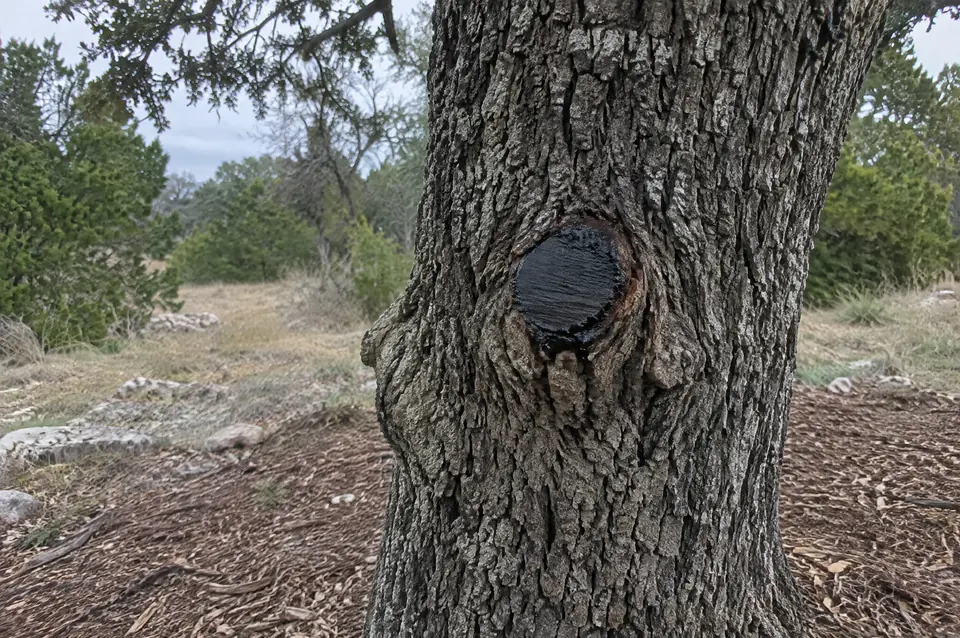
You protect live oaks during land clearing by keeping machines off their bark and surface roots and by treating any wound right away. The USDA and Texas Forest Service guide says to treat all pruning cuts and wounds to oaks, "including freshly-cut stumps and damaged surface roots," immediately with a wound or latex paint.
Protection starts before a machine moves:
- Flag every oak and shade tree you want to keep, and walk the line with the operator.
- Clear selectively around keepers instead of clearing everything and sorting it out later.
- Keep the mulching head off trunks and exposed roots under the canopy.
- Paint any nick, broken limb or root scrape on an oak the same day, in any season.
- If an unwanted oak comes down, paint the fresh stump too.
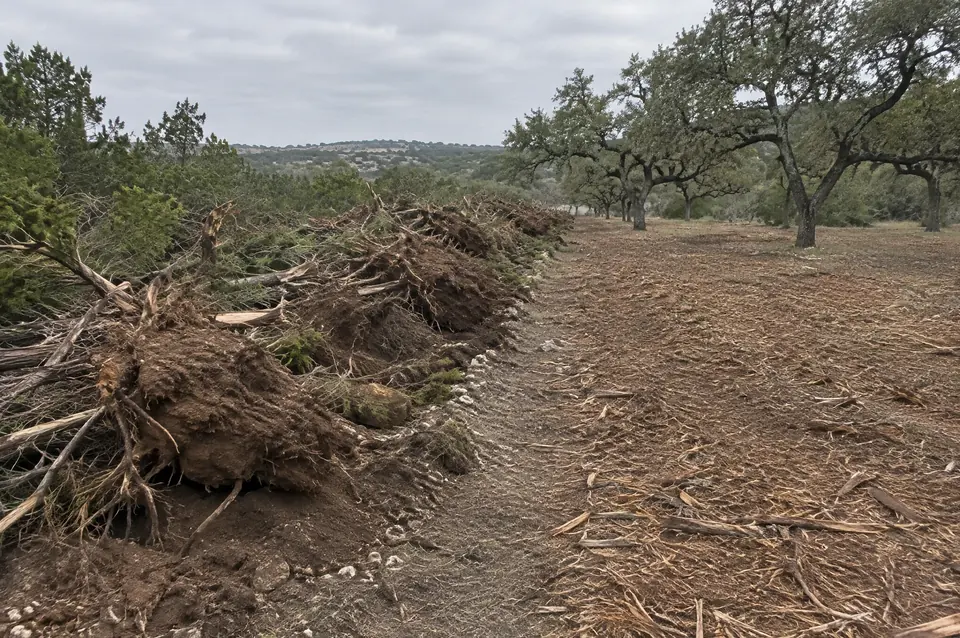
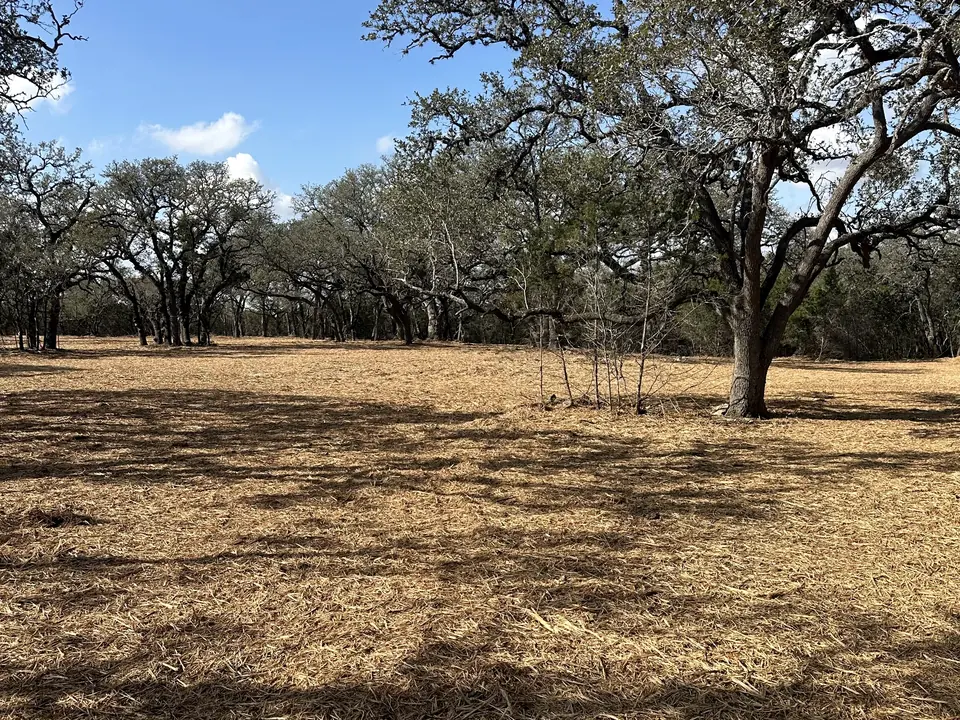
Method matters. Forestry mulching grinds cedar and brush where they stand and leaves root balls and soil in place, so the ground around keeper oaks stays put. Bulldozer clearing pushes trees out by the roots and disturbs soil. Our comparison of forestry mulching vs bulldozing covers when each fits.
The same care applies to every oak on the place, not only live oaks. "All oak trees are susceptible to oak wilt," Demian Gomez, regional forest health coordinator with Texas A&M Forest Service, told AgriLife Today.
Why do red oaks need extra care when clearing land?
Red oaks need extra care when clearing land because red oaks grow the fungal mats that feed overland spread. Spanish oak, Shumard oak and blackjack oak belong to the red oak group and are highly susceptible, per the USDA and Texas Forest Service guide. Red oaks "can die within as little as one month of infection," Gomez said.
A dead, infected red oak left standing is a risk to the oaks around it. The mats under its bark give off a fruity smell that draws sap beetles. Texas A&M Forest Service says infected red oaks that died "should be cut down and burned, buried or chipped soon after discovery," before mats can form.
That makes a diseased red oak a poor candidate for the woodpile and a good candidate for grinding on site. Forestry mulching turns a tree into fine mulch where it stands, with no logs hauled off the property. Have a Texas A&M Forest Service forester confirm the diagnosis first, since drought stress also causes tree decline in Central Texas.
What should you do with oak firewood after clearing?
Keep oak firewood on the property where it was cut, and handle wood from diseased red oaks with extra care. Texas A&M Forest Service advises against moving firewood, which can carry oak wilt to new places.
The USDA and Texas Forest Service guide adds practical rules:
- Burning infected wood does not spread the fungus, but mats can form on firewood in storage.
- Use wood that has dried for at least one full year.
- Burn all firewood before spring.
- Never store unseasoned wood from infected trees near healthy oaks.
- If wood from diseased trees must sit near healthy oaks, cover it with clear plastic and bury the edges.
Forestry mulching sidesteps most of this. Cedar and brush become ground cover instead of a woodpile, and nothing leaves the property. Any oak you want for the fireplace can be cut, stacked and stored away from keeper trees.
When does a property need oak wilt trenching, and is there cost share?
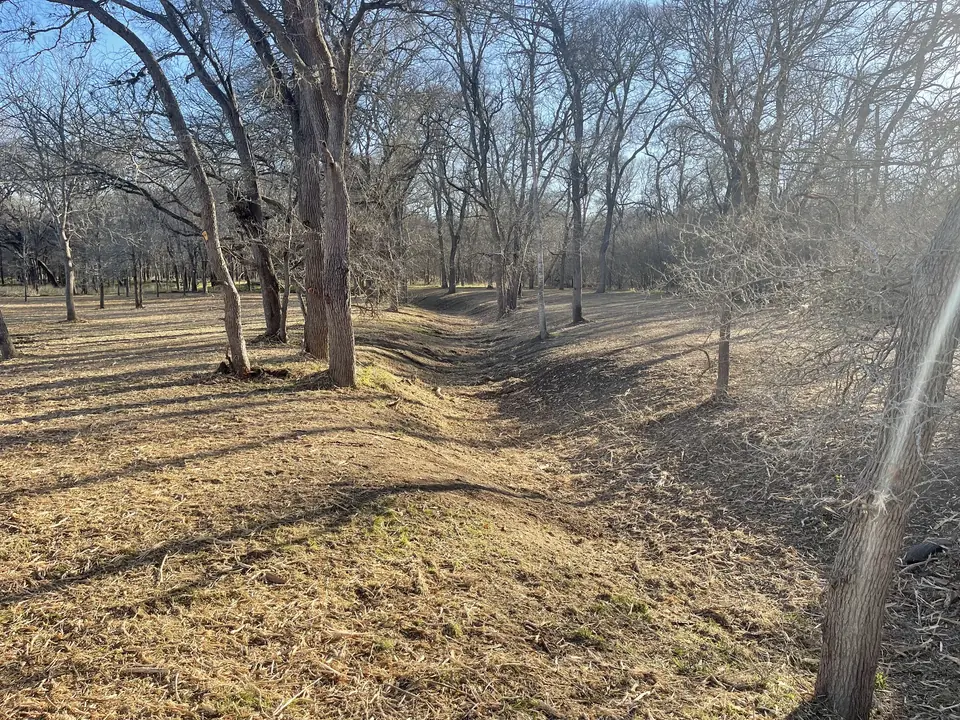
A property needs oak wilt trenching when an active disease center in live oaks threatens healthy trees nearby. Texas A&M Forest Service calls for trenches at least 4 feet deep, placed at least 100 feet beyond symptomatic trees, to cut the root connections. Trees inside the trench line may be removed. Fungicide injection protects only the trees injected, and preventive injections work best on healthy oaks about 75 to 150 feet from symptomatic ones.
The Forest Service runs an Oak Wilt Cost Share program for Central Texas landowners and communities. It pays 50 percent of approved costs for trenching, removing or pushing diseased trees inside the trench line, and removing certain diseased red oaks. The agency announced more funding in February 2026. An application "must be approved before any cost-shareable treatment can begin," so call your local forester before any work.
A 4-foot trench is excavation under the Texas811 law, which starts at 16 inches. Call 811 before anyone digs.
Clear around your oaks with a plan
Tell us which oaks matter most, and we will plan the timing and the clearing around them. See how selective land clearing around the oaks you keep works on Hill Country property.
Sources
- Texas Oak Wilt, Texas A&M Forest Service
- Prevent the spread of oak wilt in Texas, Texas A&M Forest Service (Feb. 2025)
- Texas A&M Forest Service increases funding to combat the spread of Oak Wilt, Texas A&M Forest Service (Feb. 5, 2026)
- How to Identify and Manage Oak Wilt in Texas, USDA Forest Service and Texas Forest Service
- Oak wilt cost-share program available to minimize spread in Texas, AgriLife Today
- Oak Wilt Cost Share, Texas A&M Forest Service
- Texas Utilities Code §251.002, definitions, Texas Public Law