
How on-site rock crushing turns the rock on your land into a road
On-site rock crushing breaks the rock already on your land into a fine, compactible base. Here is which rock qualifies, how a job runs from brush to base, and where it falls short.
How does on-site rock crushing work?
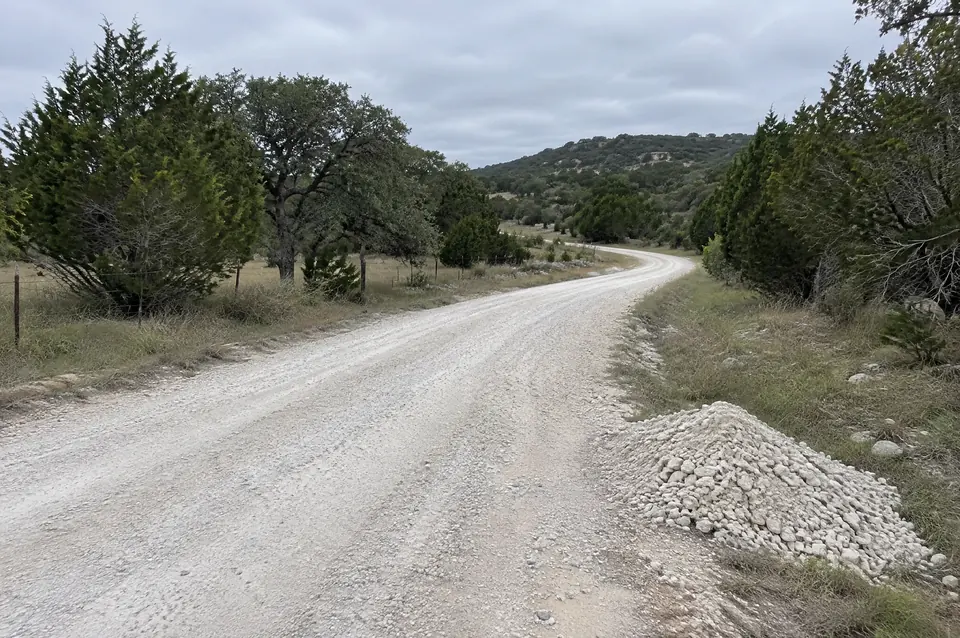
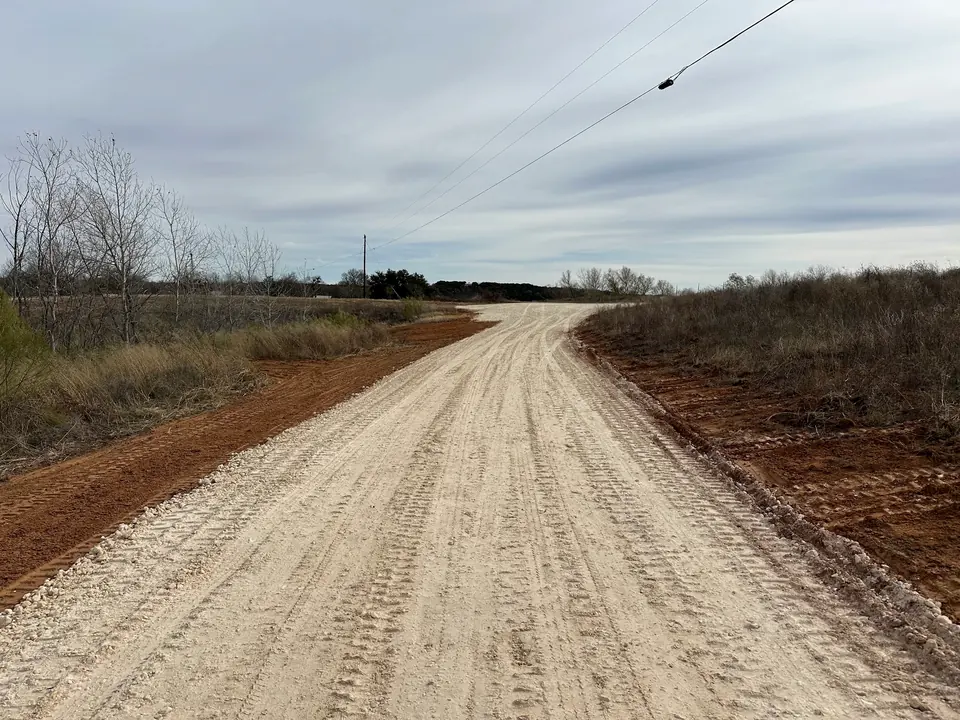
On-site rock crushing works by clearing the route, then running a crushing head over loose surface rock and fractured ledge so the stone breaks down where it lies. The crushed rock is graded to a crown, compacted and drained, which turns rock already on the property into a fine, compactible base for roads and driveways.
On-site rock crushing breaks the loose rock and fractured ledge on your land into road base right where it lies. Once the route is cleared, a crushing head works the stone down, and the crushed rock is graded, crowned and compacted, so your road or driveway is built from your own ground. That is the work behind our on-site rock crushing service in Central Texas.
This guide covers what crushing does to rock, which rock qualifies, how a job runs from brush to base, and where it falls short. If you are weighing it against trucking base in, our side-by-side on crushing your own rock vs hauling in road base runs the truckload math.
What does on-site rock crushing do to the rock?
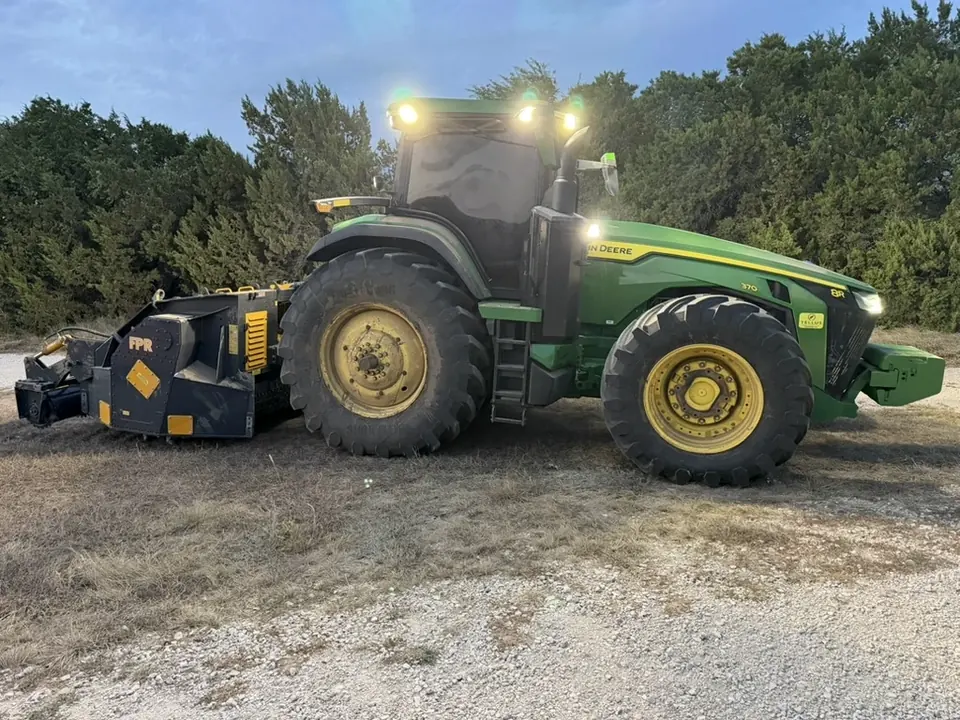
On-site rock crushing breaks stone into smaller, angular pieces and fines without lifting it off the ground. The crushing head carries a spinning rotor fitted with carbide teeth. As the machine moves, the rotor draws rock into a crushing chamber and breaks it there. Fecon describes its crusher as one that "breaks the rock down where it lies" (Fecon).
Operators control how fine the product comes out. On FAE's skid-steer crusher, adjustable Hardox counter knives set the size of the final product, and a rear hydraulic door adjusts how much material leaves the crushing chamber (FAE STC/SSL). Loftness gives its Stone Ax an adjustable anvil and rear hydraulic door to control how thoroughly stones are processed (Farm Equipment).
Angular, broken rock is what makes the result useful. The FHWA Gravel Roads Construction and Maintenance Guide (2015) says gravel has more strength when it holds more crushed particles, because crushed pieces interlock better with the particles around them. Around the Hill Country you will also hear the work called rock milling or rock grinding. The idea is the same.
What rock can be crushed on site?
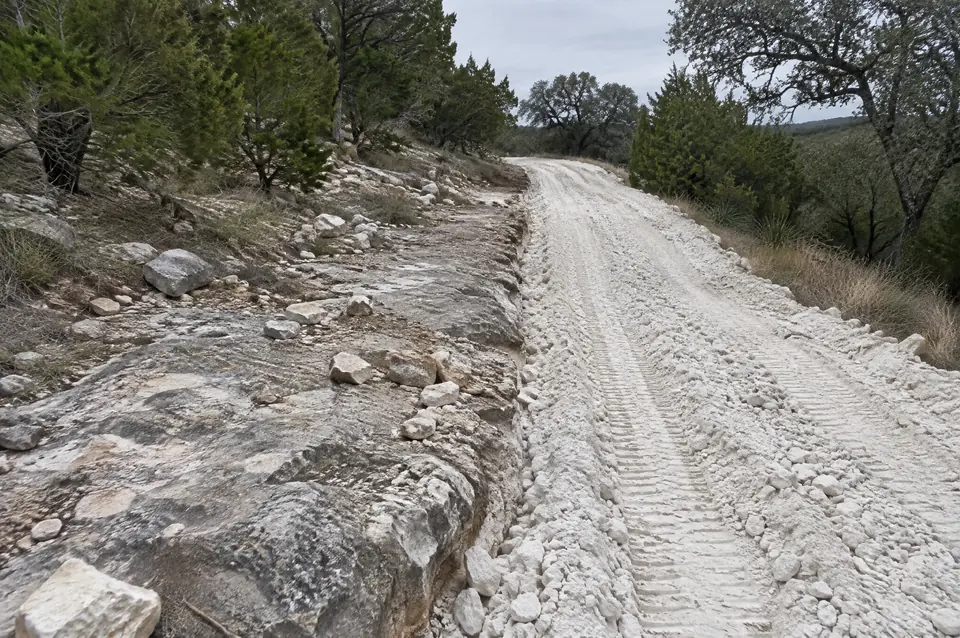
On-site crushing works on rock a crushing head can reach and take in: loose stones on the surface and fractured ledge close to it. The USDA's official description of the Eckrant soil series, an extensive Edwards Plateau soil, lists surface fragments of 3 to 50 percent, limestone bedrock 4 to 20 inches down, and rock fragments making up 35 to 80 percent of the soil by volume. It describes the rock below as "coarsely fractured indurated limestone bedrock."
Stone size matters as much as depth. In Eckrant soils, 15 to 60 percent of the soil volume is rock 75 to 600 mm across, about 3 to 24 inches. Here is how common rock conditions line up with crushing equipment:
| Rock on your land | What on-site crushing can do with it |
|---|---|
| Loose stones up to about 6 inches | Skid-steer attachments take them; FAE rates its unit at 15 cm max |
| Stones larger than about 6 inches | Too big for skid-steer heads; FAE's RSH/HP tractor head is rated for stones up to 50 cm |
| Fractured ledge near the surface | Breaks into base where the head can reach it |
| Solid ledge below a head's rated depth | Out of reach for that machine |
| Deep soil with little rock | Nothing to crush; hauled base fits better |
Rated depths and stone sizes are manufacturer maximums. Our rock crushing depth guide compares them by machine class.
How does an on-site rock crushing job run?
An on-site rock crushing job runs in a fixed order: look, clear, crush, shape, compact and drain. Each step sets up the next one.
- Walk the ground. A discovery call and site visit show the rock, the route and the access. Our crew is based in Spring Branch, and we start land clearing in Spring Branch jobs the same way.
- Clear the route. Forestry mulching grinds cedar and brush where they stand, with no pushing, piling, hauling or burning. Root balls stay in the ground to hold soil, except where the roadbed needs root-free ground. There the strip is grubbed and the root balls are mulched on site.
- Crush the rock. Crushing heads and attachments break the surface rock down to a fine, consistent grade. FAE advises keeping its attachment "level at or slightly below grade during operation" (Compact Equipment).
- Grade and crown. Rough grading, leveling and fine grading shape the crushed rock. FHWA highly recommends about 1/2 inch of crown per foot, roughly 4 percent, so water runs off the surface.
- Compact. FHWA says pneumatic, rubber-tired rollers are most often used on gravel. Binding material can stick to a smooth steel drum roller, especially when moisture is at or above optimum.
- Drain. Ditches, culverts and erosion control carry water off and under the road.
What do you end up with after on-site rock crushing?
After on-site rock crushing, you end up with a fine, compactible road base made from your own rock, graded with proper crown and drainage. We build those roads to support heavy equipment and truck traffic and to stay usable through changing weather. Processing the rock on site also eliminates imported material and speeds completion, because nobody waits on deliveries.
That base goes wherever a property needs a way in that holds up:
- Ranch roads that carry trucks and trailers
- Internal roads on development tracts
- Driveways to home sites
- New access where there was none
The same crew handles the rest of the dirt work around those roads, including cutting pads and fine-grading pad sites for foundations and future buildings.
Base and driving surface are not always the same material. Whether your crushed rock also makes a good top layer depends on how much binder it carries. A site visit is where we sort that out.
Where does on-site rock crushing fall short?
On-site rock crushing falls short when the rock is out of reach, too big, too scarce, or sitting in wet ground.
- Rock out of reach. Skid-steer heads are rated to work about 4 to 6 inches deep: 4 inches on the Loftness Stone Ax and 6 inches on the FAE STC/SSL 150 (FAE data sheet). On thin soil over solid ledge, a shallow pass mostly reworks soil and loose stone. FAE's RSH/HP tractor head is rated to 50 cm, about 20 inches (FAE RSH/HP), and like every rating, that is a maximum. 9 Arrow runs a large, dedicated rock crushing machine built to work far deeper than the skid-steer attachments most crews use. As far as we know, no other crew in the Hill Country runs one.
- Rock too big. Stones past a head's rated size need another approach before the crusher can take them.
- Too little rock. Deep soil with little stone gives a crusher nothing to work, so hauled base is the better call there.
- Wet clay. FHWA warns that water seeping into the subgrade can soften the whole roadway, and that weak subgrades "cannot support heavy loads." Drainage comes before rock, and crushing waits for firm ground.
What rules apply to on-site rock crushing?
On-site rock crushing disturbs soil, so it can fall under rules that forestry mulching does not. Texas Edwards Aquifer rules exclude "clearing of vegetation without soil disturbance" from regulated activity on the recharge zone (30 TAC 213.3). Crushing, grading and road building break ground.
- Edwards Aquifer recharge zone. TCEQ requires a Water Pollution Abatement Plan for regulated activities such as building roads and excavation, approved before construction starts (TCEQ).
- Edwards Aquifer contributing zone. The contributing zone rules apply to regulated activities disturbing at least 5 acres, or less as part of a larger common plan that could disturb 5 or more (30 TAC 213.21).
- Stormwater. Disturbing an acre or more of soil brings in TCEQ's construction stormwater general permit, TXR150000 (TCEQ).
- Texas811. Texas law counts grading, ripping and scraping as excavation when mechanized equipment disturbs soil to a depth of 16 or more inches (Tex. Util. Code §251.002). Walk private well, septic and electric lines with the crew before any digging.
This is general information, not legal advice. Confirm your project with TCEQ, your county and Texas811 before work starts.
See what your rock can become
A site visit shows how much usable rock sits on your route and how deep it runs. See how our on-site rock crushing for roads and driveways works, and we will tell you straight whether crushing fits your ground.
Sources
- Stone crusher (SC6220 and SC7620), Fecon
- STC/SSL stone crushers for skid steers, FAE Group
- STC/SSL stone crushers for skid steers data sheet (US), FAE Group
- RSH/HP stone crusher specifications, FAE Group
- Loftness Stone Ax stone crusher, Farm Equipment
- We discuss stone crusher attachments with FAE's Giorgio Carera, Compact Equipment
- Stone crushers lend a hand in site prep, land clearing and more, Compact Equipment
- Gravel Roads Construction and Maintenance Guide (2015), Federal Highway Administration
- Eckrant series, Official Soil Series Description, USDA Natural Resources Conservation Service
- 29 CFR 1926.1153, Respirable crystalline silica, Cornell Legal Information Institute
- 30 TAC 213.3, Edwards Aquifer definitions, Cornell Legal Information Institute
- 30 TAC 213.21, Contributing zone applicability, Justia
- Water Pollution Abatement Plan, Texas Commission on Environmental Quality
- Stormwater permits for construction sites (TXR150000), Texas Commission on Environmental Quality
- Texas Utilities Code §251.002, Definitions, Texas Public Law