
Why rock crushing depth decides what your road sits on
Skid-steer crushers are rated 4 to 6 inches deep. The deepest heads reach about 20. Here is what that depth means on thin Hill Country soil, and where it stops helping.
Why does rock crushing depth matter?
Rock crushing depth matters because Hill Country bedrock often sits only 4 to 20 inches down. Skid-steer crushing attachments are rated to about 4 to 6 inches, which mostly reworks soil and loose stone. The deepest tractor-driven heads are rated to about 14 to 20 inches, deep enough to reach ledge and process a full road base layer.
Rock crushing depth decides whether a crusher reworks the top few inches of soil and loose stone or reaches the limestone ledge underneath. On Hill Country land, where bedrock often sits 4 to 20 inches down, that difference changes what your road is built on. Depth is why our rock crushing service in Central Texas works the way it does. 9 Arrow runs a large, dedicated rock crushing machine built to work far deeper than the skid-steer attachments most crews use. As far as we know, no other crew in the Hill Country runs one.
Here is how depth breaks down by machine class, what a deep pass reaches, how thick a road base needs to be for trucks, and where depth stops helping.
What rock crushing depth can each machine class reach?
Rock crushing depth ranges from about 4 inches on the smallest skid-steer attachments to about 20 inches on the deepest tractor-driven heads. Published ratings climb steeply with horsepower:
| Machine class | Published examples | Rated max depth | Max stone | Power |
|---|---|---|---|---|
| Skid-steer or compact track loader attachment | Loftness Stone Ax; FAE STC/SSL 150 | 4 in; 6 in | About 6 in | 80 to 135 hp |
| Mid tractor PTO head | FAE STCM, STCH, RSL | 8 to 11 in (20 to 28 cm) | 12 to 20 in | 80 to 400 hp |
| Dedicated tracked carrier head | FAE SFM on PT300 | About 12 in (30 cm) | About 8 in | Purpose-built carrier |
| Deep tractor PTO head | Seppi MAXISOIL; FAE RSM | 14 to 16 in (35 to 40 cm) | About 20 in | 200 to 450 hp |
| Deepest tractor PTO head | FAE RSH/HP; FAE MTH | About 20 in (50 cm) | About 20 in | 300 to 500 hp |
Every figure in the table is a manufacturer's rated maximum, not a measured field depth. Seppi's distributor, for example, lists the MAXISOIL at 35 cm "and deeper, depending on working conditions" (International Mowers). Skid-steer heads are limited by the carrier's hydraulic power. Fecon told Compact Equipment in 2026 that a stone crusher needs a high-flow machine, "typically 90 hp or greater," and called crushing "a very abusive environment." The deep heads run on tractors rated at 200 to 500 horsepower, which makes them a different class of tool.
What does a deeper crushing pass reach on Hill Country land?
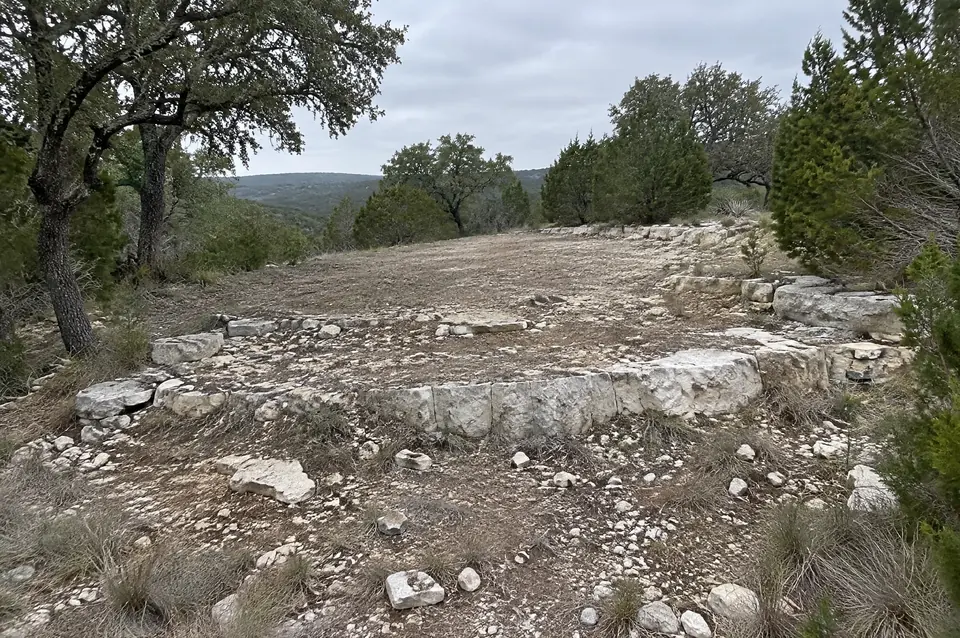
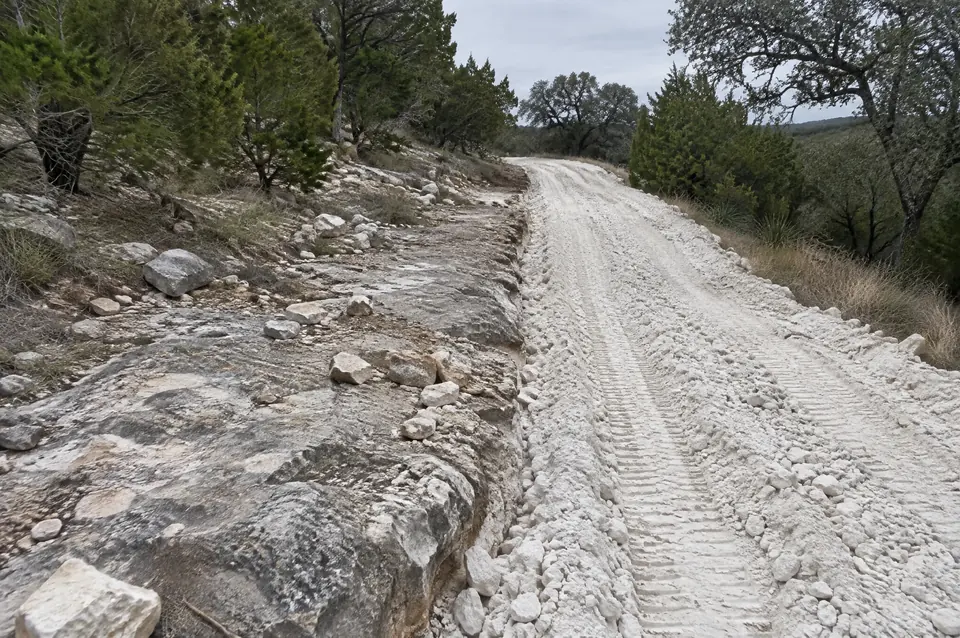
A deeper crushing pass reaches the limestone ledge under thin soil instead of only the loose stone on top. USDA soil series descriptions put bedrock at 4 to 20 inches for Eckrant soils, 10 to 20 inches for Comfort soils and 5 to 20 inches for Brackett soils, all common on Hill Country uplands. On that ground, a 4 to 6 inch head mostly reworks soil and surface stone. A head rated to 14 to 20 inches can reach into the rock itself.
Manufacturers draw the same line. FAE pitches its shallower 25 cm STCH head at soils with large quantities of loose, moving stones (FAE STCH). Its 40 cm RSM offers a rotor "ideal for lands where stones emerge" (FAE RSM), and its 50 cm MTH is marketed for rock slab milling (FAE MTH).
Depth also raises the stone size a head will take, from about 6 inches on skid-steer attachments to about 20 inches on the deep heads. For a landowner around Spring Branch or Bulverde, that means the stair-step ledge across a driveway line, or the rock that stopped a road cut, can become road base instead of an obstacle. It is the same rock we deal with in land clearing across Comal County, and our guide to building on rocky land in Texas explains why that ledge is there.
How thick should crushed rock road base be for heavy trucks?
Crushed rock road base should be sized to the heaviest trucks that will use the road, not to pickups. Design guidance calls heavy axle loads, counted in 18,000-pound equivalents, "considered vital to gravel road thickness design," while private cars and light trucks barely affect the result (Gravel Road Thickness Design Methods, Appendix A). Concrete trucks, loaded trailers, dump trucks and equipment lowboys set the thickness.
A South Dakota design catalog in that source lists minimum gravel thickness by heavy trucks per day and by how strong the ground underneath is:
| Heavy trucks per day | Weak subgrade | Medium subgrade | Strong subgrade |
|---|---|---|---|
| 0 to 5 | 6.5 in | 5.5 in | 4.5 in |
| 5 to 10 | 8.5 in | 7.0 in | 5.5 in |
| 10 to 25 | 11.5 in | 9.0 in | 7.0 in |
| 25 to 50 | 14.5 in | 11.5 in | 8.5 in |
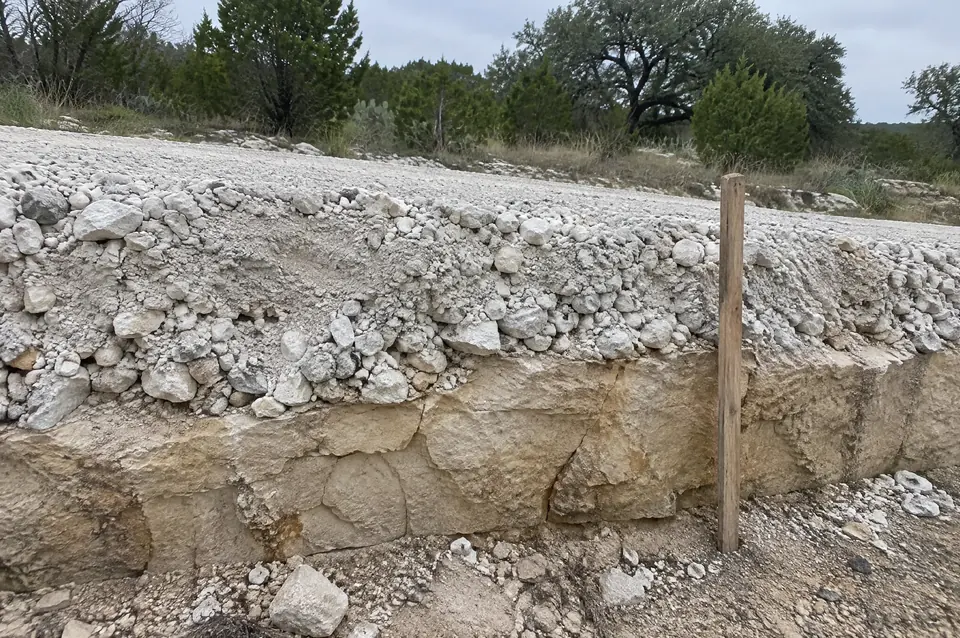
The catalog shows why crushing depth matters. A 4 to 6 inch head cannot process even the light-traffic minimum on weak ground in one pass, while a head rated to 14 to 20 inches reaches the heaviest band. The standard "ideal" gravel road stacks 6 to 12 inches of coarse base under at least 3 inches of surface gravel (Skorseth, South Dakota LTAP, 2008). Over solid ledge, the ground under the road is already strong, so the thickest sections matter most on valley clay and soft marl stretches.
Where does crushing depth stop helping?
Crushing depth stops helping once the base is thick enough for your traffic, and depth alone never makes a road last. Four limits apply to any deep pass.
- Rated depth is a ceiling. No manufacturer we found says how much depth drops in harder rock or how many passes it takes to reach the rating. Dense Edwards ledge and chert slow any head, and chert rates 7 on the Mohs scale against 3 for the calcite in limestone (Geology.com, Mohs scale), so it also wears teeth faster.
- Loose depth compacts thinner. Crushed rock settles into a denser, thinner layer under the roller, and we found no published loose-to-compacted factor for crushed limestone.
- Road specs build thick base in compacted lifts. Ohio DOT caps a compacted aggregate base lift at 4 inches without a vibratory roller, 6 inches with a 10 to 12 ton vibratory roller and 8 inches with a heavier one (Ohio DOT Item 304). TxDOT compacts flexible base to at least 100 percent of lab maximum dry density within 2 points of optimum moisture (TxDOT Item 247, 2024).
- Drainage decides lifespan. The FHWA Gravel Roads Construction and Maintenance Guide (2015) recommends about 1/2 inch of crown per foot, roughly 4 percent. In one FHWA case, 10 inches of compacted gravel over fabric went 12 years with no foundation repair and only surface upkeep.
Does deep rock crushing trigger 811 or permit rules?
Deep rock crushing can trigger rules that forestry mulching avoids, plus a Texas811 depth line that shallow passes stay under. Texas law defines "excavate" as using mechanized equipment to disturb soil "to a depth of 16 or more inches" (Tex. Util. Code §251.002). A 4 to 6 inch skid-steer pass falls under that line. The deepest heads are rated to about 20 inches, so a pass worked past 16 inches crosses it, and the excavator must notify Texas811 no later than 48 hours and no earlier than 14 days before work, not counting weekends and holidays (Tex. Util. Code §251.151). Lines that serve only the owner, such as well lines, private electric runs and septic lines, are not marked through 811 (§251.003), so walk them with the crew.
Edwards Aquifer rules treat soil disturbance differently from clearing. The rules exclude "clearing of vegetation without soil disturbance" (30 TAC §213.3), which is where forestry mulching sits. Rock crushing breaks ground. On the recharge zone, roads and excavation need an approved plan before work starts, at any size (TCEQ), and on the contributing zone the trigger is 5 or more acres. Disturbing an acre or more anywhere in Texas brings in the TCEQ construction stormwater permit, TXR150000 (TCEQ). A deeper pass is also more likely to break into a karst void, and on the recharge zone that means suspending nearby work immediately (30 TAC §213.5).
This is a summary, not legal advice. Confirm your project with TCEQ, your county and Texas811, and see our guide to road building permits in Texas.
Match the crushing depth to your ground
A site visit tells us how deep your rock sits, what trucks the road has to carry and how deep the crusher needs to work. See how our deep on-site rock crushing fits your property.
Sources
- Stone crushers lend a hand in site prep, land clearing and more, Compact Equipment (2026)
- STC/SSL stone crushers for skid steers data sheet, FAE Group
- STCM stone crusher specifications, FAE Group
- STCH stone crusher specifications, FAE Group
- RSL stone crusher specifications, FAE Group
- SFM multitask head for PT300 brochure, FAE Group
- Seppi MAXISOIL specifications, International Mowers
- RSM and RSM/HP stone crusher specifications, FAE Group
- RSH/HP stone crusher specifications, FAE Group
- MTH and MTH/HP multitask head specifications, FAE Group
- Official Soil Series Descriptions, USDA Natural Resources Conservation Service: Eckrant, Comfort, Brackett
- Gravel Road Thickness Design Methods, Appendix A, U.S. Environmental Protection Agency archive
- Unpaved road maintenance (Skorseth, 2008), South Dakota Local Transportation Assistance Program
- Mohs hardness scale, Geology.com
- Item 304, Aggregate Base (2013 Construction and Material Specifications), Ohio Department of Transportation
- Item 247, Flexible Base (2024 Standard Specifications), Texas Department of Transportation
- Gravel Roads Construction and Maintenance Guide (2015), Federal Highway Administration
- Texas Utilities Code §251.002, §251.151 and §251.003, Texas Public Law
- 30 TAC §213.3, Edwards Aquifer definitions, Cornell Legal Information Institute
- Water Pollution Abatement Plan, Texas Commission on Environmental Quality
- Stormwater permits for construction sites (TXR150000), Texas Commission on Environmental Quality
- 30 TAC §213.5, Required Edwards Aquifer protection plans, Cornell Legal Information Institute