
Mulch it or doze it? Forestry mulching vs bulldozing on Texas land
Forestry mulching vs bulldozing comes down to whether your soil and roots need to move. Here is how the two compare on erosion, brush piles, rules and finish.
Is forestry mulching or bulldozing better for clearing Texas land?
Forestry mulching is better than bulldozing for clearing most Texas land, because it grinds brush in place and leaves soil, roots and ground cover intact. Bulldozing is better where roots and soil must move, such as foundations, pads, stock tanks and road subgrade. Many projects mulch most acres and doze only those footprints.
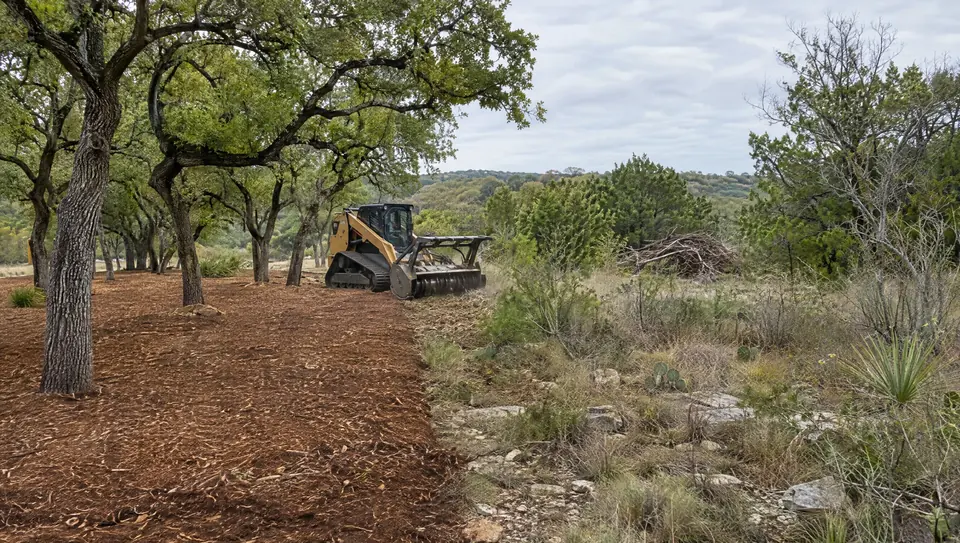
Forestry mulching vs bulldozing comes down to one question: does the soil need to move? Forestry mulching grinds trees and brush where they stand and leaves the topsoil and root balls in place. Bulldozing pushes trees out by the roots and moves dirt along with them. On most brushy Texas land, mulching is the better default, and the dozer earns its keep on pads, foundations and earthwork.
We run both at 9 Arrow. Forestry mulching in Central Texas is the core of our business, and we bring in bulldozers and excavators when roots truly have to come out. Here is how the two methods compare on soil, debris, rules and finish.
Forestry mulching vs bulldozing: what is the difference?
Forestry mulching uses one machine with a spinning, toothed drum that grinds standing trees and brush into mulch down to ground level. Bulldozing uses a blade to push trees over, roots and all, and shove them into piles. The mulcher leaves ground cover behind. The dozer leaves bare dirt and a pile.
| Forestry mulching | Bulldozing | |
|---|---|---|
| What the machine does | Grinds trees and brush in place | Pushes trees out by the roots and piles them |
| Soil and roots | Topsoil and root balls stay put | Soil is scraped and roots are torn out |
| Debris | Mulch stays as ground cover | Piles to burn, haul or leave |
| County burn bans | No effect, nothing is burned | Pile burning stops during a ban |
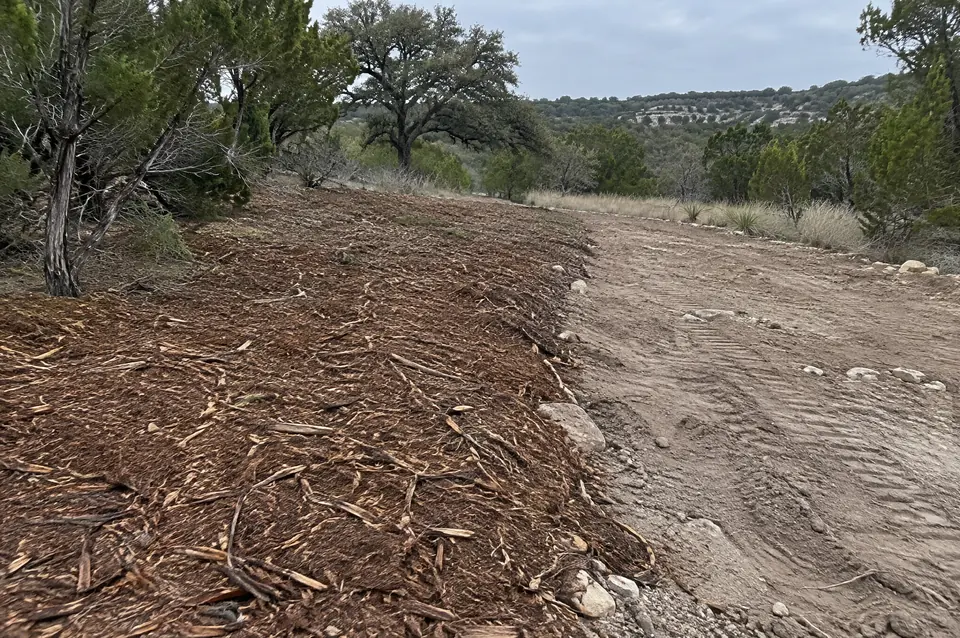
| Finish | Fine mulch you can drive over | Bare, loosened dirt with root holes |
| Trees you keep | Operator works around keepers | Harder to control near keepers |
| Best fit | Pasture, cedar, home sites, lines, lots | Foundations, pads, stock tanks, road subgrade |
Both machines move a lot of material in a day. The difference is what is left on the ground when they leave.
Does bulldozing cause more erosion than forestry mulching?
Bulldozing usually leaves land more exposed to erosion than forestry mulching, because a dozer strips the cover and loosens the soil while a mulcher leaves both in place. Texas A&M AgriLife Extension's guide to brush management methods puts it plainly: "Bulldozing may cause considerable soil disturbance." The same guide warns that grubbing in shallow, rocky soils can leave the surface "extremely rough."
The federal standard for brush work points the same way. The USDA NRCS Brush Management practice standard (Code 314) tells planners to choose the method with "the least amount of soil disturbance" when erosion potential is high and new cover is slow or uncertain.
Hill Country ground raises the stakes. The Eckrant soil, an extensive series on the Edwards Plateau, reaches limestone bedrock at 4 to 20 inches, according to its USDA official soil series description. The Texas A&M Forest Service's Central Texas brush management guide warns that soil erosion "can be devastating until grasses reestablish," and that rocks can be brought to the surface. On soil that thin, a lost inch is hard to get back.
Forestry mulching still needs good timing. Any heavy machine can rut saturated clay, so wet weeks are a reason to wait with either method.
What happens to root balls and brush piles with each method?
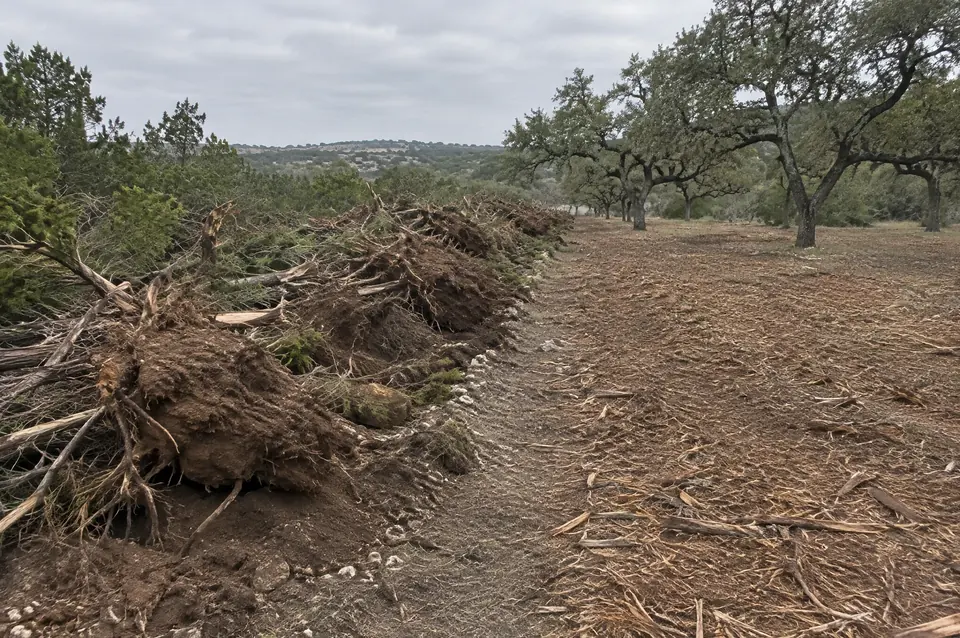
Forestry mulching leaves root balls in the soil, where they hold the ground together, and turns the trees into mulch on site. Bulldozing pulls the root balls and stacks trunks, limbs, roots and dirt into piles. Those piles have to be burned, hauled or left to sit.
Burning a dozer pile in Texas comes with rules. The TCEQ guide Outdoor Burning in Texas (RG-049) allows land clearing debris to be burned only at the site where it was cleared. TCEQ rule 111.219 adds limits on every burn:
- Start no earlier than one hour after sunrise, and finish by one hour before sunset.
- Do not start if forecast wind is under 6 mph or over 23 mph.
- Burn downwind of, or at least 300 feet from, neighboring structures with sensitive receptors, unless the neighbor approves in writing.
- Keep someone with the fire while it is actively burning.
County burn bans can stop pile burning altogether during dry spells, and a pile that cannot be burned just sits. For the full picture, read our comparison of mulching vs burning brush.
We also mulch old bulldozer piles, including piles as large as a house, so an old dozer job does not have to stay a burn problem.
Which clearing method triggers more rules in the Hill Country?
Bulldozing triggers more rules than forestry mulching in much of the Hill Country, because Texas rules often draw the line at soil disturbance. TCEQ's Edwards Aquifer rules list "clearing, excavation, or any other activities that alter or disturb" a site as regulated activity, and they exclude "clearing of vegetation without soil disturbance" (30 TAC 213.3). The Edwards rules reach parts of eight counties, including Comal, Bexar and Hays (30 TAC 213.21).
On the recharge zone, a Water Pollution Abatement Plan must be approved before regulated work starts. TCEQ's Edwards Aquifer Protection Program allows up to 30 days for administrative review and 90 days for technical review.
Statewide, TCEQ's construction stormwater permit (TXR150000) overview treats clearing, grading and excavating that disturb or expose soil as construction, and permit coverage starts when a site disturbs one acre or more. The same overview lists some agricultural land disturbance as outside that definition, but do not assume a clearing job qualifies.
Under that wording, forestry mulching that clears vegetation without disturbing soil sits on the excluded side of the Edwards line. Grubbing, pad work and road building do not. Rules apply parcel by parcel, so check your land on TCEQ's map and confirm with the agency before work starts. This is general information, not legal advice.
When is bulldozing the right call?
Bulldozing is the right call when roots and soil have to move. Common examples include the following.
- Foundations and house pads that need root-free ground
- Stock tanks, ponds and other earthwork
- Road and driveway subgrade
- Mesquite you want gone for good, since the Texas A&M Forest Service calls grubbing the preferred way to kill mesquite and redberry juniper
On those jobs we grub with bulldozers and excavators, and we prefer to mulch the root balls on site instead of piling them. Most projects mix the two methods. We mulch the bulk of the acreage and doze only the footprints that need it, which keeps bare soil to the spots that have to be bare.
Our comparison of forestry mulching vs traditional land clearing walks through more combinations. Our forestry mulching in the Texas Hill Country page covers how we work rocky slopes and limestone ground.
Pick the method by what the ground has to do next
If you want open, grazeable or buildable land with the soil intact and the best trees kept, start with forestry mulching for Texas land. If a slab or a stock tank is going in, plan dozer work for that footprint and mulch everything around it.
Sources
- Brush Management Methods (E-44), Texas A&M AgriLife Extension
- Conservation Practice Standard: Brush Management, Code 314, USDA NRCS
- Central Texas: Brush Management, Texas A&M Forest Service
- Eckrant Series, Official Soil Series Description, USDA NRCS
- Outdoor Burning in Texas (RG-049), TCEQ
- 30 TAC 213.3, Edwards Aquifer definitions, Cornell Legal Information Institute
- 30 TAC 213.21, Edwards Aquifer contributing zone, Cornell Legal Information Institute
- Water Pollution Abatement Plan, TCEQ
- Edwards Aquifer Protection Program, TCEQ
- Stormwater Construction General Permit (TXR150000) Overview, TCEQ, 2023