

How to build a ranch road that holds up on Hill Country rock
A ranch road that lasts starts with the route and ends with drainage. Here is the step-by-step sequence for building one on thin soil and limestone in the Texas Hill Country.
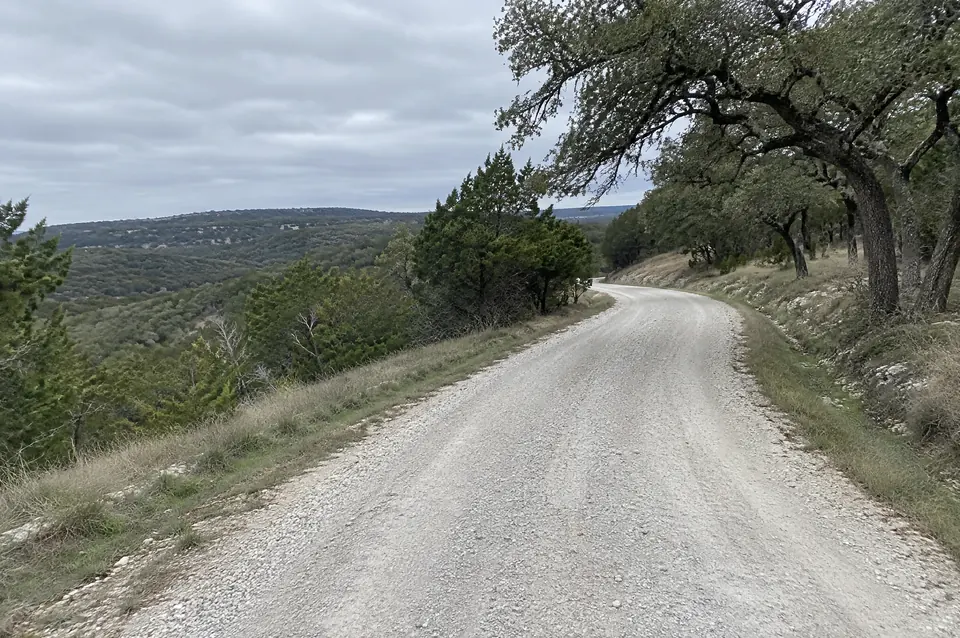
How do you build a ranch road?
You build a ranch road by routing it along ridges at grades of about 12 percent or less, clearing the corridor, shaping the roadbed, and compacting a crushed rock base under a binding surface layer. Then you give it a crown of about 4 percent and add dips, turnouts and culverts or low-water crossings to move water off.
Knowing how to build a ranch road in the Hill Country comes down to three jobs done in order: pick a route that trucks and water can live with, build a rock base strong enough for the heaviest load, and move every drop of water off the road. Get the route and the drainage right, and the rest of the road has a chance to last.
This guide walks through the sequence step by step on thin soil over limestone. It is the same order of work behind our access road building and ranch road construction: clearing, rough grading, fine grading, road base, drainage and culverts.
How to build a ranch road that follows the land
To build a ranch road that follows the land, route it along ridges and gentle side slopes at grades of about 2 to 10 percent, and cross draws only where you have to. The 2017 Texas Forestry Best Management Practices handbook from Texas A&M Forest Service says roads should follow ridges as much as possible. It adds that grades steeper than 10 percent should not run more than 500 feet, and slopes over 15 percent no more than 200 feet. The USDA Forest Service low-volume roads field guide keeps grades at 12 percent or less, with short pitches up to 15 percent.
Route matters more on Hill Country ground than almost anywhere. The Glen Rose limestone around Spring Branch alternates hard ledges with soft marl and shows "well developed stair-step topography," according to USGS geologic mapping. A road that climbs straight up a hillside fights every ledge and sends runoff straight down its own surface.
Walk the line before any machine shows up:
- Flag the route along the contour, and mark the oaks and shade trees you want to keep.
- Look for firm crossing spots where draws have low banks and a rock bottom.
- Note seeps, wet spots and places where water already cuts across.
- Check whether the land sits on an Edwards Aquifer zone or in a mapped flood zone. Our guide to road building permits in Texas explains what each one triggers.
How do you clear the corridor for a ranch road?
Clearing the corridor for a ranch road starts with forestry mulching, which grinds cedar, brush and trees where they stand so nothing gets pushed into piles or burned. Clear wider than the driving surface. The corridor has to hold the road, its shoulders and any side ditch.
On thick cedar, the road line can follow a surveyor's plan instead of a guess. 9 Arrow mounts Trimble GPS receivers on its mulching machines and loads the licensed surveyor's CAD files, so the operator follows the certified line in real time. That cuts down on survey crews staking ahead through brush. This GPS survey line clearing is how we open future road locations through dense timber. We are not surveyors and do not replace one.
Mulching leaves root balls in the ground and the soil in place, which keeps the shoulders and slopes beside the road stable. The roadbed itself is different. Where the road needs root-free ground, a dozer or excavator grubs that strip, and the root balls get mulched on site instead of piled. That keeps disturbed ground to the width the road actually needs.
How do you build the roadbed on thin soil and rock?
You build a Hill Country roadbed by cutting through a few inches of soil to the limestone, shaping it to grade, and turning that rock into the road's base. Most upland soils here are thin. USDA soil descriptions put bedrock at 10 to 20 inches for the Comfort series and 4 to 20 inches for the Eckrant series, two of the most common.
That rock is the building material. On-site crushing breaks surface rock into a fine, compactible road base with no imported material. Depth decides how much of the ledge a crusher reaches. Skid-steer crusher attachments are rated to about 4 to 6 inches, per specs compiled by Compact Equipment and FAE. The deepest tractor-driven heads are rated to about 35 to 50 cm, roughly 14 to 20 inches (FAE RSH/HP). Those are manufacturer maximums. 9 Arrow runs a large, dedicated rock crushing machine built to work far deeper than the skid-steer attachments most crews use. As far as we know, no other crew in the Hill Country runs one. See how on-site rock crushing works.
Size the base for the heaviest truck that will use the road. A South Dakota catalog in Gravel Road Thickness Design Methods sets minimum gravel thickness at about 4.5 to 6.5 inches for 0 to 5 heavy trucks a day, up to 8.5 to 14.5 inches for 25 to 50. Concrete trucks, loaded trailers and equipment lowboys set the section, not pickups.
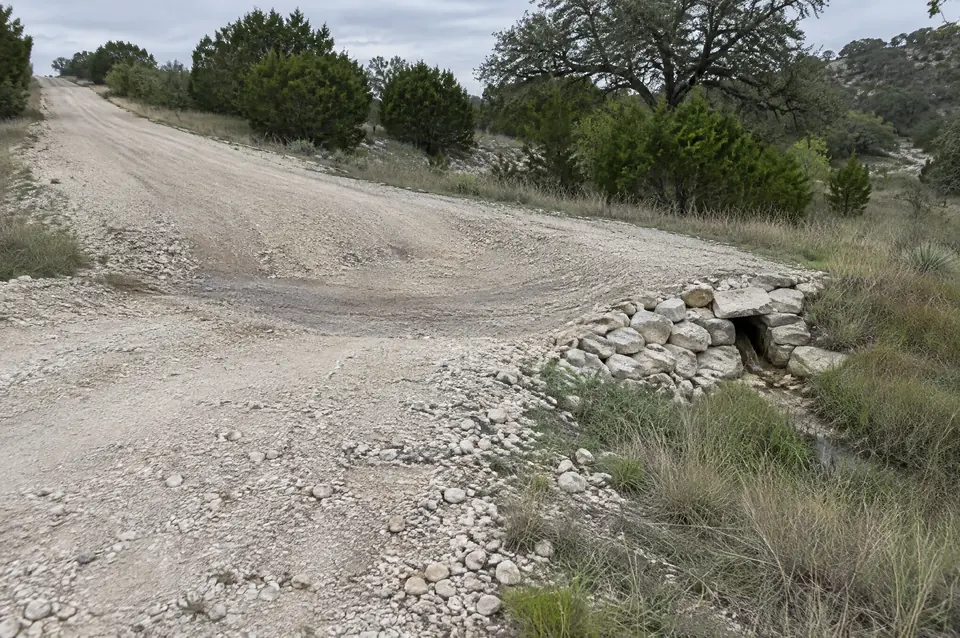
What makes a crushed rock road surface last?
A crushed rock road surface lasts when it is built in two layers, a coarse base below and a binding surface course on top, both compacted at the right moisture. The FHWA Gravel Roads Construction and Maintenance Guide notes that base gravel has very little fines, so used alone as a driving surface it will not form a crust.
The two layers want different amounts of fines, the dust-sized particles that pass a No. 200 sieve:
- Base: Texas Transportation Institute research found that "fines contents of 5 to 10 percent appear to be optimum" (TTI 0-4358-S).
- Surface: the FHWA surface gravel guideline calls for 4 to 15 percent fines with a plasticity index, a measure of clay binder, of 4 to 12 (UC Pavement Research Center).
A South Dakota field test shows why the cap matters. After harvest traffic, uncontrolled gravel had 405 tons of loose rock per mile against 71 tons on gravel built to spec, and it needed up to four bladings against one (SD Surface Gravel Study, 2022).
Compaction locks the layers in. TxDOT Item 247 requires base compacted to at least 100 percent of lab density, within 2 percentage points of optimum moisture. FHWA notes rubber-tired rollers are the usual choice on gravel. Which rock you use matters too, and our comparison of caliche vs crushed limestone covers the better base.
How do you keep water off a ranch road?
You keep water off a ranch road with a crown of about 4 percent and with dips and turnouts spaced closer together as the grade gets steeper. FHWA puts the crown at half an inch per foot and warns that "it is not good to exceed 6 percent in any condition." Measure it. On the South Dakota test road, crown specified at 4 percent never topped 3 percent once graded.
The Texas A&M Forest Service handbook gives spacing by grade for broad-based dips, which are built for grades of 12 percent or less, and for wing ditches that turn water out of the side ditch:
| Road grade | Broad-based dip spacing | Wing ditch spacing (max) |
|---|---|---|
| 2% | 300 ft | 200 ft |
| 4% | 200 ft | 200 ft |
| 6% | 165 ft | 100 ft |
| 8% | 150 ft | 100 ft |
| 10% | 140 ft | 75 ft |
| 12% | 130 ft | not listed |
Steeper or little-used stretches get water bars, which the same handbook tightens from 250 feet apart at 2 percent to 35 feet at 30 percent. Water is the base's main enemy. TTI found that Texas flexible bases "perform very well as long as they are kept dry" and fail fast once water gets in.
When does a ranch road need a culvert or a low-water crossing?
A ranch road needs a culvert where steady water has to pass under the road, and a low-water crossing where a small draw runs only after rain. The USDA Forest Service field guide recommends fords or vented low-water crossings over culverts on small, low-flow streams, because culverts plug more easily. Armor the whole wetted area and the downstream edge so floodwater cannot scour the crossing.
Where a culvert is the right call, the Texas A&M Forest Service handbook sets the basics:
- The smallest pipe on its culvert size chart is 18 inches in diameter.
- Cover should equal at least half the culvert diameter, preferably 1 foot of fill per foot of diameter.
- Cover should never be less than 1 foot.
Crossings can also bring permits. Grading or placing fill in a mapped flood zone counts as development, and Comal County issues floodplain development permits through its County Engineer's Office, as does Kendall County. Ask before you build. Culvert installation and creek crossings are part of our road work across the Texas Hill Country.
Plan your ranch road before the first cut
A walk of the route with the crew settles most of these questions, from grade and rock depth to where the water wants to go. See how we handle ranch road and access road building in the Hill Country, from clearing through culverts.
Sources
- Texas Forestry Best Management Practices (2017), Texas A&M Forest Service
- Low-Volume Roads Engineering Best Management Practices Field Guide, USDA Forest Service
- Geologic map of the Anhalt, Fischer and Spring Branch quadrangles (SIM 3333), U.S. Geological Survey
- Comfort series, USDA Natural Resources Conservation Service
- Eckrant series, USDA Natural Resources Conservation Service
- Stone crushers lend a hand in site prep, land clearing and more, Compact Equipment
- STC/SSL stone crushers for skid steers, FAE
- RSH/HP stone crusher, FAE
- Gravel Road Thickness Design Methods, Appendix A, Gravel Roads manual (EPA archive)
- Gravel Roads Construction and Maintenance Guide, Federal Highway Administration
- High Performance Flexible Bases, Project Summary 0-4358-S, Texas Transportation Institute
- Making Better Gravel Roads, UC Pavement Research Center
- Surface Gravel Study update, South Dakota DOT and SDLTAP (2022)
- Item 247, Flexible Base (2024 Standard Specifications), Texas Department of Transportation
- Floodplain Administration, Comal County Engineer's Office
- Floodplain, Kendall County