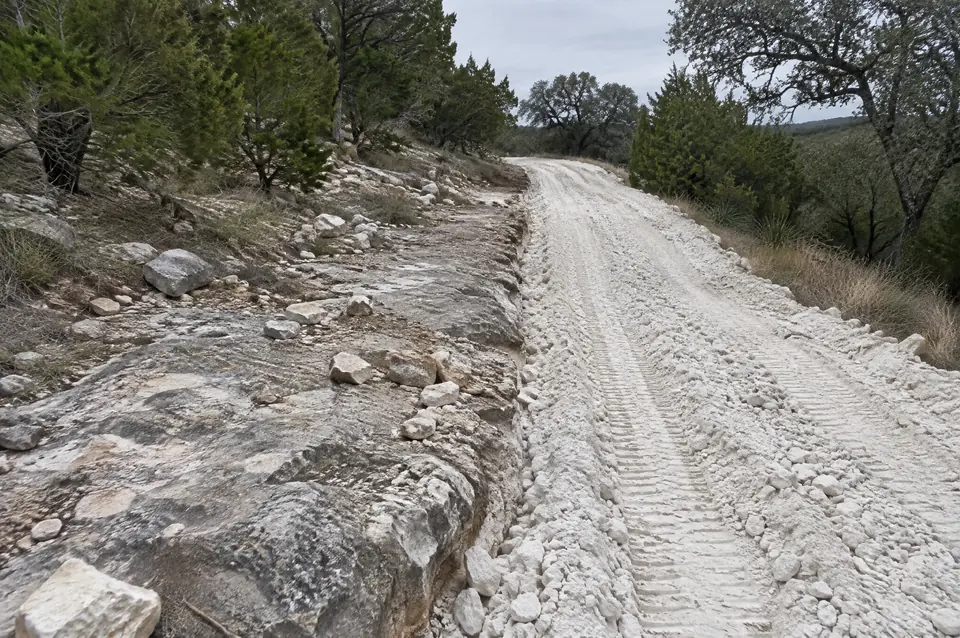

Road building permits in Texas: what applies to a private road or rock crushing job
Building a road or crushing rock disturbs soil, and that brings rules that brush clearing usually avoids. Here is what can apply in Texas and who to ask before work starts.
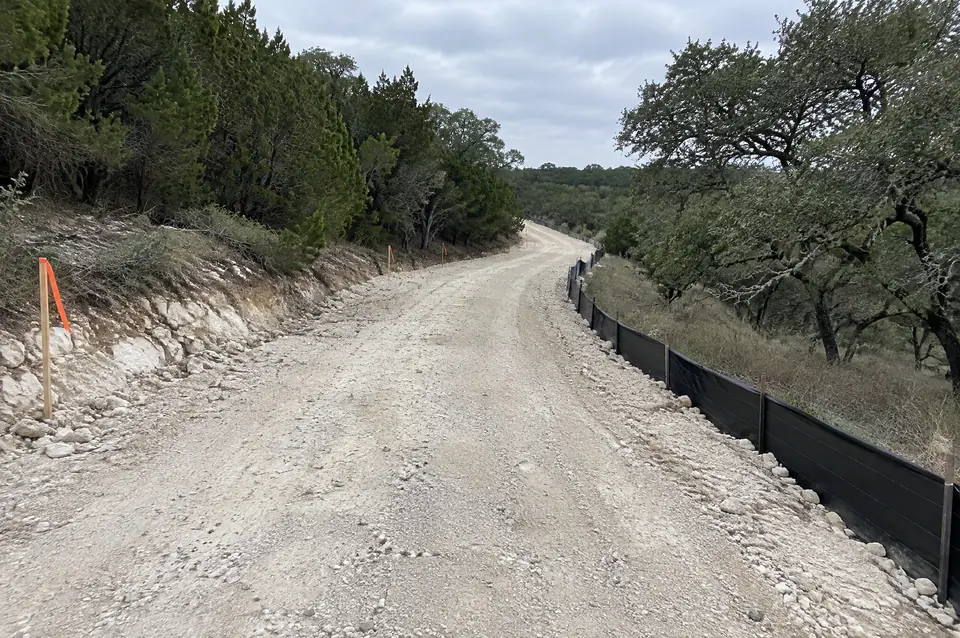
Do you need a permit to build a road on private land in Texas?
You may need permits to build a road on private land in Texas, depending on location and size. Road building on the Edwards Aquifer recharge zone generally needs a TCEQ-approved plan at any size, disturbing an acre or more brings in the TXR150000 stormwater permit, and flood-zone work needs a county permit. Confirm with each agency first.
Road building permits in Texas depend on where your land sits and how much ground the work disturbs. A road on the Edwards Aquifer recharge zone needs a state plan before work starts, an acre or more of disturbed soil brings in a stormwater permit, and creek crossings in a flood zone can need a county permit.
The common thread is soil. Cutting a road, grading or crushing rock breaks ground, and that is where most of these rules begin. This guide covers what can apply to access road building on Texas land, who to ask, and why brush clearing is treated differently. It is a summary, not legal advice.
Which road building permits in Texas can apply to private land?
Road building permits in Texas can come from TCEQ, the county, federal agencies and the Texas811 law, and nearly all of them turn on disturbing soil. TCEQ's Edwards Aquifer rules exclude "clearing of vegetation without soil disturbance" from regulated activity (30 TAC 213.3). Forestry mulching grinds brush in place and leaves soil and root balls in the ground. Rock crushing, grading and road building break ground, so they can trigger rules that mulching does not. We found no TCEQ classification of in-place rock crushing specifically, so do not assume it is exempt. Our guide to the permit to clear land in Texas covers the clearing side.
| Rule | What can trigger it | Who to ask |
|---|---|---|
| Edwards Aquifer (30 TAC 213) | Recharge zone: roads or excavation, any size. Contributing zone: 5+ acres | TCEQ regional office |
| Construction stormwater (TXR150000) | 1+ acre of disturbed soil | TCEQ stormwater program |
| Floodplain development | Grading, fill or crossings in a mapped flood zone | County floodplain administrator |
| Clean Water Act Section 404 | Fill in federal waters | U.S. Army Corps of Engineers |
| Texas811 | Mechanized digging 16+ inches deep | Texas811 |
| OSHA silica | Crews working silica-bearing rock | The employer |
| Endangered species | Warbler woodland or karst zones | U.S. Fish and Wildlife Service |
When does the Edwards Aquifer rule apply to a road?
The Edwards Aquifer rule applies to a road when the land sits on a regulated zone in one of eight counties: Kinney, Uvalde, Medina, Bexar, Comal, Hays, Travis and Williamson (30 TAC 213.21). Spring Branch is in Comal County, so many of our neighbors in Comal County land clearing and road work need to check. Kendall, Kerr and Blanco are not on the list.
On the recharge zone, TCEQ requires a Water Pollution Abatement Plan for building roads and for "clearing, excavation, or any other activities" that alter a site's topography, geology or recharge. The plan must be "approved prior to the commencement of construction," and TCEQ's WPAP page sets no minimum acreage. A site that lies partly on the recharge zone is generally treated entirely as recharge-zone land (TCEQ).
On the contributing zone, a Contributing Zone Plan applies when work disturbs 5 or more acres, or less as part of a larger plan of development or sale. Both zones exclude agricultural activities and one single-family home on a lot over 5 acres (30 TAC 213.22). No rule we found says a new ranch road counts as agricultural.
Plan on time. The TCEQ Edwards Aquifer Protection Program allows up to 30 days for administrative review and 90 days for technical review. If a cave or sinkhole opens during regulated work, nearby work must stop and TCEQ must be notified (30 TAC 213.5). Check your parcel on TCEQ's Edwards Aquifer map viewer.
When does a road need a TCEQ stormwater permit?
A road needs coverage under TCEQ's construction stormwater permit, TXR150000, when the work disturbs one acre or more, or less as part of a larger common plan (TCEQ construction stormwater). An acre adds up fast on a long road. A 12-foot-wide road reaches one acre at about 3,630 feet, a little over two-thirds of a mile.
What the 2023 general permit requires depends on size:
- 1 to under 5 acres: a stormwater pollution prevention plan, plus a signed site notice posted at least 2 days before work starts.
- 5 acres or more: the plan, plus a Notice of Intent filed with TCEQ before construction.
Two carve-outs matter on ranches. Routine grading of an existing dirt road to its original line and grade is maintenance, not construction activity. Stormwater from agricultural activities that are not point source discharges is outside the permit, though the permit's examples are crops, livestock fences and stock ponds, not roads.
The permit says the secondary operator is "often the property owner." Agree in writing with your contractor on who writes the plan and posts the notice. The current permit runs through March 5, 2028.
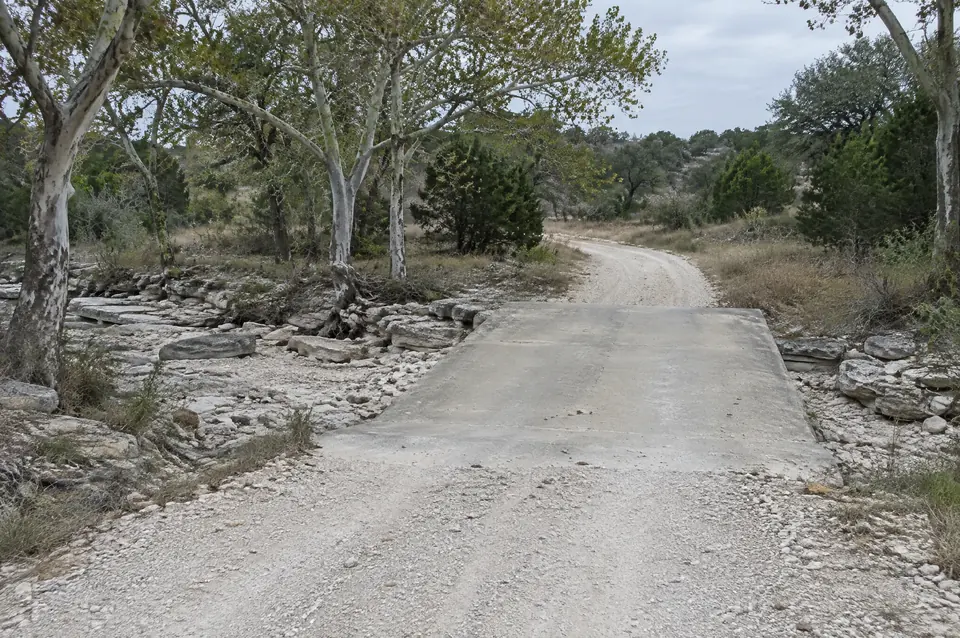
Do creek crossings need a floodplain or Section 404 permit?
Creek crossings often need a county floodplain permit when they sit in a mapped flood zone, and some need federal Section 404 review. Federal floodplain rules define development to include "filling, grading, paving, excavation" and similar work (44 CFR 59.1). Comal County issues floodplain development permits through its County Engineer's Office, Kendall County runs its flood order through its County Engineer, and Hays County requires a permit for any development, including grading and creek crossings.
Section 404 of the Clean Water Act covers fill placed in federal waters. Building and maintaining farm roads is exempt only when baseline best management practices are followed, such as keeping roads in waters to a minimum and bridging or culverting fill so it does not block flood flows (33 CFR 323.4). The exemption is lost if the work converts waters to a new use and impairs flow.
Which dry-most-of-the-year Hill Country draws count as federal waters narrowed after the 2023 Sackett ruling and is still unsettled. As of October 6, 2026, no final rule redefining federal waters had been issued, Farm Progress reported. Ask the county and the Corps before setting a crossing.
Does building a road count as excavation under the Texas811 law?
Building a road counts as excavation under the Texas811 law when mechanized equipment disturbs soil 16 inches deep or more. Texas Utilities Code §251.002 lists grading, ripping, scraping and trenching among the activities that qualify. Cutting a roadbed, digging ditches and setting culverts often go that deep.
Notice goes to 811 no later than 48 hours and no earlier than 14 days before work, not counting weekends and holidays (§251.151). A skid-steer crushing pass rated at 4 to 6 inches stays under the threshold. The deepest crushing heads, rated to about 20 inches, can go past it, which is one reason rock crushing depth matters beyond road strength.
Two gaps catch owners. Lines that serve only the owner, such as well lines, private electric runs and septic lines, are not covered and will not be marked (§251.003). Point those out before any digging. Texas law carves out some agricultural operations from the notice duty (§251.156), but do not assume a road job qualifies. Call anyway: an owner who calls keeps protection from liability if a line operator fails to mark.
What other rules apply to rock crushing on a road job?
Rock crushing on a road job also brings dust and wildlife rules. OSHA's construction silica standard sets an exposure limit of 50 micrograms per cubic meter over an 8-hour shift (29 CFR 1926.1153). For crushing machines, OSHA's listed controls are water spray at the crusher plus a ventilated booth or remote control station. For heavy equipment that fractures silica-bearing rock, the controls are an enclosed cab, plus water when others work nearby.
TCEQ requires air authorization before plant-type rock crushers operate, and its standard permit for temporary crushers sets the smaller tier at least 200 feet from property lines (TCEQ temporary crushers). Whether an in-place crushing head needs one is not confirmed, so ask TCEQ rather than assume.
Wildlife can matter too. The golden-cheeked warbler is still listed as endangered (USFWS), and one USFWS screening key uses a March 1 to August 31 breeding season. Endangered karst invertebrates live in caves in Bexar, Travis and Williamson counties, and USFWS survey protocols also screen zone extensions into Comal, Medina and Bell.
Sort out the rules before the road goes in
A site visit is the right time to flag the zones, flood maps and crossings on your land. See how we plan road building and access preparation in Central Texas, from clearing and grading to culverts.
This is a summary, not legal advice. Confirm your project with TCEQ, your county, the Corps of Engineers and Texas811 before work starts.
Sources
- 30 TAC 213.3, Edwards Aquifer definitions, Cornell Legal Information Institute
- 30 TAC 213.21, Contributing zone applicability, Cornell Legal Information Institute
- 30 TAC 213.22, Contributing zone definitions, Cornell Legal Information Institute
- 30 TAC 213.5, Required Edwards Aquifer protection plans, Cornell Legal Information Institute
- Water Pollution Abatement Plan, Texas Commission on Environmental Quality
- Edwards Aquifer Protection Program, Texas Commission on Environmental Quality
- What plans you might need, Edwards Aquifer Protection Program, Texas Commission on Environmental Quality
- Edwards Aquifer map viewer, Texas Commission on Environmental Quality
- Construction stormwater permits, Texas Commission on Environmental Quality
- 2023 Construction General Permit TXR150000, Texas Commission on Environmental Quality
- 44 CFR 59.1, Floodplain management definitions, Cornell Legal Information Institute
- Floodplain Administration, Comal County Engineer's Office
- Floodplain, Kendall County
- Development Permits FAQ, Hays County
- 33 CFR 323.4, Discharges not requiring permits, Cornell Legal Information Institute
- Public comment on new WOTUS supplemental proposal ends Oct. 9, Farm Progress (Oct. 6, 2026)
- Texas Utilities Code §251.002, definitions, Texas Public Law
- Texas Utilities Code §251.151, notice of excavation, Texas Public Law
- Texas Utilities Code §251.003, facilities not covered, Texas Public Law
- Texas Utilities Code §251.156, exceptions, Texas Public Law
- 29 CFR 1926.1153, Respirable crystalline silica in construction, Cornell Legal Information Institute
- Temporary rock and concrete crushers standard permit, Texas Commission on Environmental Quality
- Service review recommends downlisting golden-cheeked warbler, U.S. Fish and Wildlife Service (Jan. 2025)
- Golden-cheeked warbler determination key, U.S. Fish and Wildlife Service
- Karst invertebrate survey protocols (2024), U.S. Fish and Wildlife Service