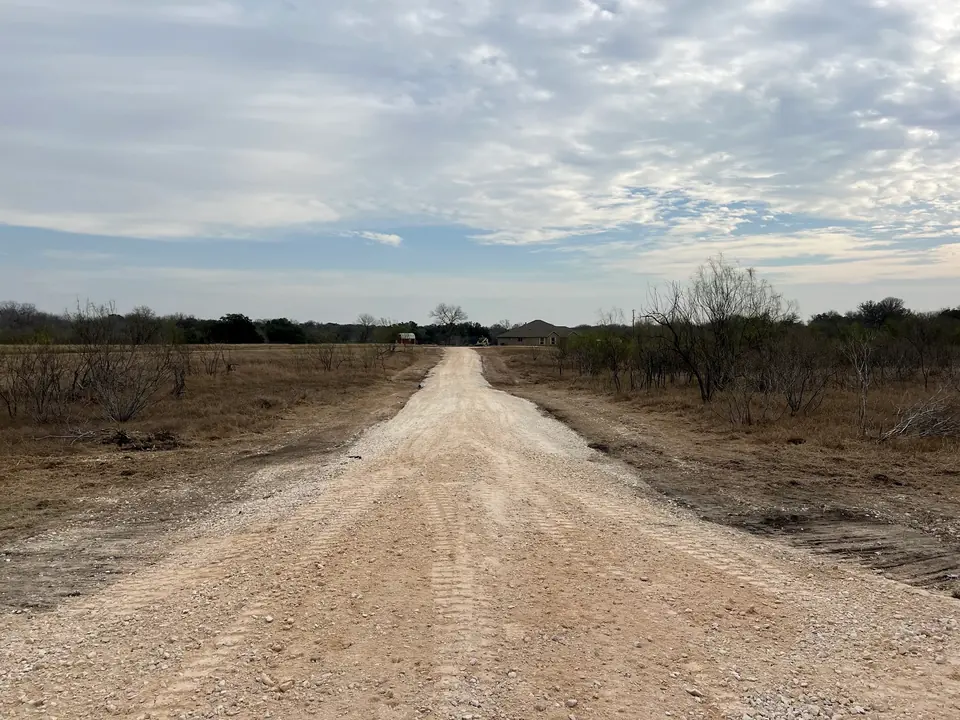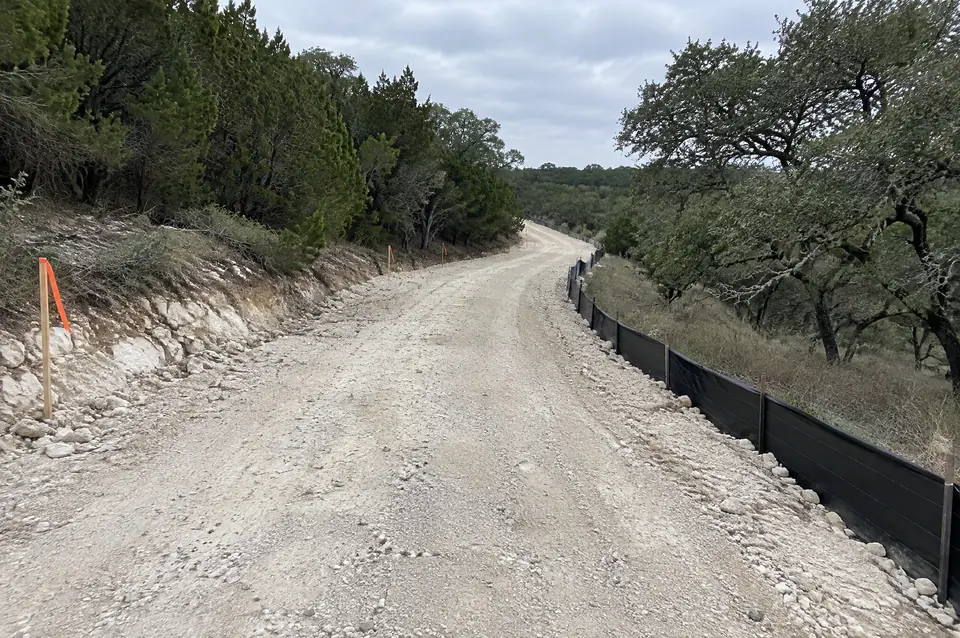

How to build a gravel driveway on Hill Country land, step by step
A gravel driveway lasts when it is built in order: clear and strip the line, firm up the subgrade, lay crushed base in thin lifts, then crown it and drain it. Here is each step.
How do you build a gravel driveway?
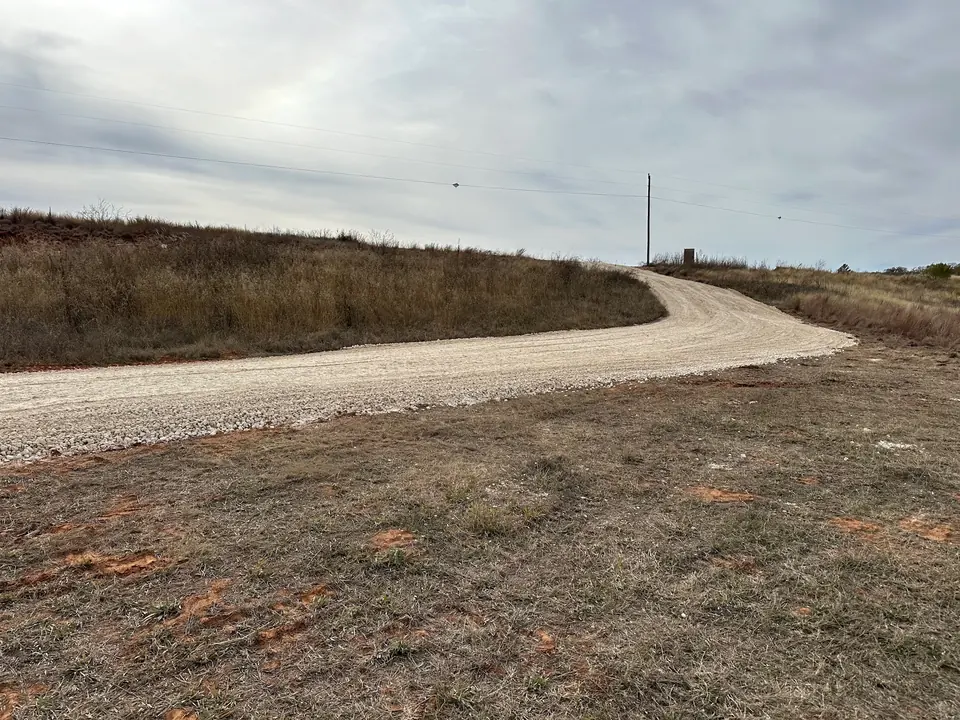
You build a gravel driveway by clearing the line, stripping topsoil and roots, compacting the subgrade and laying crushed rock base in compacted layers, generally no more than 4 inches loose each. Then you crown it about half an inch per foot, open side ditches, and set any culvert at the road under the county or TxDOT permit.
Knowing how to build a gravel driveway on Hill Country land comes down to doing the steps in order: clear and strip the line, firm up the ground underneath, lay crushed rock in thin compacted layers, then crown it and give the water somewhere to go. Skip one and the drive ruts, potholes or washes out at the road.
That order matches the sequence behind our driveway and access road building: clearing, rough and fine grading, road base, drainage and culverts. Long ranch roads add dips, crossings and steep grades, covered in our guide on how to build a ranch road.
How to build a gravel driveway, starting with the layout
To build a gravel driveway, start by walking the line and fixing its two ends: where it leaves the public road and where it stops at the house, barn or pad. Between those points, the drive should follow the ground and stay out of low spots that hold water.
The road end carries the most rules. The FHWA Gravel Roads Construction and Maintenance Guide (August 2015) says the driveway entrance should always match the edge of the public road, and the public road should keep its normal crowned shape where it passes a driveway. For driveways onto state highways, the TxDOT Roadway Design Manual calls for enough sight distance for an entering driver to slow and turn safely, and for an exiting driver to judge a safe gap in traffic.
Walk the route and flag the entrance, the road ditch it crosses, the oaks you want kept, the septic area and well, and any spot where runoff already crosses.
How do you clear and strip a driveway line?
You clear a driveway line by mulching the brush and trees on the corridor, then pulling roots, stumps and topsoil out of the strip the gravel will sit on. FHWA's construction guidelines say trees, stumps, roots, large rocks and other obstructions need to be cleared and removed.
Forestry mulching opens the corridor with no pushing, piling or burning. Our machines grind cedar, brush and trees where they stand, and the mulch can be stockpiled or hauled off if you want the line bare. On a long drive through thick cedar, our machines can follow your licensed surveyor's CAD files with Trimble GPS. We are not surveyors and do not replace one.
Mulching leaves root balls in the ground, which keeps the shoulders stable. The roadbed is different. Where the gravel goes, root balls come out by grubbing with a dozer or excavator, and we prefer to mulch them on site instead of piling them.
Then strip the topsoil. FHWA puts it plainly: "Topsoil will contain organic matter which is never good for a road surface." The same guide says saturated organic soils may have to be dug out and removed before construction begins.
How do you prepare the subgrade under a gravel driveway?
You prepare the subgrade under a gravel driveway by shaping it to grade, digging out soft spots and compacting it before any base goes down. FHWA calls compaction of material critical, and notes that sheepsfoot or pad drum rollers are good in soils that are mostly clay or fine material, while rubber tired rollers suit sandy or granular soils.
On thin Hill Country soils, the subgrade can be rock, not dirt. The USDA description of the Eckrant soil series, found on the Edwards Plateau, puts lithic bedrock 4 to 20 inches down. Where the cut reaches ledge, the job is shaping that rock so water drains off it instead of pooling in low spots along the line.
Deep clay and wet draws need more. For weak, wet soil, one solution FHWA gives is to excavate and remove it. FHWA also describes a woven or nonwoven geotextile placed on the subgrade, which "becomes a separator between the weak soil and the new material" above it. FHWA recommends at least 6 inches in the first layer over the fabric and says not to let equipment drive directly on it.
How thick should each layer of driveway gravel be?
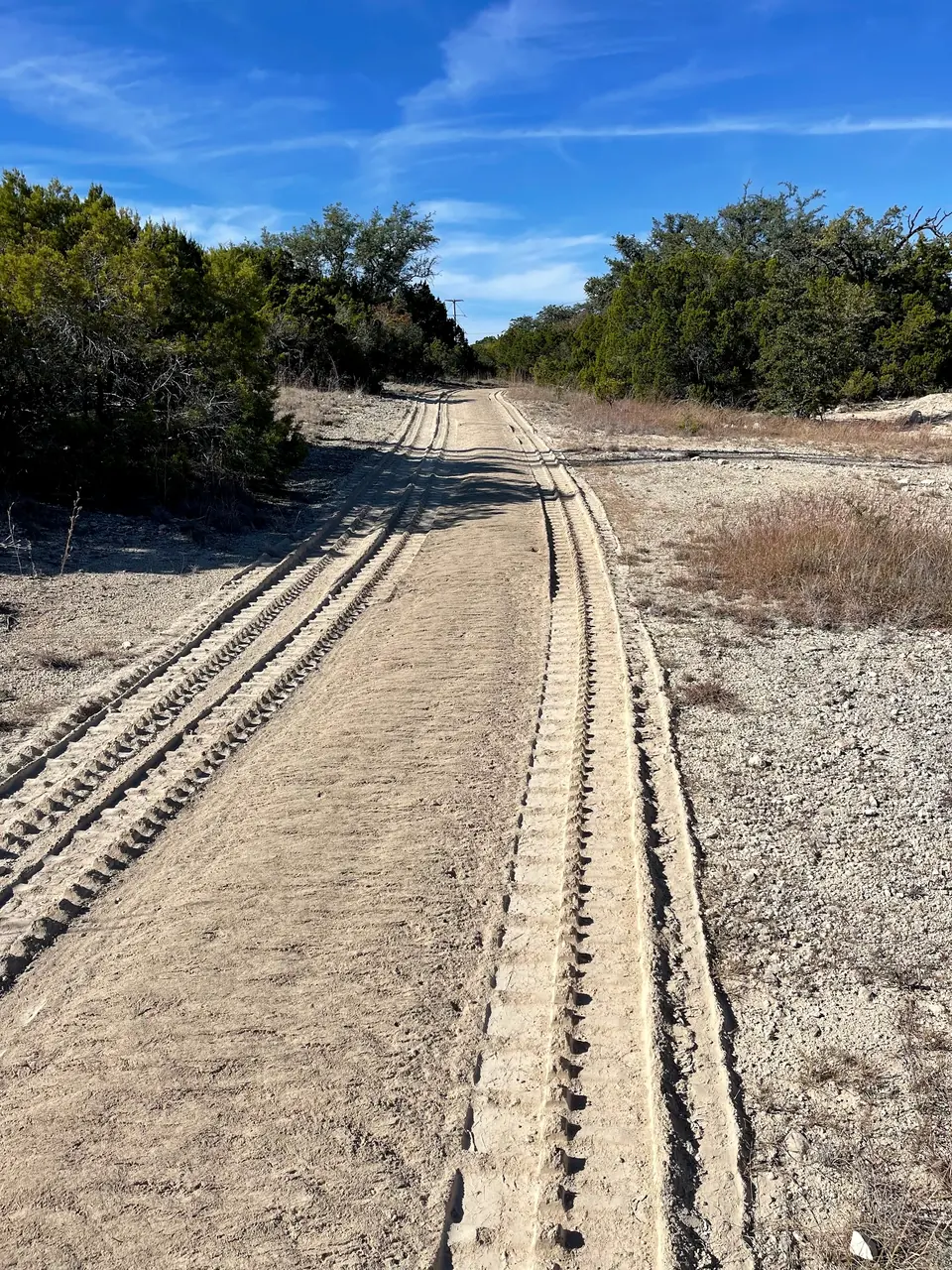
Each layer of driveway gravel should generally go down no deeper than 4 inches loose and be compacted before the next one goes on. FHWA's construction guidelines say "material shall be placed in horizontal layers" generally not exceeding a loose depth of 4 inches, and that layers up to 8 inches could be placed if larger compaction equipment is available.
Three more rules from the same FHWA guide:
- Make each layer at least twice as thick as the largest stone in it.
- Work the material to optimum moisture, hauling and applying water as needed, to get maximum density.
- Finish with a surface layer at least three inches deep, so there is enough material to blade later.
Total thickness depends on the heaviest truck the drive will carry, such as a concrete truck during the house build, not on the family car.
How do you crown and drain a gravel driveway?
You crown a gravel driveway so the center sits higher than the edges, then give the runoff side ditches or a downhill shoulder to reach. FHWA calls about 1/2 inch of crown per foot, approximately 4 percent, highly recommended, and adds: "It is not good to exceed 6 percent in any condition." On a 12-foot driveway, half an inch per foot puts the center about 3 inches above each edge, by our arithmetic.
FHWA says standing water anywhere in the road's cross section, including the ditch, is one of the major reasons roads fail. Keep side ditches open, with a clear outlet at the low end.
At the public road, the drive has to cross the road ditch without blocking it. Comal County's driveway permit application says drainage in roadway side ditches "shall not be altered or impeded" (PIPROW application), and TxDOT's Access Management Manual says a driveway must not impede the flow of water away from the highway. Where the ditch carries real flow, that means a culvert set on the ditch flow line, sized by the road office.
What permit does a driveway onto a county road or highway need?
A driveway onto a county road or state highway needs a permit from the office that owns that road, issued before any work in the right of way. Here is what the published rules say in a few places around the Hill Country:
| Road the driveway joins | Who to ask | What the published rules say |
|---|---|---|
| County road, Comal County | Comal County Engineer's Office | PIPROW permit first; on-site meeting with the Right-of-Way Inspector; build to the Driveway Detail Standard; final inspection |
| County road, Kendall County | Kendall County Access Coordinator | Access (Driveway) Permit before building or changing a driveway; address and access permit come before development, septic and well permits |
| State highway | Local TxDOT district office | Permit to construct access driveway facilities; 24-hour notice to TxDOT; TxDOT inspection |
| City street, Bulverde | City of Bulverde | Right-of-way permit form calls for TxDOT Item 247 Grade 1 flex base at least 4 inches thick, compacted to 95 percent, in the city right of way |
Two details catch owners. TxDOT requires driveways in highway right of way to be paved with a stabilized all weather surface acceptable to TxDOT, to prevent tracking mud onto the highway, though it may approve an exception. And Comal County's application makes the applicant responsible for construction and maintenance of the improvement.
Building the drive itself can bring in other rules, from stormwater to Texas811, and our guide to road building permits in Texas covers them. Confirm with the office that owns the road before work starts. This is general information, not legal advice.
Can you build a gravel driveway from the rock on your land?
You can often build a gravel driveway from the rock already on your land, because on-site crushing turns surface rock into road base where it lies. Our crushing heads and attachments process existing surface rock into a fine, compactible road base, broken down to a fine, consistent grade, with no imported material. 9 Arrow runs a large, dedicated rock crushing machine built to work far deeper than the skid-steer attachments most crews use. As far as we know, no other crew in the Hill Country runs one. See how on-site rock crushing works.
Two honest limits apply. Rock crushed on site is not certified spec material, so where a permit calls for TxDOT Item 247 base in the right of way, plan on tested base for that apron unless the office accepts otherwise. And some ground has little usable rock to crush. Our crew is based in Spring Branch and works into Kendall County, including land clearing around Boerne.
Plan your driveway before the first cut
A site walk settles the entrance, the route, the rock and the drainage before any machine starts. See how our driveway and access road building handles each step, from clearing the line to setting the culvert.
Sources
- Gravel Roads Construction and Maintenance Guide (August 2015), Federal Highway Administration
- Roadway Design Manual, 16.2 General Design Guidelines, Texas Department of Transportation
- Eckrant series, Official Soil Series Description, USDA Natural Resources Conservation Service
- PIPROW Permit Application (revised January 2021), Comal County Engineer's Office
- PIPROW Permit, Comal County Engineer's Office
- Access Management Manual, Drainage, Texas Department of Transportation
- Access Management Manual, Permits, Texas Department of Transportation
- Access Management Manual, Section 4: Driveway Permits, Design, and Materials, Texas Department of Transportation
- Access/Driveway Permit, Kendall County
- Application for Permit to Construct Access Driveway Facilities (form dated 10.26.2018), City of Bulverde