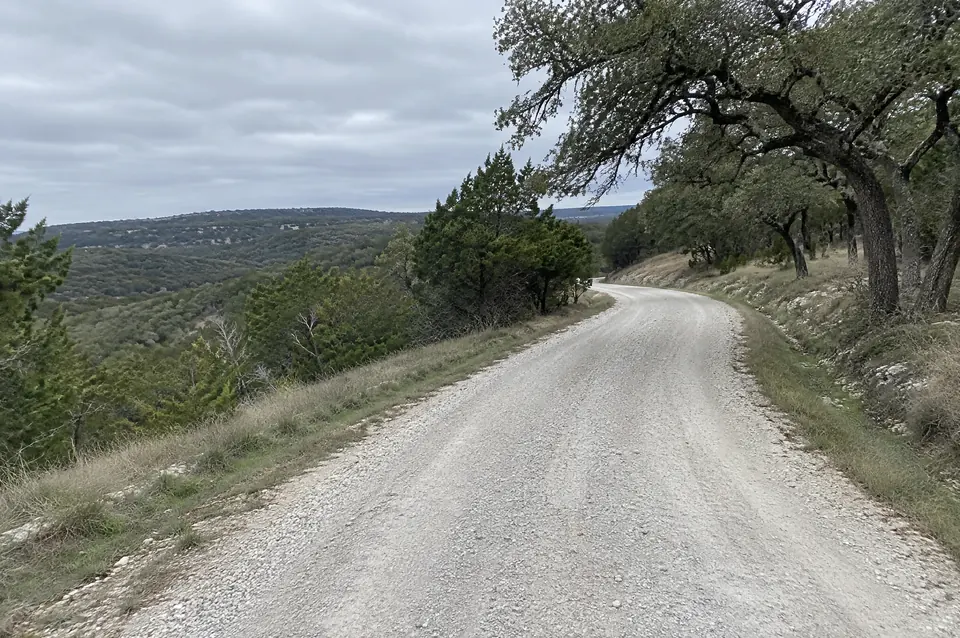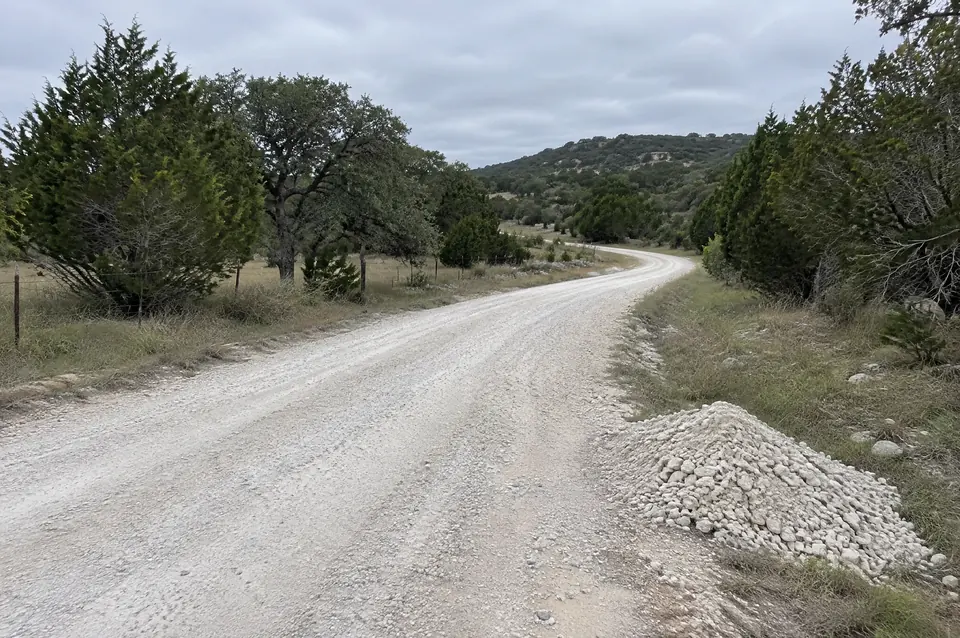

How long does a gravel road last on Texas ranch land?
A gravel road lasts in two layers: a base that can go a decade or more and a surface that wears out in 5 to 10 years. Here is what decides both, and how to fix what fails.
How long does a gravel road last?
A gravel road lasts a decade or more at the base and about 5 to 10 years at the surface, as long as water stays out. In one FHWA case, a rebuilt gravel road needed no foundation repair for 12 years. The driving surface needs blading and re-topping. We found no agency that publishes an official service life.
How long does a gravel road last? The base of a well-drained, compacted gravel road can go a decade or more without structural repair, while the driving surface wears away and needs re-topping about every 5 to 10 years. We found no federal or Texas agency that publishes an official service life, so those numbers come from field cases and road engineers. Drainage, fines and compaction decide both, and they are the backbone of our access road building in Texas.
Here is what makes a crushed rock road last, how gravel roads fail, how to fix them and how much upkeep to expect.
How long does a gravel road last, base and surface?
A gravel road lasts in two layers with very different lives. The structural base can last a decade or more if it stays dry. The wearing surface on top is consumable and needs blading and periodic re-topping.
The base can outlast expectations. In a case documented in the FHWA Gravel Roads Construction and Maintenance Guide (2015), a road rebuilt with 10 inches of compacted gravel over geotextile fabric went 12 years without its foundation ever being repaired, with only surface maintenance. Texas research agrees that dry base holds up. Standard TxDOT Item 247 bases "perform very well as long as they are kept dry," according to the Texas Transportation Institute (2007), and fail fast once water gets in.
The surface wears out on a shorter clock. A 2022 presentation by road consultant Steve Monlux put surface gravel life at about 10 years for good gravel versus about 5 years for typical gravel (NDACE County Roads Conference, 2022). On busy roads carrying 100 or more vehicles a day, the good gravel also needed about 2 blade jobs a year versus about 10.
The standard "ideal" gravel road stacks 6 to 12 inches of coarse, low-fines base under at least 3 inches of surface gravel (Skorseth, South Dakota LTAP, 2008). We found no Texas agency service-life data for limestone ranch roads, so treat any single number as a rough guide.
Why does drainage decide how long a gravel road lasts?
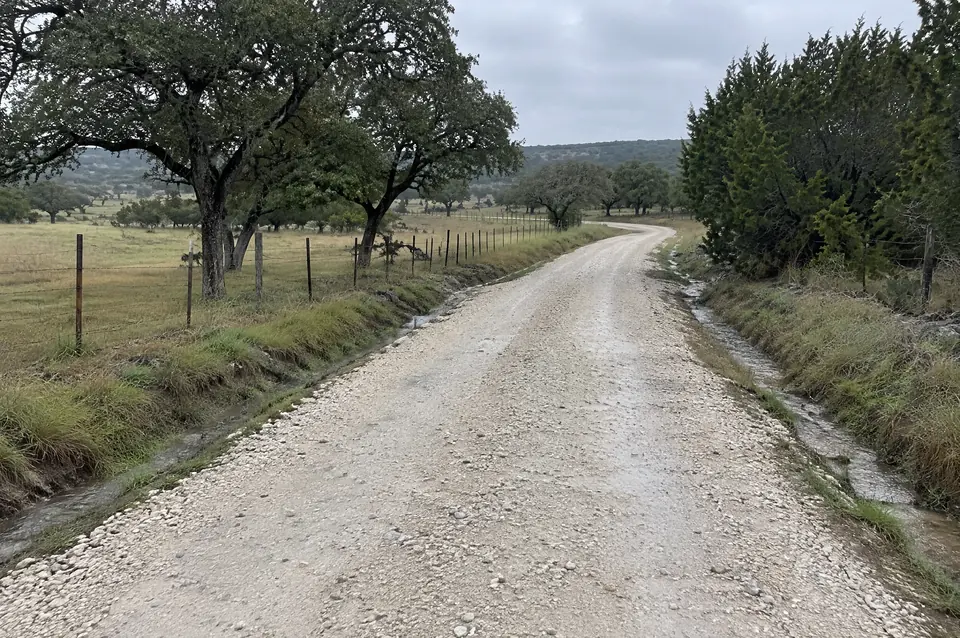
Drainage decides how long a gravel road lasts because water is what ruins the base. A gravel road that sheds water keeps its base dry and firm. A gravel road that holds water softens, ruts and potholes.
Crown comes first. FHWA recommends about 1/2 inch of crown per foot, roughly 4 percent, and warns: "It is not good to exceed 6 percent in any condition." Measure crown instead of eyeballing it. On a South Dakota test road, crown specified at 4 percent never measured above 3 percent once graded (South Dakota surface gravel study, 2022).
Water also has to get off the road at intervals. Texas forestry best management practices space broad-based dips about every 300 feet on a 2 percent grade, 200 feet at 4 percent, 150 feet at 8 percent and 130 feet at 12 percent, and do not use them on steeper grades (Texas Forestry BMPs, 2004). The same guide's culvert chart starts at 18 inches, with cover of at least half the pipe diameter and never less than 1 foot.
Ditches and culverts only work while they stay clear, so check them after big storms. For the full build sequence from route to culverts, see our guide on how to build a ranch road.
What keeps crushed rock from breaking down on a road?
Crushed rock holds together on a road when the base is low in fines, the surface has enough fines and binder, and both layers are compacted at the right moisture.
- Base fines. Texas Transportation Institute research found "fines contents of 5 to 10 percent appear to be optimum" for typical Texas base, yet many Texas bases run above 20 percent (TTI, 2007).
- Surface fines and binder. The FHWA guideline for surface gravel calls for 4 to 15 percent passing the No. 200 sieve with a plasticity index of 4 to 12 (Jones, UC Pavement Research Center, 2016). FHWA notes that base gravel, with its larger stone and few fines, will not form a crust as a driving surface.
- Proof from the field. On a South Dakota test road after harvest traffic in 2012, uncontrolled gravel had about 405 tons per mile of loose aggregate on the surface against about 71 tons on gravel with at least 10 percent fines and a plasticity index of 7 or more. The uncontrolled section needed up to four bladings to the spec section's one.
- Compaction. TxDOT Item 247 requires base compacted to at least 100 percent of lab maximum dry density within 2 points of optimum moisture, and adds: "Do not achieve density by drying the material after compaction" (TxDOT Item 247, 2024).
For Hill Country owners, the takeaway is two layers: strong crushed limestone base, capped with a surface that has enough fines to bind. Our post on crushing your own rock vs hauling in road base covers where that material can come from.
What makes a gravel road fail, and how do you fix it?
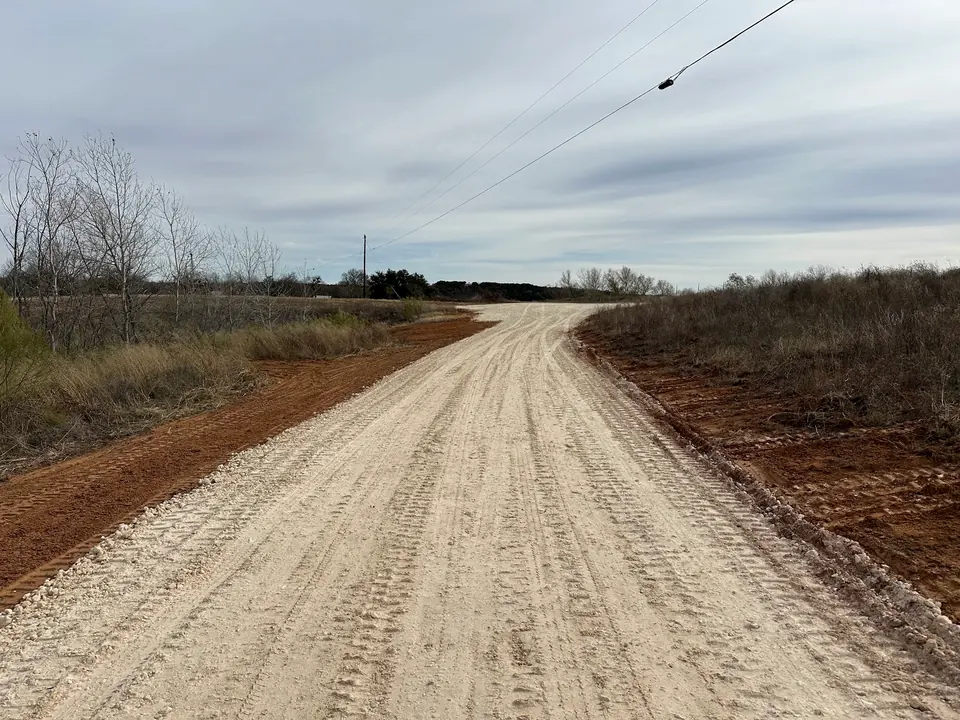
Most gravel road failures trace back to water, poor gravel or heavy loads on wet ground. Minnesota's local roads program puts it plainly: "About half of all problems on gravel roads are caused by poor gravel" (MnLTAP, 2006).
| Problem | Usual cause | Fix |
|---|---|---|
| Washboarding | Driving habits, dry weather, poor gravel, too little crown | Rework when moist, cut at least 1 in below the ridges, add binder, roll |
| Potholes | Water standing on a flat surface or lost crown | Restore about 4% crown, cut below the hole depth, re-lay and compact |
| Ruts | Water in the base, heavy loads on wet ground | Fix drainage, reshape the full cross-section, add base where it is thin |
| Loose rock and raveling | Fines lost to traffic and dust | Top with a fines-rich, slightly plastic surface course |
| Washouts | Too few dips, turnouts or culverts | Add drainage at BMP spacing and armor the outlets |
Blading technique matters as much as material. FHWA says good blading work is nearly impossible above 3 to 5 mph, calls for a moldboard angle of 30 to 45 degrees, and names spring, when gravel is moist, as the best time to reshape. The Texas forestry guide calls for reworking a road when ruts average more than 6 inches deep over more than 50 feet. At that point the problem is in the base, and blading the surface will not fix it.
How much upkeep does a gravel road need?
A gravel road needs light blading through the year, a reshape when the crown flattens, fresh surface material every several years and clear culverts. Traffic sets the pace. An Iowa study cited in Wisconsin Transportation Bulletin No. 13 (1997) found that one vehicle driving an unpaved road once a day for a year produces about one ton of dust per mile. By that rule, a quarter-mile ranch drive with 10 trips a day loses roughly 2.5 tons of fines a year, by our arithmetic.
Dust control slows the loss. The same bulletin reports that dust control can cut aggregate loss by 25 to 75 percent, and that chloride treatments such as calcium chloride typically last 6 to 12 months. MnLTAP adds that dust control works best with a 4 percent crown and good surface gravel.
A simple upkeep calendar for a crushed rock road:
- After big storms: check culverts, ditches and dips, and clear debris.
- Spring: reshape and roll while the gravel is moist.
- Through the year: blade lightly when washboard or potholes start.
- Every several years: re-top the surface course where fines and stone have worn away.
On Hill Country land, re-topping material can come from the rock already on the property through on-site rock crushing. Our crew is based in Spring Branch, and our road builds start by opening the route with the same machines behind our land clearing in Spring Branch. Every road we build is graded with proper crown and drainage to carry heavy equipment and truck traffic through changing weather.
Build the road to last from day one
Most of a gravel road's life is decided the day it is built: crown, drainage, base thickness and compaction. See how our ranch road and access road building handles each one.
Sources
- Gravel Roads Construction and Maintenance Guide (2015), Federal Highway Administration
- Materials, specifications and construction techniques for high performance flexible bases, Project Summary 0-4358-S (2007), Texas Transportation Institute
- Gravel basics (Monlux, 2022), NDACE County Roads Conference, Upper Great Plains Transportation Institute
- Unpaved road maintenance (Skorseth, 2008), South Dakota Local Transportation Assistance Program
- Surface gravel study update (2022), South Dakota DOT and SDLTAP, Upper Great Plains Transportation Institute
- Texas Forestry Best Management Practices (2004 reprint), Texas Forest Service, Texas Forestry Association and Texas State Soil and Water Conservation Board
- Making Better Gravel Roads (Jones, 2016), University of California Pavement Research Center
- Item 247, Flexible Base (2024 Standard Specifications), Texas Department of Transportation
- Gravel road maintenance: meeting the challenge (2006), Minnesota Local Technical Assistance Program
- Dust control on unpaved roads, Wisconsin Transportation Bulletin No. 13 (1997), Wisconsin Transportation Information Center