
How long does land clearing take on a Texas lot, tract or ranch?
How long does land clearing take? Forestry mulching runs about half an acre to three acres a day by machine. Here is what slows it down and how lots and ranches add up.
How long does land clearing take?
Land clearing takes about one to two machine days per acre on a compact track forestry mulcher, which clears roughly half an acre to one acre a day. Large high-horsepower mulchers clear about one to three acres a day in reasonable tree cover. Density, tree size, slope, rock, access and selective work set where a job lands.
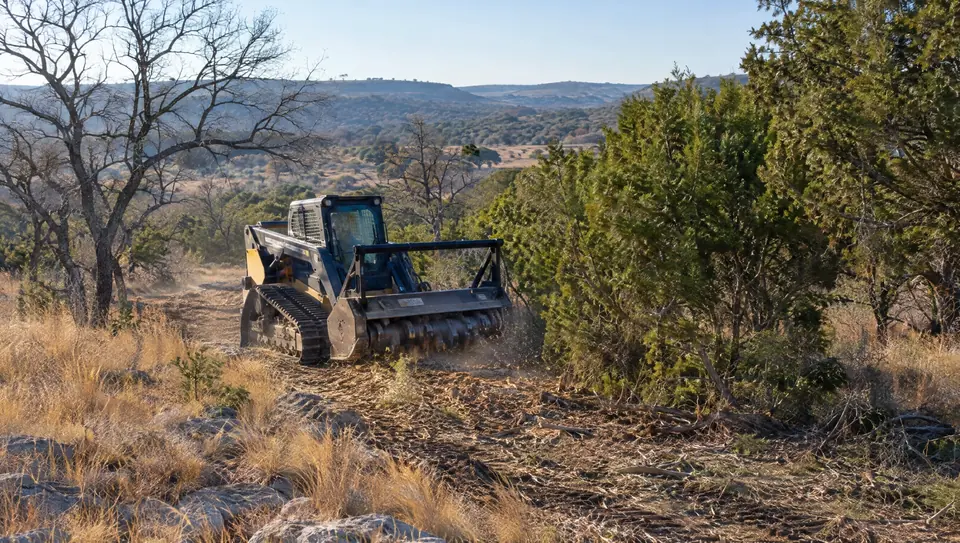
How long does land clearing take? On most Central Texas ground, forestry mulching clears about half an acre to one acre per 8-hour day on a compact track machine, and about one to three acres per day on a large high-horsepower machine. That puts a one-acre lot at a day or two of machine time and a 40-acre pasture at several weeks.
Density, tree size, slope, rock and access move every job along that range. This guide walks through the numbers we use when we schedule land clearing in Central Texas, what slows a job down, and what has to happen before the first tree comes down.
How many acres a day can a forestry mulcher clear?
A forestry mulcher clears anywhere from half an acre to several acres a day, depending on the machine class and the brush. These are the production ranges we plan around.
| Machine class | Typical pace | Best fit |
|---|---|---|
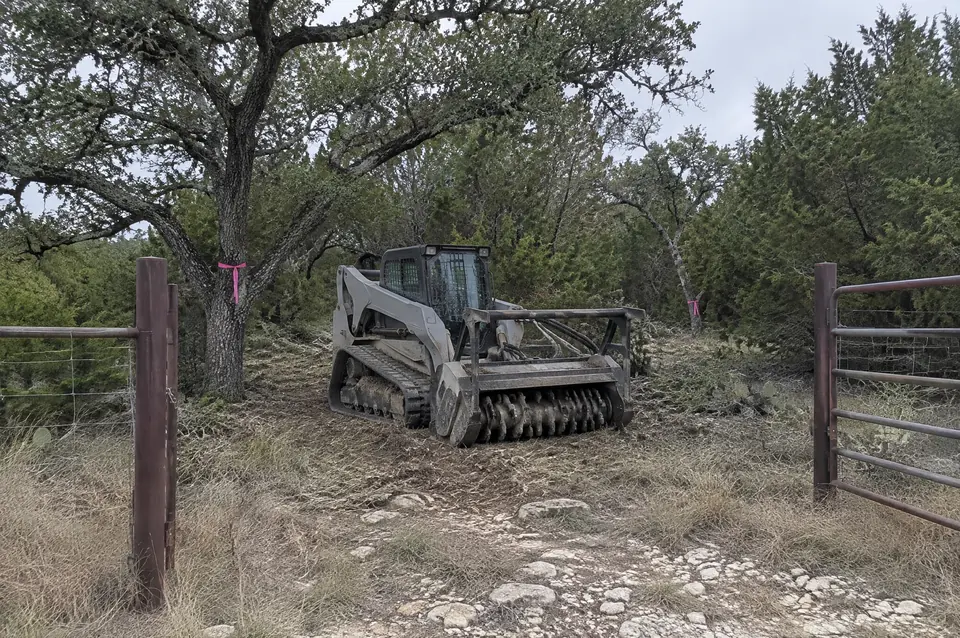
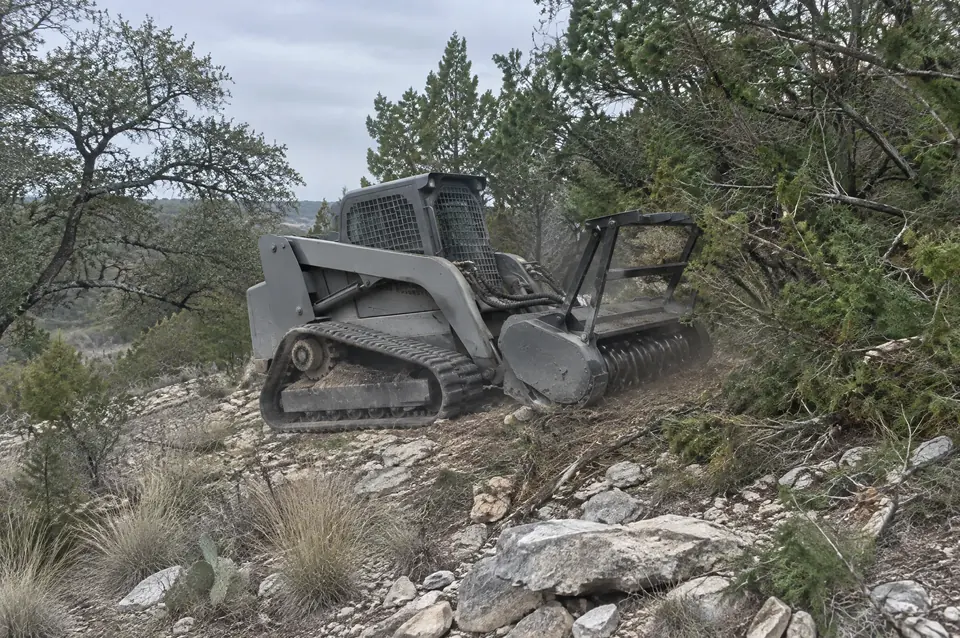
| Compact track machine | About 0.5 to 1 acre per 8-hour day | Tight access, slopes, home sites, selective work |
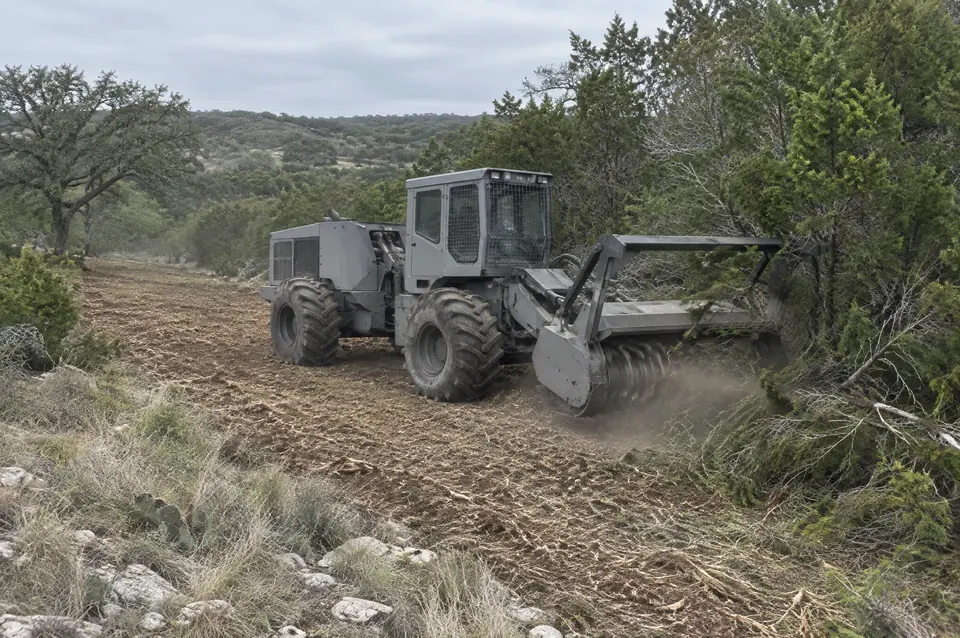
| Large articulated wheel machine | About 1 to 3 acres per day in reasonable tree cover | Larger tracts, big trees, mass clearing |
| Large machine in light brush | Up to about 5 acres per day | Open ground with light regrowth |
Tree size shifts the pace as much as acreage does. There is no tree size limit on what we mulch, but a tree that takes an hour on a smaller machine can take as little as 15 minutes on a large one. That is why the machine choice is part of every estimate.
Some land needs less than a mulcher. For tall grass and light brush, mowing with agricultural equipment may be all the property needs.
What slows land clearing down?
Land clearing slows down when there is more material per acre, harder ground to work, or more care needed around what stays. These are the usual causes.
- Density. A thick cedar break carries far more wood per acre than scattered regrowth.
- Tree size and species. Large hardwoods take longer than light brush.
- Slope and rock. Much of the Hill Country has thin soil over limestone. The Eckrant soil, an extensive series on the Edwards Plateau, reaches limestone bedrock at 4 to 20 inches, according to its USDA official soil series description. Ledges and loose rock slow machines and wear down mulcher teeth.
- Access. Narrow gates, creek crossings and tracts with no road in add time.
- Selective work. Clearing around flagged oaks and shade trees takes longer than an open sweep.
- Wet ground. Soft clay ruts and bogs machines.
- Extra scope. Old brush piles, grubbing and pad work each add their own time.
How long does land clearing take on a lot, acreage or ranch?
Land clearing takes from a day on a small lot to several weeks on a ranch pasture, based on the paces above. These sample timelines count machine days of mulching only, with one machine working 8-hour days.
| Project | Likely machine | Machine days for clearing |
|---|---|---|
| 1-acre home lot, moderate cedar | Compact track | About 1 to 2 days |
| 10-acre tract, mixed cedar and oak | Large wheel machine | About 3 to 10 days |
| 40-acre ranch pasture, reasonable cover | Large wheel machine | About 13 to 40 days |
| 40-acre pasture, light regrowth | Large wheel machine | About 8 days at up to 5 acres a day |
These ranges leave out weather days, grubbing, pad work, roads and brush piles. A 10-acre tract with tight access may call for a compact machine, which stretches the timeline. Sloped, rocky or heavily selective work lands at the long end, and open ground lands at the short end.
Speed still has to come with care. Ashley Cooke, whose 20 acres in Bulverde we cleared, wrote in a Google review, "They got the job done fast," and noted "the care and attention they took." See more about our land clearing in Bulverde.
What has to happen before clearing day?
Several steps come before the first tree comes down, and some carry their own waiting periods.
- Discovery call and site visit. We talk through your goals, acreage, access and keeper trees, then walk the land when needed.
- Estimate. You get a number by the day or by the acre before work starts.
- Flagging and corners. Mark keeper trees, and have property corners found or marked by your surveyor.
- 811 for any digging. Texas law treats mechanized work that disturbs soil 16 or more inches deep as excavation, and notice must reach the one-call center at least 48 hours ahead, not counting weekends and holidays (Tex. Util. Code 251.151).
- Edwards Aquifer plans, if they apply. On the recharge zone, soil-disturbing work needs a TCEQ plan approved before it starts. The TCEQ Edwards Aquifer Protection Program allows up to 30 days for administrative review and 90 days for technical review. Clearing vegetation without soil disturbance is excluded (30 TAC 213.3). Confirm your parcel with TCEQ before work starts.
- Oak timing. To limit oak wilt, the Texas A&M Forest Service says "pruning or wounding trees should be avoided from February through June." Work close to keeper oaks may wait for summer or winter.
Before choosing a crew, our guide on how to choose a land clearing contractor lists the questions to ask.
How does weather change a land clearing timeline?
Weather changes a land clearing timeline mostly through rain and heat. Wet clay ruts under heavy machines, so a big storm can cost a few days. In San Antonio, the 1991 to 2020 seasonal normals published by the National Weather Service put fall rain at 9.71 inches and spring at 9.13 inches, against 7.84 inches in summer and 5.70 inches in winter. Spring and fall jobs deserve a few weather days in the plan.
Summer brings firm ground and fire risk. The Texas A&M Forest Service reports that equipment use and careless debris burning account for 50 percent of Texas wildfires, and its equipment use guidance advises against mowing during the hottest, driest part of the day. Crews working in summer watch heat, wind and dry grass.
Burn bans do not stall forestry mulching, because nothing gets burned. For a season-by-season look, read our guide to the best time to clear land in Texas.
How soon can you use land after clearing?
Land is usable as soon as the mulcher leaves. There are no piles to burn or haul, and a fine finish, the small material we call toothpicks or hamster chips, is easy to walk and drive over.
Grass is the slower part. Under a light layer of mulch, grass can green up within days after a good rain. Under a heavy layer, up to 12 inches deep, grass can take two to three years to push through. If you need open ground sooner, the mulch can be stockpiled or hauled off.
Time the clearing to what comes next. If you plan to sell, clearing ahead of listing gives grass time to recover before photos and showings. If you plan to graze, clearing before spring lets the grass use the rain.
Building sites take one more step. Grubbing the foundation footprint, cutting a pad and trenching utilities follow the clearing on their own schedule, so tell us about the builder's start date during the discovery call.
Get a timeline for your land
The fastest way to a real schedule is a site walk. Start with a discovery call for land clearing services in Central Texas, and we will lay out the machine, the days and the weather plan for your property.
Sources
- Eckrant Series, Official Soil Series Description, USDA NRCS
- Texas Utilities Code Section 251.151, Notice of Excavation, Texas Public Law
- Edwards Aquifer Protection Program, TCEQ
- 30 TAC 213.3, Edwards Aquifer definitions, Cornell Legal Information Institute
- Prevent the spread of oak wilt in Texas, Texas A&M Forest Service, February 2025
- San Antonio Area Precipitation Records, National Weather Service Austin/San Antonio
- Equipment Use, Texas A&M Forest Service