
How to choose a land clearing contractor you can trust with your land
How to choose a land clearing contractor comes down to scope, equipment, finish, insurance and rules know-how. Here are the questions to ask and the red flags to skip.
How do you choose a land clearing contractor?
You choose a land clearing contractor by matching the crew's equipment and method to your land, then getting a written estimate that spells out scope, finish, trees kept, root balls and debris. Verify insurance, ask how the crew handles burn rules, Texas811 and oak wilt timing, and skip anyone pressing for full payment upfront.
How to choose a land clearing contractor comes down to five checks: the right machine for your ground, a written scope you can compare, a finish you have seen with your own eyes, insurance you have verified, and real knowledge of Texas clearing rules. Price matters, but only after two bids describe the same work.
We are a family-owned crew based in Spring Branch, and land clearing in Central Texas is what we do every day, from land clearing in Spring Branch to ranches across the Hill Country. Here is what we would ask if we were the ones hiring.
How to choose a land clearing contractor: the questions to ask
The best questions to ask a land clearing contractor are about method, scope and finish, not just price. Ask every crew the same list so the answers line up.
- What machine will you bring, and why does it fit my land?
- How many acres a day do you expect on my brush and terrain?
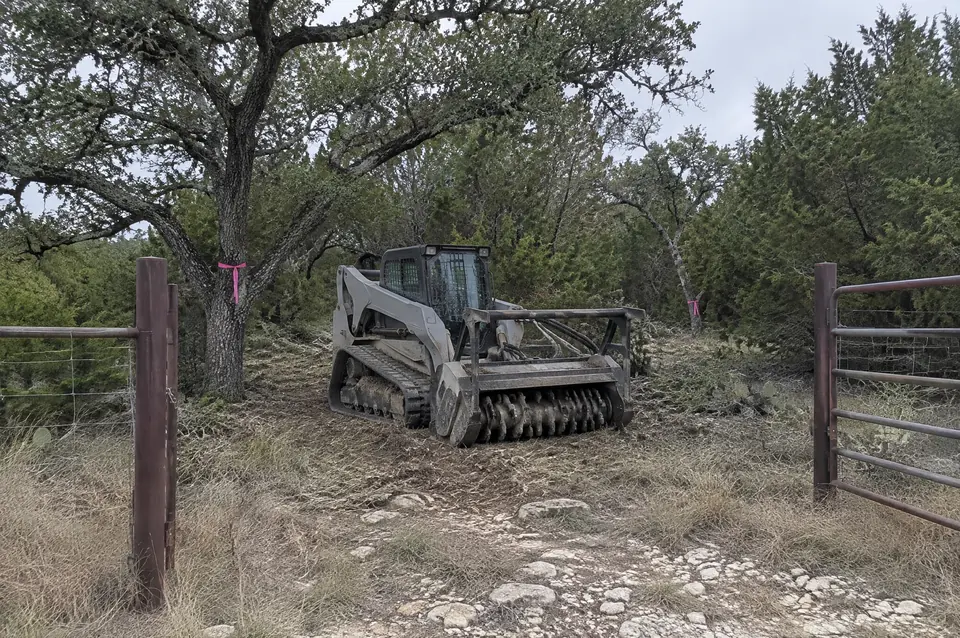
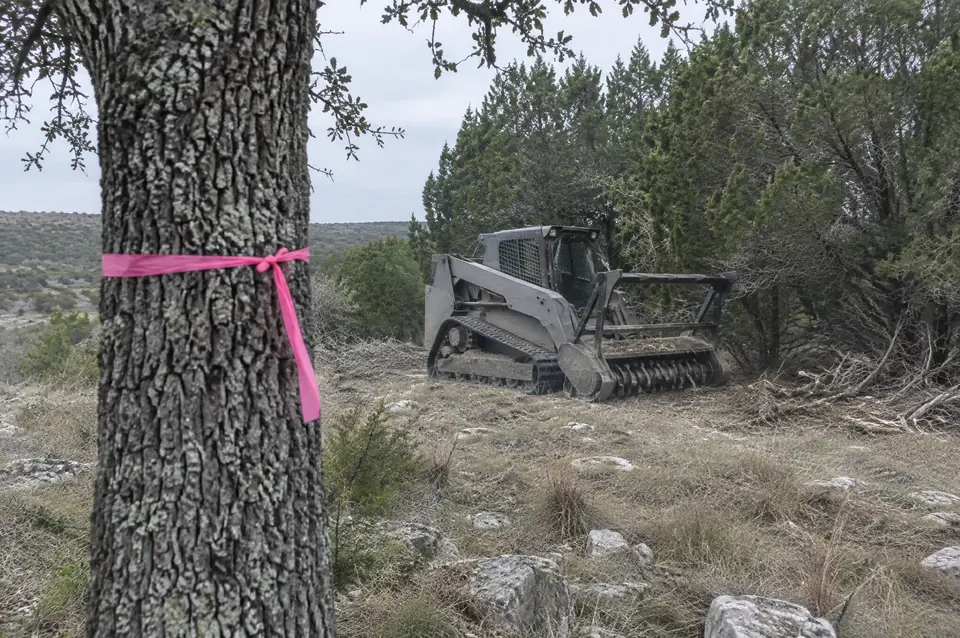
- Which trees stay, and how will we mark them?
- Will root balls stay in the ground or come out?
- What happens to existing brush piles and to the mulch?
- What will the ground look like the day you leave?
- Who contacts 811, and how will we find my private lines?
- Can I see finished jobs or talk to past customers?
The Texas Attorney General gives the same core advice for repair and clean-up work in a 2019 consumer alert: get more than one estimate, and ask for referrals and references.
Good answers are specific. A contractor who cannot name the machine, the keeper trees and the finish has not looked closely at your land. Communication matters as much as horsepower. One customer, Travis Roberson, wrote in a Google review that our crew has "Talented operators that listen and communicate well."
What should a written land clearing estimate include?
A written land clearing estimate should describe the work closely enough that another contractor could bid the same job. The Attorney General's alert advises consumers to get everything in writing, including warranty terms.
| Estimate item | What to look for |
|---|---|
| Pricing basis | By the day or by the acre, and what each includes |
| Area | Acreage, boundaries and how the lines are marked |
| Method | Forestry mulching, grubbing, or both, and where |
| Trees kept | Which trees stay and how they are flagged |
| Root balls | Left in place, or removed in set footprints |
| Brush piles and mulch | Ground in place, spread, stockpiled or hauled |
| Finish | What the ground looks like when the crew leaves |
| Extra work | Pads, driveways, roads, culverts or rock crushing |
Ask what the estimate leaves out, too, so nothing about gates, fences or mulch haul-off turns into a surprise later.
At 9 Arrow, every estimate is shown by the day or by the acre after a discovery call and, when needed, a site visit. For what drives the number itself, read our guide to land clearing cost in Texas.
Does the contractor's equipment fit your land?
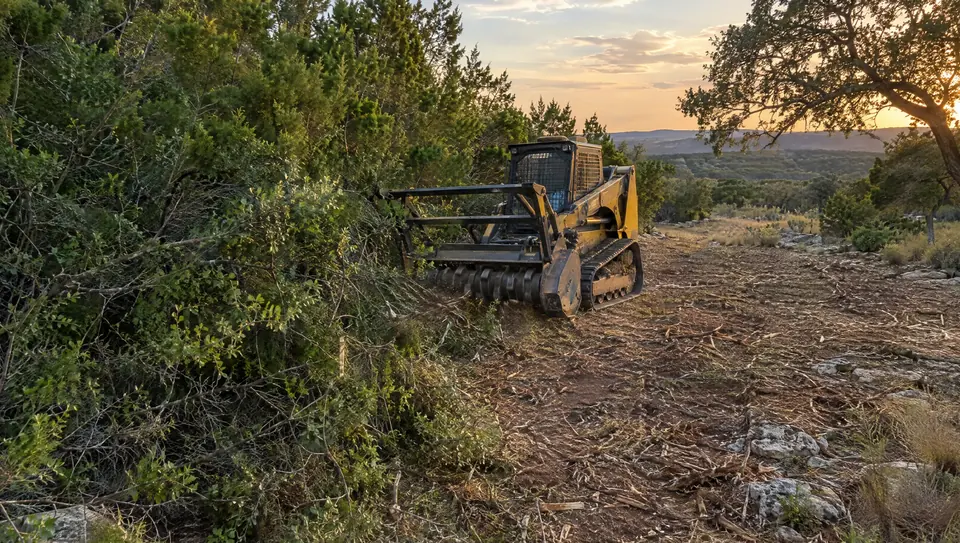
A land clearing contractor's equipment should match your access, slope, tree size and acreage. Compact track machines handle tight gates, slopes, home sites and selective work around keeper trees. Large articulated wheel machines bring the horsepower for big tracts and big trees.
Pace follows the machine. Our smaller compact track machines clear about half an acre to one acre in an 8-hour day. Our larger machines clear about one to three acres a day with reasonable tree cover. A tree that takes an hour on a smaller machine can take as little as 15 minutes on a large one.
Ask what the finish looks like, then ask to see it. A fine finish leaves small material, the kind we call toothpicks or hamster chips. Ground finished that fine is easy to drive over and lets grass come back faster. A rough pass leaves stubs and splinters that someone has to clean up later.
If the work follows property lines or a future road, ask whether the crew can follow your surveyor's data. We mount Trimble GPS receivers on our mulchers and load the licensed surveyor's CAD files for survey line clearing. We are not surveyors and do not replace one.
What insurance should a land clearing contractor carry?
A land clearing contractor should carry liability insurance and be able to show how injured workers are covered. Texas law makes that second point worth asking about. The Texas Department of Insurance says "Texas allows private-sector employers to forgo buying workers' compensation insurance," and its 2024 biennial report found 24 percent of Texas employers were nonsubscribers. The same report found 13 percent of Texas employees worked for a nonsubscriber.
Heavy machines work near fences, wells, power lines and neighbors' property, so ask for a current certificate of insurance. Read the coverage types, limits and dates, and call the insurer listed to confirm the policy is active. If the contractor brings in subcontractors or rented operators, ask whether the same coverage applies to them. Then ask your own insurance agent what your policy covers if someone gets hurt on your land.
Does the contractor know Texas land clearing rules?
A good land clearing contractor knows the rules that apply to your property and tells you which ones to confirm with the agency. Listen for clear answers on four points.
- Burning. TCEQ allows land clearing debris to be burned only at the site where it was cleared, with limits on wind, daylight and distance from neighbors, according to its guide Outdoor Burning in Texas. County burn bans can stop burning entirely.
- Digging. Texas law treats mechanized work that disturbs soil 16 or more inches deep as excavation (Tex. Util. Code 251.002). Texas811 says contacting 811 two business days before digging is the contractor's responsibility. Lines that serve only the owner, like well and septic lines, are yours to point out.
- The Edwards Aquifer. TCEQ excludes "clearing of vegetation without soil disturbance" from regulated activity on the recharge zone, while soil-disturbing work can need an approved plan (30 TAC 213.3).
- Oak wilt. The Texas A&M Forest Service advises avoiding pruning or wounding oaks from February through June and painting oak wounds immediately.
Rules vary parcel by parcel. A contractor should point you to the agency, not promise you an exemption. This is general information, not legal advice.
What are the red flags when hiring a land clearing contractor?
The biggest red flags when hiring a land clearing contractor are pressure, a vague scope and shortcuts on debris. Slow down or walk away if you see any of these.
- Pressure to sign on the spot, or a demand for full payment upfront. The Texas Attorney General says to "never pay in full up-front for promised work."
- A one-line bid like "clear the lot" with no finish, tree or debris details.
- A number far below the others with no site visit on a large or wooded job.
- A plan to haul brush somewhere else and burn it. TCEQ does not allow moving land clearing debris to burn it elsewhere.
- No photos of finished work, and no customers willing to talk.
- A shrug about 811, oak wilt or burn bans.
The lowest bid is not always the cheapest job. A second bill to clean up a rough finish costs more than doing it right once. We're not the cheapest. We are the best.
Start with a site walk
The best way to judge a land clearing contractor is to walk your land together. Set up a discovery call and site visit for land clearing services in Central Texas, and if you are still weighing methods, read whether forestry mulching is worth it for your property.
Sources
- AG Paxton Issues Consumer Alert: Beware of Repair and Clean-Up Scams, Office of the Texas Attorney General, October 21, 2019
- Snapshot: 2024 Biennial Report to the 89th Texas Legislature, Texas Department of Insurance, Division of Workers' Compensation
- Outdoor Burning in Texas (RG-049), TCEQ
- Texas Utilities Code Section 251.002, Definitions, Texas Public Law
- Homeowners, Texas811
- 30 TAC 213.3, Edwards Aquifer definitions, Cornell Legal Information Institute
- Prevent the spread of oak wilt in Texas, Texas A&M Forest Service, February 2025