
Driveway culvert installation: who permits it, what size, and how to set the pipe
A driveway culvert in a road ditch starts with the road office's permit. Here is how Texas counties set size and length, and how the pipe gets bedded, covered and finished.
How do you install a driveway culvert?
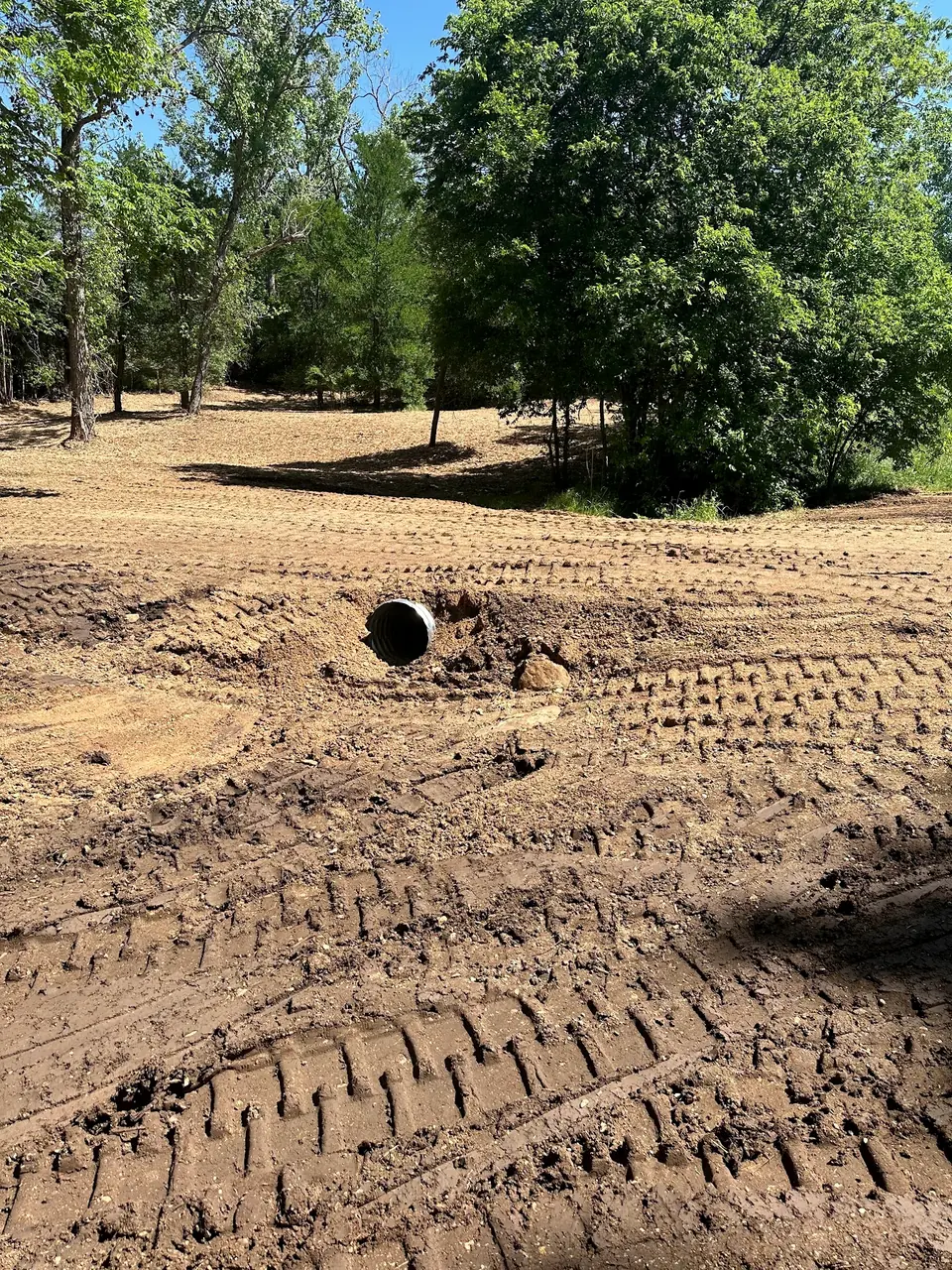
You install a driveway culvert by getting the county or TxDOT permit, using the pipe size, length and material that office sets, and bedding the pipe on the ditch flow line. Then you backfill in thin compacted layers, cover the pipe to the required depth, and finish both ends with sloped safety end treatments instead of headwalls.
Driveway culvert installation starts at the county or TxDOT office, not at the ditch. The office that owns the road usually sets the pipe size, length, material and end treatment. The job in the field is to bed the pipe on the ditch flow line, backfill it in compacted layers, finish the ends and keep it clear.
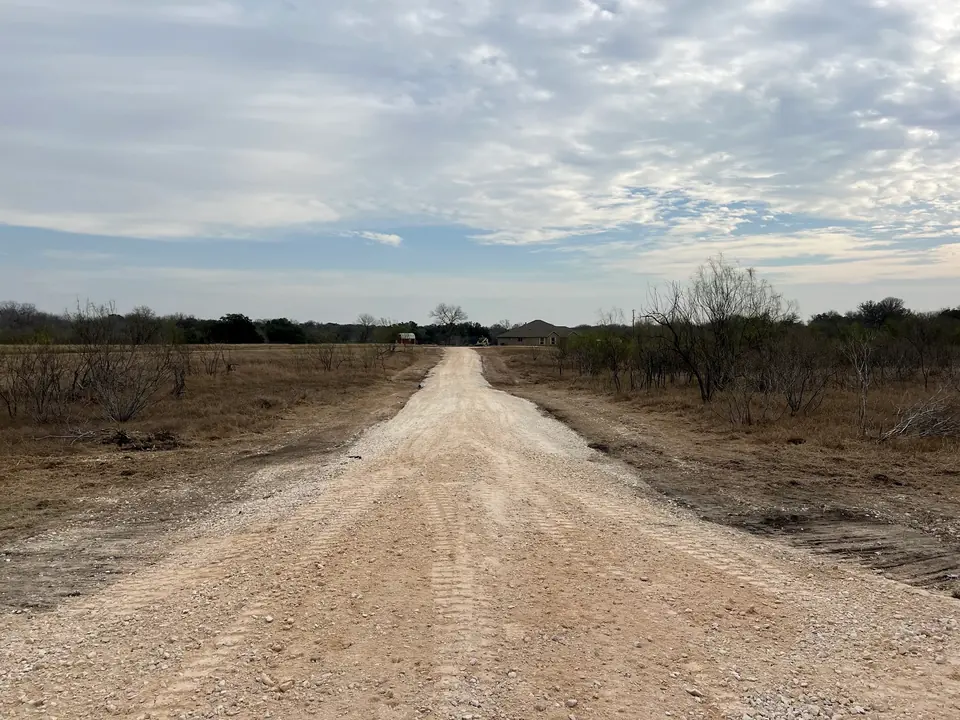
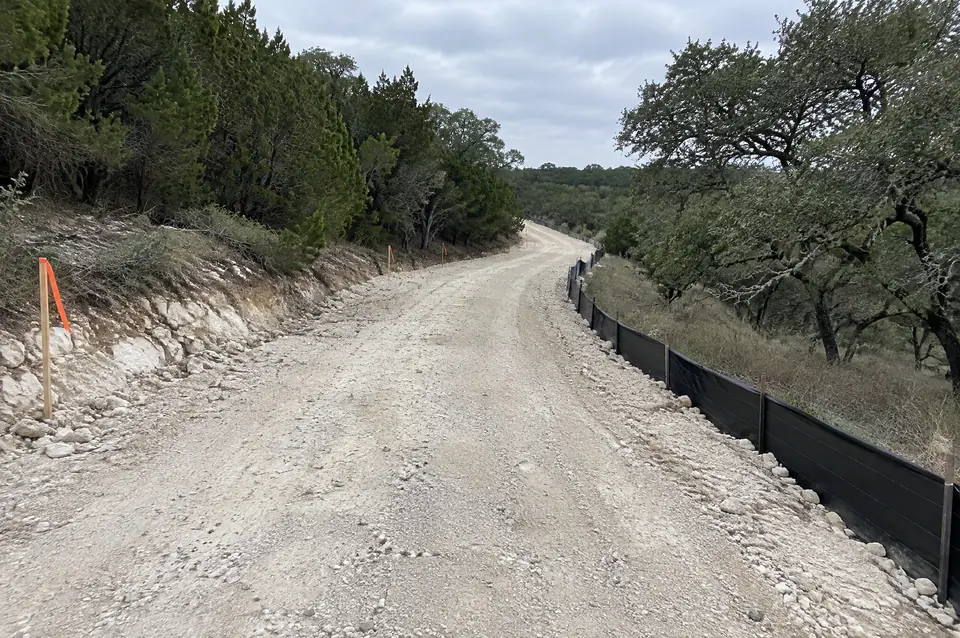
Culvert installation is part of our driveway and access road building, along with clearing, grading, road base and drainage. The pipe size comes from the county or your engineer, not from the crew. Here is what Texas rules say about each step.
Who permits a driveway culvert in Texas?
The office that owns the road permits a driveway culvert in its ditch: the county for county roads, TxDOT for state highways and the city for city streets.
- Comal County. Driveway work in county right of way needs a PIPROW permit, and the Right-of-Way Inspector checks right-of-way safety, drainage and damage to the county road (Comal County Engineer's Office).
- TxDOT. "When drainage structures are required, the size and other design features shall be approved by TxDOT" (Access Management Manual).
- Williamson County. When a resident applies for a residential or agricultural driveway, the county sizes the culvert and gives installation information (driveway policy, effective December 7, 2021).
- Bastrop County. The county approves the size and other design features (driveway standards, revised July 2026).
An interior culvert, where your drive crosses a draw on your own land, sits outside any road right of way, yet flood zones and other rules can still apply. Our guide to road building permits in Texas covers them. This is general information, not legal advice.
What size culvert does a driveway need?
A driveway needs the culvert size the road office sets for that ditch, and the published minimums we found in Texas county rules run from 12 to 24 inches. Some offices also size pipe to a design storm: Williamson County to a 10-year storm and Guadalupe County to a 25-year storm.
| Office | Minimum pipe | Minimum length | Who sets the size |
|---|---|---|---|
| Williamson County | 18 in interior diameter | 24 ft | County, for residential and ag driveways |
| Bastrop County | 15 in (12 to 15 in with good cause) | Driveway width plus 2 ft each side, at least 24 ft | County approves |
| Guadalupe County | 12 in in one section, 24 in in another | 20 ft | Owner installs to county specs |
| TxDOT (state highways) | Not stated in the access manual | Not stated | TxDOT approves |
Guadalupe County's subdivision regulations (amended May 27, 2025) show why you ask first. One section sets the minimum driveway culvert at 12 inches and 20 feet long. Another lists driveway culverts among pipes that must have a 24-inch minimum interior diameter. The same rules make roadside ditches at least as deep as the driveway culvert diameter plus 9 inches.
Do not size a culvert by eye or by what the neighbor used. Get the size in writing before you buy pipe.
Which pipe can you use for a driveway culvert?
Use the pipe material your county lists, because some Texas counties do not allow plastic in the right of way.
- Williamson County: corrugated metal pipe (CMP), corrugated metal pipe arch (CMPA) or reinforced concrete pipe (RCP), with cast-in-place work prohibited without County Engineer approval.
- Bastrop County: corrugated steel or reinforced concrete pipe, with concrete pipe as reinforced Class III.
- Guadalupe County: RCP, reinforced concrete box, CMP or CMPA. Thermoplastic pipe, including PVC and HDPE, is prohibited for drainage in the right of way and easements tied to the road system.
On an interior drive with no road office involved, choose pipe the maker rates for the cover depth and loads you plan to put on it.
Driveway culvert installation: bedding, backfill and cover
Driveway culvert installation in the ditch comes down to a firm, rock-free bed at the ditch grade, backfill in thin compacted layers worked under and around the bottom half of the pipe, and enough cover on top. The Low-Volume Roads Engineering field guide by Gordon Keller and James Sherar, two USDA Forest Service engineers (2003), sets these details:
- Bedding beneath the pipe should have no rocks larger than 3.8 cm (about 1.5 inches).
- Ideal backfill is moist, well-graded granular or sandy gravel soil, placed in 15 cm (about 6 inch) layers.
- Firmly compact fill around the culvert, particularly around the bottom half.
- Cover metal and plastic pipe with at least 30 cm (about 12 inches) of fill, and concrete pipe with at least 60 cm (about 24 inches).
County numbers can be lower. Bastrop County sets six inches as the minimum cover for corrugated metal pipe and says cover should not create a hump. Williamson County tells applicants to use the manufacturer's recommended minimum cover.
On Hill Country ground, where the USDA Eckrant soil series reaches bedrock 4 to 20 inches down, a culvert trench can hit rock, and broken rock has to stay out of the bedding. Our crews work in rocky terrain and excavate up to about 4 feet deep. Call 811 before the trench is dug.
How should a driveway culvert line up with the ditch?
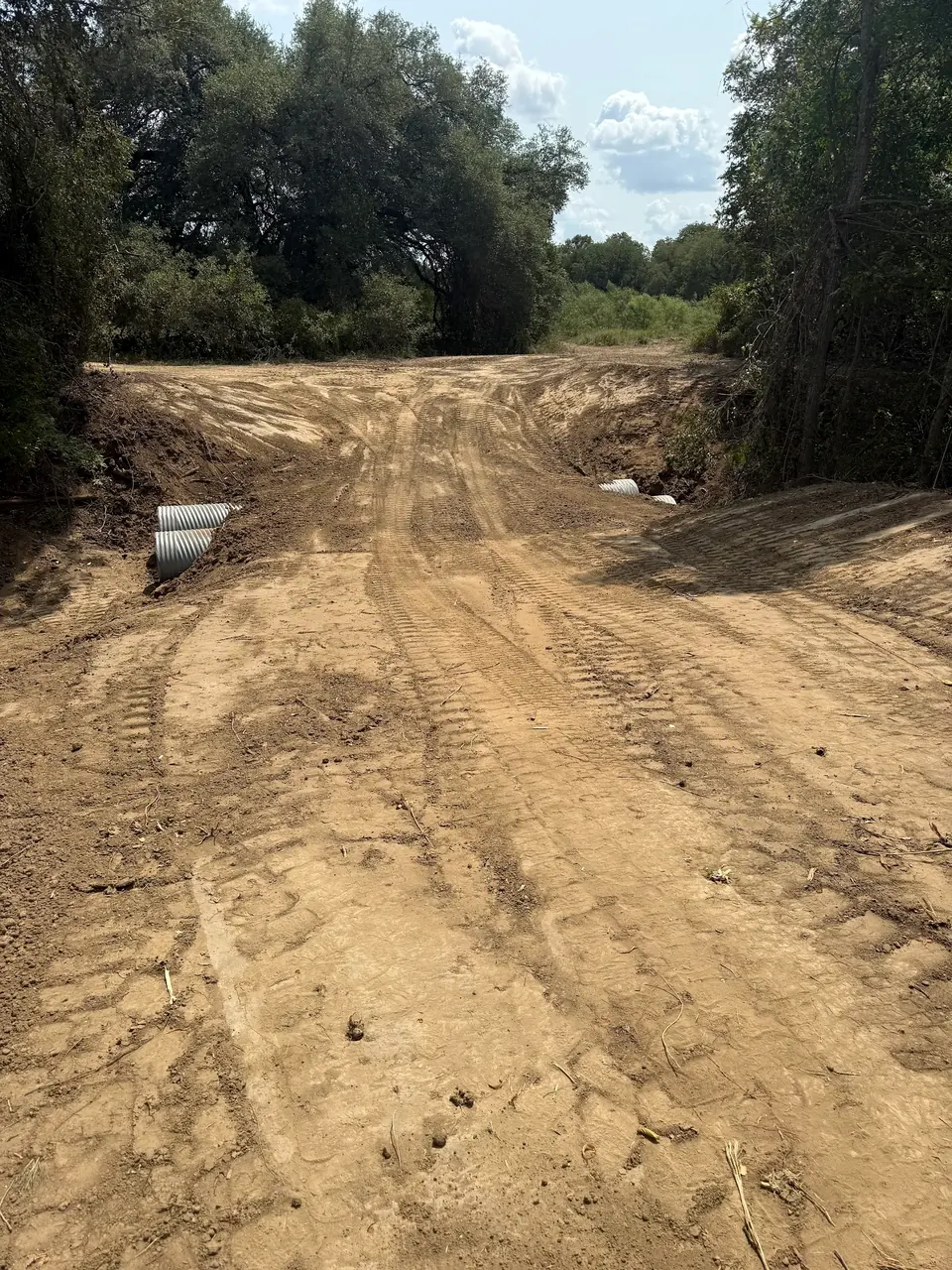
A driveway culvert should sit on the flow line of the ditch, at the ditch bottom, so water enters and leaves the pipe without pooling. The FHWA Gravel Roads Construction and Maintenance Guide (August 2015) shows a culvert "placed perfectly on the flow line of the ditch" and says this eliminates any accumulation of water at the inlet or outlet. The Keller and Sherar guide notes that a culvert outlet is usually lower than the inlet so water flows through.
Road rules say the same thing. Comal County's PIPROW application says drainage in roadway side ditches "shall not be altered or impeded." TxDOT requires a driveway that does not impede the flow of water away from the highway. Williamson County makes the applicant responsible for achieving the proper culvert flowline slope, and requires driveways to match the grade of the pavement edge or shoulder.
Where an interior drive crosses a natural draw, the Keller and Sherar guide says to align culverts in the bottom and middle of the natural channel without changing the stream bottom elevation. Our guide on how to build a ranch road covers when a low-water crossing fits better than a pipe.
What end treatments does a driveway culvert need?
A driveway culvert in public right of way needs sloped safety end treatments instead of headwalls, under TxDOT rules and the county rules we found. TxDOT says safety end treatments will be used for all driveways with drainage structures in highway right of way, and "There shall be no culvert headwalls or similar vertical ends." TxDOT's other rules:
- Pipe ends sloped at 6:1 or flatter, with concrete riprap.
- Driveway embankment slope of 6:1 maximum, with 8:1 preferred.
- Grates on pipes over 30 inches in diameter, or on multiple pipes over 24 inches each.
Counties write their own versions. Williamson County calls for concrete safety end treatments to current TxDOT standards, with ends sloped 4:1 or flatter and concrete riprap to prevent erosion and protect the pipe end, or 6:1 where pipe runners are required. Bastrop County uses 6:1 or flatter and allows no headwalls or similar vertical ends in the clear zone.
Who keeps a driveway culvert clear?
The property owner keeps a driveway culvert clear under each Texas rule we found. Comal County's application puts construction and maintenance on the applicant. Bastrop County makes the applicant or landowner responsible for repairing or replacing a culvert that fails. TxDOT's maintenance manual says private driveways are constructed and maintained by the owner of the property served. Williamson County assumes no responsibility for driveway maintenance, but reserves the right to clear obstructions in a driveway culvert or repair or remove inoperable culverts that harm the roadway.
FHWA explains why it matters: "Small culverts and box structures can easily become plugged from eroded soil and debris." Check both ends after big storms, pull out brush and silt, and keep the ditch open above and below the pipe. Our crew builds roads and installs culverts from Spring Branch across Comal County and the Hill Country.
Get the culvert size before the pipe goes in
Ask the road office for the size, length and end treatment first, and the install is straightforward. See how culverts fit into our driveway and access road building, from clearing the line to final grade.
Sources
- PIPROW Permit, Comal County Engineer's Office
- PIPROW Permit Application (revised January 2021), Comal County Engineer's Office
- Access Management Manual, Drainage, Texas Department of Transportation
- Driveway Policy (effective December 7, 2021), Williamson County
- Bastrop County Driveway Standards (adopted March 2019, revised July 2026), Bastrop County
- Subdivision Regulations (amended May 27, 2025), Guadalupe County
- Low-Volume Roads Engineering Best Management Practices Field Guide (Keller and Sherar, 2003), produced for USAID with the USDA Forest Service
- Eckrant series, Official Soil Series Description, USDA Natural Resources Conservation Service
- Gravel Roads Construction and Maintenance Guide (August 2015), Federal Highway Administration
- Maintenance Manual, Driveways, Texas Department of Transportation