
Defensible space in Texas: how to clear brush and cedar around your home
Texas A&M Forest Service splits defensible space into three zones reaching 100 feet or more. Here is how to handle brush and cedar in each zone and where fuel breaks belong.
What is defensible space in Texas?
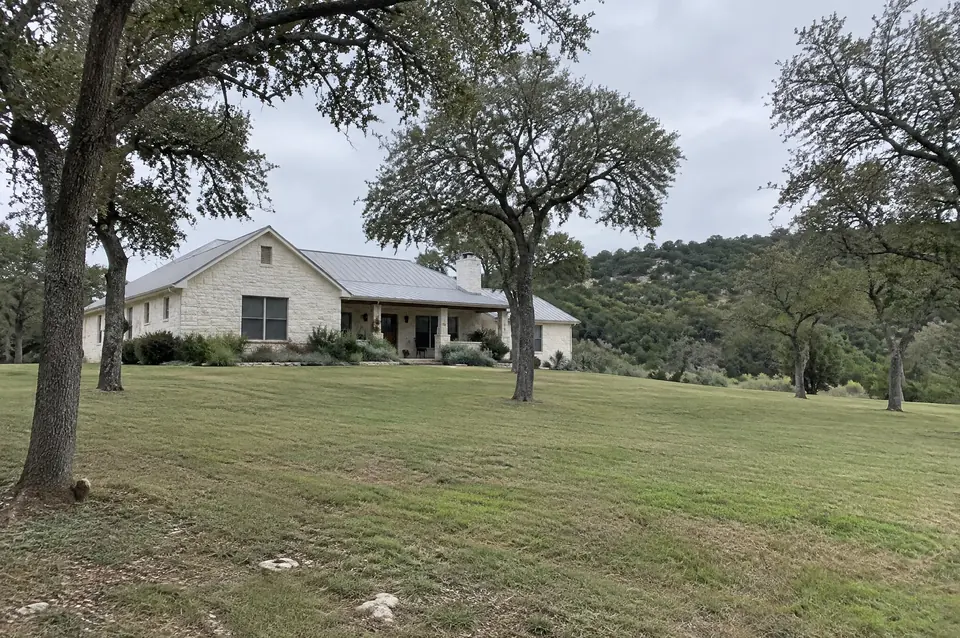
Defensible space in Texas is the area around a home where vegetation is cleared and thinned so a wildfire slows down and loses intensity before it reaches the house. Texas A&M Forest Service divides it into three zones: 0 to 5 feet, 5 to 30 feet, and 30 to 100 feet, extending to 200 feet where possible.
Defensible space in Texas is the buffer of cleared and thinned vegetation around a home that gives it a fighting chance in a wildfire. Texas A&M Forest Service lays it out in three zones, from the walls of the house out to 100 feet or more. On Hill Country land, most of the work in those zones is brush and cedar.
This guide walks through each zone, how much cedar to take, where fuel breaks belong and why mulching beats leaving slash. Our brush removal in Central Texas handles the clearing side of defensible space without a single burn pile.
What are the home ignition zones in Texas?
The home ignition zones in Texas are three rings around a house, each with its own job. Texas A&M Forest Service defines them this way:
| Zone | Distance from the home | Main goals |
|---|---|---|
| Immediate | 0 to 5 feet | Clean roofs and gutters. Keep mulch, plants and firewood away from exterior walls. |
| Intermediate | 5 to 30 feet | Mow grass to 4 inches. Remove ladder fuels. Space tree crowns at least 18 feet apart. Keep canopies 10 feet from the house. |
| Extended | 30 to 100 feet, out to 200 feet if available | Remove dead plant and tree material. Space crowns 12 feet apart from 30 to 60 feet and 6 feet apart from 60 to 100 feet. |
The Forest Service adds that slope, species and site conditions may call for more spacing. In the Intermediate Zone, driveways, walkways and patios can serve as fuel breaks. For the ground right against the house, an April 2024 AgriLife Today article on wildfire landscaping recommends noncombustible materials such as rock, turf grass and flame-resistant mulches.
The stakes are real in Central Texas. A February 2025 statewide wildfire risk report posted by Texas A&M Forest Service counts an average of 2,714 wildfires and 73,636 acres burned per year in the Central Texas region from 2005 to 2024. The same report says 86% of Texas wildfires occur within two miles of a community, and over 90% are human caused.
How much cedar should you clear around a house?
How much cedar to clear around a house depends on the zone, but thick cedar close to a home should go. Texas A&M Forest Service puts it plainly in its fuels reduction guidance: "a thick patch of cedar could readily ignite and release significant heat and embers." The agency says that kind of patch would need to be removed.
Cedar changes with the weather. The 2025 risk report notes that under average conditions in Central Texas, Ashe juniper is "relatively resistant to ignition" and can help slow a fire. In drought, the same foliage "can become highly volatile." Dead cedar is worse. The USDA Forest Service Fire Effects Information System calls dead Ashe juniper trees "highly volatile fuels."
That points to a plan, not a clear-cut:
- Remove cedar thickets and dead cedar within 100 feet of the house.
- Keep healthy oaks and shade trees, spaced to the zone guidelines.
- Take out ladder fuels. The Forest Service advises removing vegetation beneath trees and pruning trees up to 6 to 10 feet from the ground, or no more than a third of the height on shorter trees.
- Remove small conifers growing between mature trees in the Extended Zone.
Selective clearing keeps the shade and character of the lot while the fuel comes out. Forestry mulching grinds cedar where it stands, so nothing is dragged across the yard, piled or burned.
Where do fuel breaks go on Hill Country land?
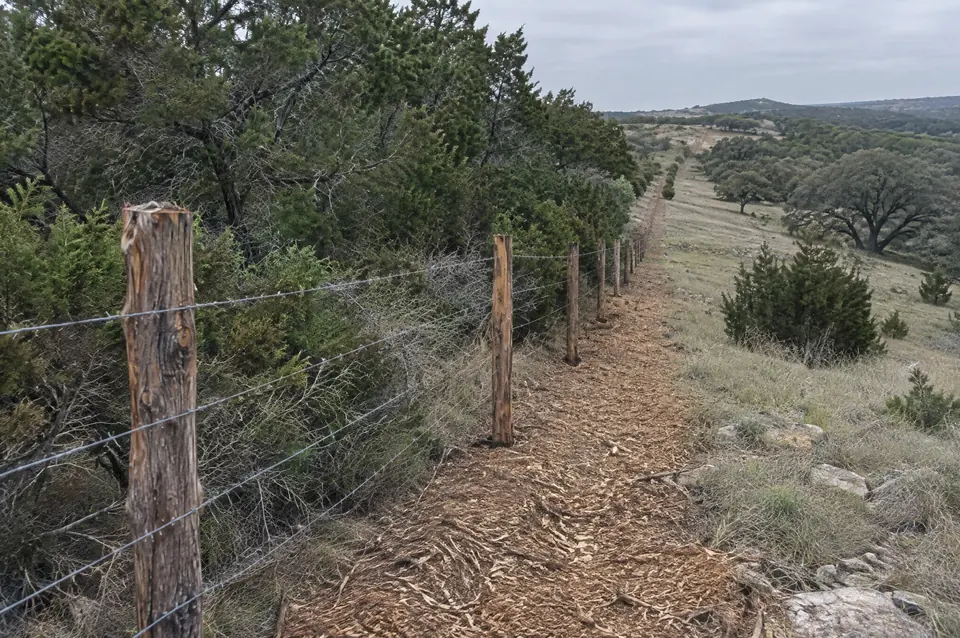
Fuel breaks on Hill Country land belong along driveways, ranch roads, fence lines and the edges of home sites. Texas A&M Forest Service says fuel breaks are most effective along a natural break like a road, which also gives equipment access. The agency calls for a minimum width of 60 feet on flat land and 100 feet on slopes.
On a typical tract outside Boerne, Bulverde or Canyon Lake, that means:
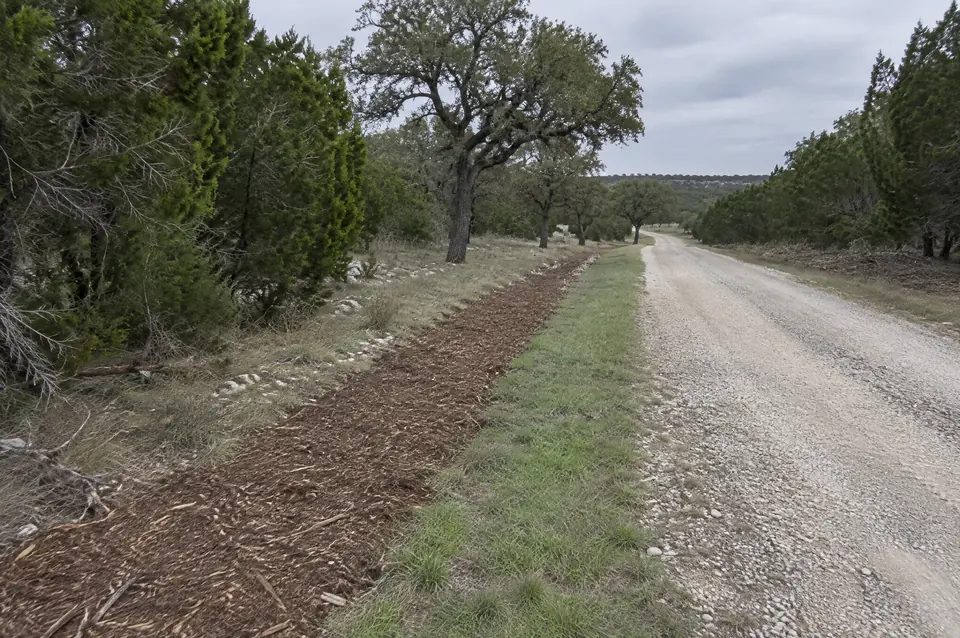
- Driveways. A cleared, thinned strip along the drive protects the route in and out.
- Ranch roads and fence lines. Existing lines are the easiest place to build and keep a break. Our post on fence line clearing covers opening a line without tearing up the wire.
- Home site edges. The Extended Zone, 30 to 100 feet out, works as the last break before the house.
- Barns and outbuildings. The Forest Service lists barns among the values fire breaks can protect, and its Extended Zone guidance calls for clearing vegetation next to sheds and outbuildings.
- Slopes below the house. The wider 100-foot standard for slopes matters on hilltop and hillside lots.
A fuel break does not have to be bare dirt. The Forest Service notes that thinning vegetation lowers the risk of extreme fire behavior, so a break can keep spaced trees over low, mowed ground.
Is mulching better than leaving slash?
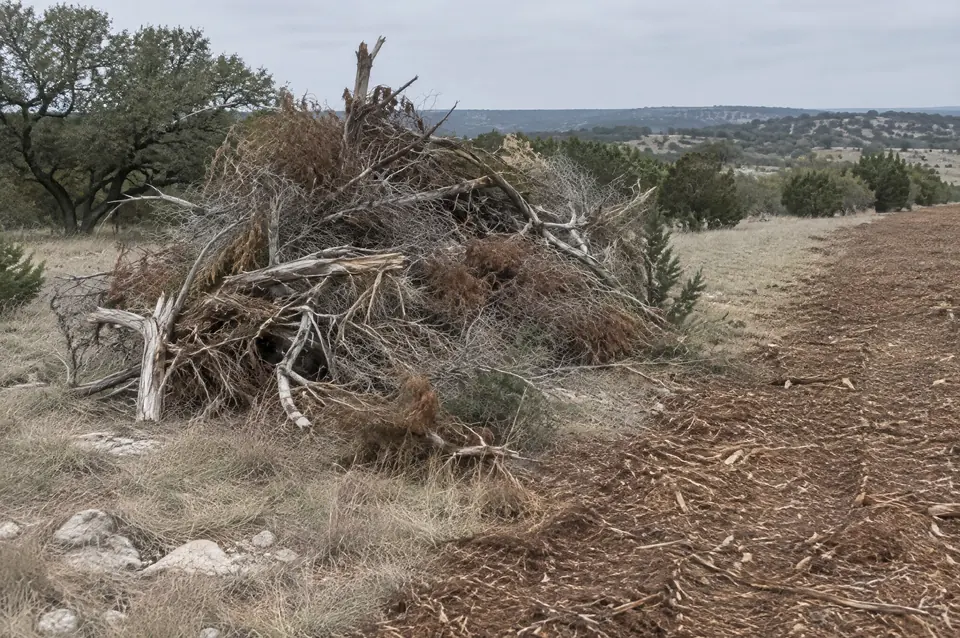
Mulching is better than leaving slash, because cut brush left lying in piles or across the ground is still fuel, and dead cedar is a highly volatile fuel. Texas A&M Forest Service explains that mulching breaks vegetation into smaller pieces spread within the fuel break. As the agency puts it, "While the smaller pieces will still carry fire, their intensity will be greatly reduced."
The Forest Service's own cost-share rules point the same way. Its Mechanical Fuel Reduction Grant allows forestry mulchers (masticators), requires debris to be removed from the property or mechanically reduced, and disqualifies any project that burns. Treatments must be at least 66 feet wide, with priority on defensible space within 100 feet of a structure. The 2026 application window closed July 14, and the next one opens June 1, 2027.
Mulch still needs managing near a home:
- Keep wood mulch out of the Immediate Zone, the first 5 feet from the walls.
- Keep the layer light in fuel breaks and yards. Under a light layer, grass can green up within days after a rain. A heavy layer, up to 12 inches deep, can take 2 to 3 years to grow through.
- Where you want open ground fast, mulch can be stockpiled or hauled off.
Mulching also leaves the soil and root balls in place. That matters on steep Hill Country lots, where bare dirt from dozer clearing is quick to erode. Burning slash brings its own problems, from burn bans to escaped fires. Our post on mulching vs burning brush covers the rules.
How do you keep defensible space in Texas working?
Defensible space in Texas keeps working only with upkeep, because grass, brush and cedar seedlings grow back every year. Texas A&M Forest Service notes that regular maintenance of fuel breaks increases their effectiveness, and its zone guidance calls for lawns and native grasses mowed to 4 inches in the Intermediate Zone.
A simple yearly routine covers most Hill Country homes:
- Keep the Intermediate Zone mowed to 4 inches through the growing season.
- Walk the Extended Zone each winter, and cut new cedar seedlings below the lowest green branch.
- Clear dead limbs and storm debris before the hot, dry months.
- Re-cut fuel breaks along drives and fence lines as brush returns.
Our grounds maintenance crew handles mowing, selective trimming with chainsaws and debris cleanup, with recurring agreements for residential properties. For larger acreage in the Texas Hill Country, we mulch fuel breaks and thin cedar with compact track machines built for slopes and tight access.
Start your defensible space plan
Walk your three zones, flag the trees worth keeping and let us handle the heavy fuel. Our brush and cedar removal for defensible space clears it without burning a thing.
Sources
- Fire resistant landscaping, Texas A&M Forest Service
- Statewide Assessment of Economic and Environmental Risk from Wildfire in Texas (February 2025), technical report posted by Texas A&M Forest Service
- Fuels reduction, Texas A&M Forest Service
- Juniperus ashei species review (1993), Janet Sullivan, Fire Effects Information System, USDA Forest Service
- Mechanical Fuel Reduction Grant, Texas A&M Forest Service
- Landscaping to help protect from wildfires (April 2024), AgriLife Today, Texas A&M AgriLife