
Fence line clearing: how wide to clear and how to keep the wire standing
Brushy fence lines hide breaks, drop trees on wire and let cattle out. Here is how wide to clear a fence line, how to mulch near wire and how to keep it open.
Why is fence line clearing worth doing on a Texas ranch?
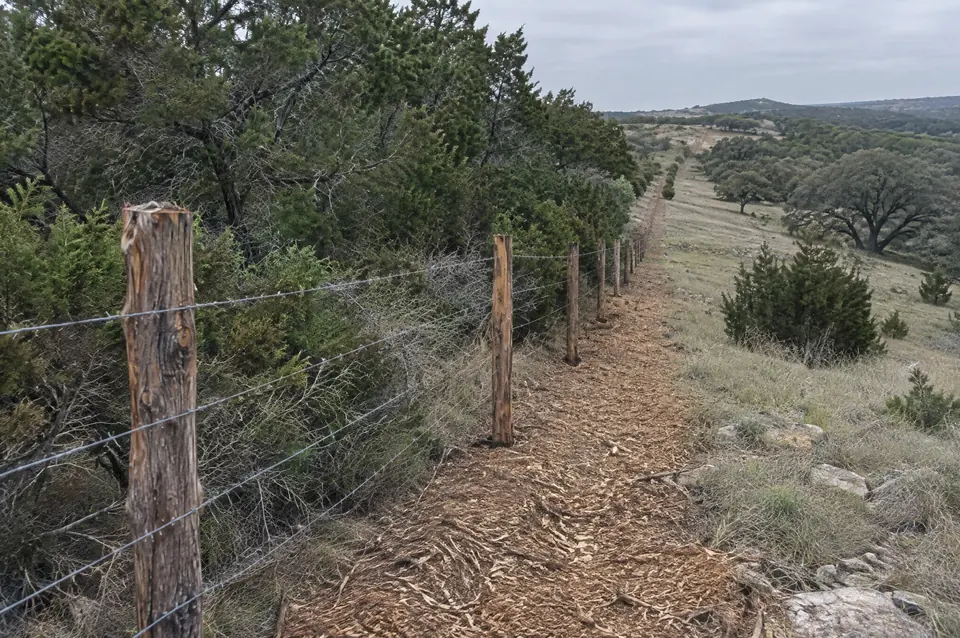
Fence line clearing is worth doing on a Texas ranch because brush and trees growing in a fence hide breaks, drop limbs on the wire and slow every repair. A cleared line can be driven, checked after storms and fixed fast. NRCS fence standards in Texas count removing woody growth in the fence as normal maintenance.
Fence line clearing is one of the most useful jobs on a ranch. A fence buried in cedar, mesquite and vines hides its own breaks. Limbs come down on the wire in every storm, and cattle find the weak spot before you do.
This guide covers why brushy lines cost money, how wide to clear, how to mulch close to wire without tearing it up, and how to keep the line open. Fence lines are usually the first step in ranch land clearing in Texas, because every other job on the place depends on fences you can trust.
Why does fence line clearing pay off for ranchers?
Fence line clearing pays off for ranchers because a brushy line turns a quick fence check into a slow, partial one. You cannot drive a line you cannot see. Breaks go unnoticed, and a downed cedar can sit on the top wire for weeks before anyone finds it.
The federal conservation standard for fences in Texas spells out the upkeep. The NRCS Texas fence specification (March 2021) states: "Inspection of fences after storm and other disturbance events is necessary." The same specification lists tree and limb removal as part of timely maintenance, including "the prevention of vegetative growth or removal of woody vegetation in the fence."
Loose livestock carries legal weight too. Under Texas Agriculture Code Section 143.102, an owner may not knowingly let livestock roam unattended on the right-of-way of a U.S. or state highway, a Class C misdemeanor, according to a Texas A&M AgriLife Extension review of Texas fence law. In one case the review covers, the court weighed whether the owners had failed to inspect the fence. A clear line makes inspection easy.
Brush in a fence row also carries fire. Texas A&M Forest Service warns that a thick patch of cedar can readily ignite and throw heat and embers, and a cedar-choked fence row runs that fuel straight across a property. A cleared fence line does the opposite. It gives a fire less to climb, gives crews a lane to work from and can double as a fuel break. Our guide to defensible space in Texas covers where fuel breaks belong around homes, drives and barns.
How wide should you clear a fence line?
How wide to clear a fence line depends on the job the line has to do. No single standard covers every ranch, so set the width by purpose:
| Purpose of the cleared line | What sets the width | Notes |
|---|---|---|
| Inspection and repair | Room for a truck or UTV, a post driver and a stretcher | Clear both sides where you own both sides |
| Keeping trees off the wire | The height of the trees next to the fence | Take the cedar and dead trees that lean toward the wire |
| Wildfire fuel break | Texas A&M Forest Service calls for at least 60 feet on flat land and 100 feet on slopes | Breaks work best along existing lines, such as roads |
| New fence or boundary | Your licensed surveyor's line | Clear before the fence crew arrives |
Most ranch fence lines land between a single equipment lane and a full fuel break. A boundary fence along a county road may justify a wider strip than an interior cross fence. Keep the shade trees you want, and take the cedar and dead timber that would fall on the wire.
Boundary fences have a neighbor on the other side. Texas law does not require neighboring landowners to share the cost or maintenance of a boundary fence, according to an AgriLife Extension overview of Texas fencing laws. Clear your own side, and get your neighbor's OK before clearing past the line. This is general information, not legal advice.
How do you mulch along a fence without damaging the wire?
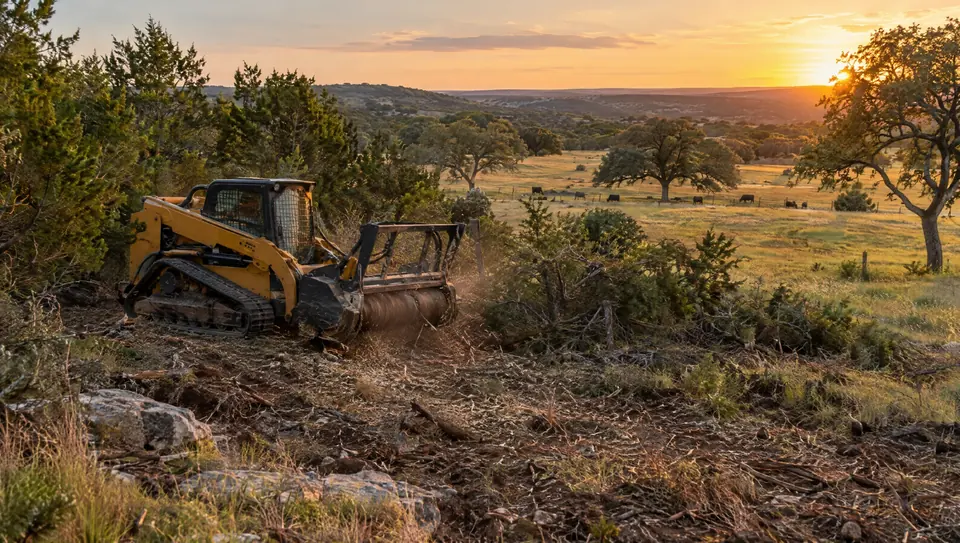
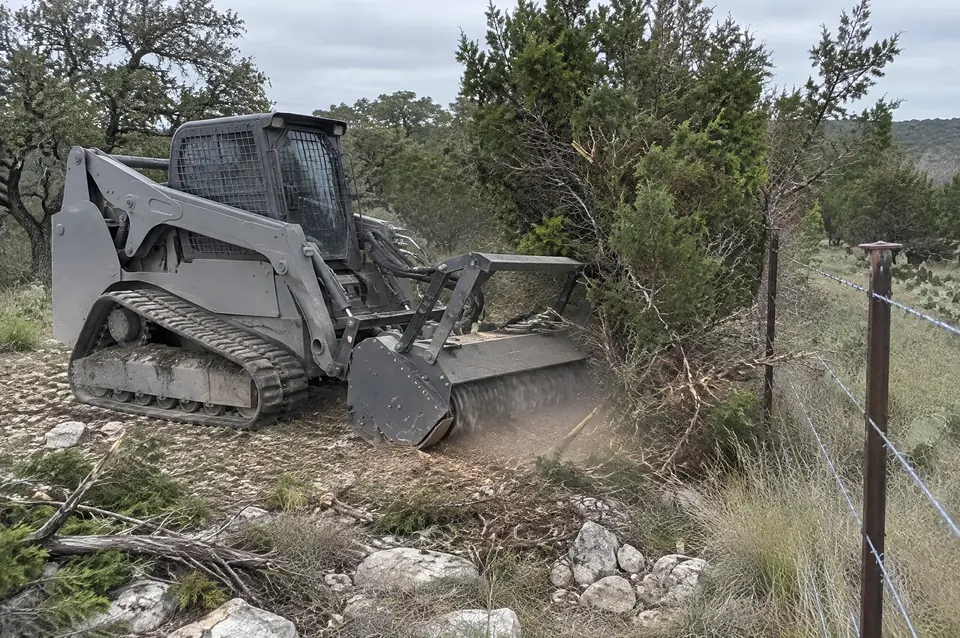
Mulching along a fence without damaging the wire takes a plan, the right machine and patience at the wire itself. A forestry mulching head grinds whatever it touches, barbed wire included, so the heavy grinding happens a few feet off the fence and the close work gets finished carefully.
A careful fence line job usually runs in this order:
- Walk the line first. Flag gates, braces, corners, water gaps and any loose wire lying in the brush.
- Mulch the strip parallel to the fence, keeping the head off the wire.
- Drop trees standing in or against the fence away from it, then grind them in the open.
- Finish tight spots by hand. Brush growing through the wire comes out with a chainsaw.
- Leave the root balls. Forestry mulching keeps roots in the ground, which holds the soil around posts.
We run compact track machines for tight lines, slopes and uneven ground, and large articulated machines for long, open runs. Our crew handles chainsaw work and hand labor in tight or sensitive spots. The finish is fine mulch you can drive a truck over, not a row of stubs and splinters.
Live oaks and red oaks on a fence line need extra care. Texas A&M Forest Service advises avoiding pruning or wounding oaks from February through June because of oak wilt, and painting any oak wound immediately. Plan oak-side fence work outside that window.
Should you clear before building a new fence?
Clearing before building a new fence saves time, as long as the line is in the right place. The AgriLife fencing law overview warns that a person who builds a fence on a neighbor's land because of a mistaken belief about the property line must remove it, even when removal is expensive or difficult.
That is why a new boundary fence starts with your licensed surveyor. Our GPS survey line clearing loads your surveyor's CAD survey files onto Trimble receivers mounted on the mulcher, and the operator follows that certified line through dense brush in real time. 9 Arrow is not a licensed surveyor and does not replace one. The result is an open, accurate lane for the fence crew, often with less pre-staking.
Before any post holes go in, call 811. Texas811 lists building or repairing a fence among the projects that need a locate request at least two business days before digging, not counting weekends and holidays. That rule applies even on your own land.
Clearing ahead of the fence crew also sets up the fence for the long haul. Trees that would lean over the new wire come out now, root balls stay put to hold the soil, and the cleared lane becomes the maintenance strip you will drive for years.
Why does brush come back along fence lines?
Brush comes back along fence lines because the fence helps plant it. Birds perch on wire and posts and drop seed below. Texas A&M's juniper ecology review notes that American robins, important eaters of juniper berries, visit a wide variety of perch sites within grassland. University of Arkansas extension writers describe the result with eastern redcedar: long rows of cedar down untended fence lines. Mesquite spreads too, carried by livestock and wildlife that eat the beans, as our post on clearing cedar and mesquite explains.
Keeping a fence line open is far easier than clearing it the first time:
- Drive or walk every line at least once a year and after big storms.
- Shred regrowth with a tractor and batwing while it is small. Mesquite resprouts from the base, so plan on follow-up.
- Cut cedar seedlings below the lowest green branch before they fill in.
- Keep grass healthy on the cleared strip so seedlings have competition.
Our grounds maintenance crew handles mowing and access-corridor upkeep on rural and ranch properties, scheduled by season and conditions.
Get your fence lines cleared
Start with the fence you check most and trust least. Our ranch and pasture clearing work opens fence lines across Central Texas and the Hill Country, starting from home in Spring Branch.
Sources
- Fence, Code 382, Texas Practice Specification (March 2021), USDA Natural Resources Conservation Service
- Texas Fence Law and Liability for Livestock on the Road (2019), Tiffany Dowell Lashmet and Lauren Thomas, Texas A&M AgriLife Extension
- Overview of Texas Fencing Laws (2019), Tiffany Dowell Lashmet and Lauren Thomas, Texas A&M AgriLife Extension
- Fuels reduction, Texas A&M Forest Service
- Prevent the spread of oak wilt in Texas (February 2025), Texas A&M Forest Service
- I want to dig, Texas811
- Juniper ecology, Allan McGinty, Texas Natural Resources Server, Texas A&M
- Plant of the Week: Eastern red cedar (2017), University of Arkansas Division of Agriculture Cooperative Extension Service