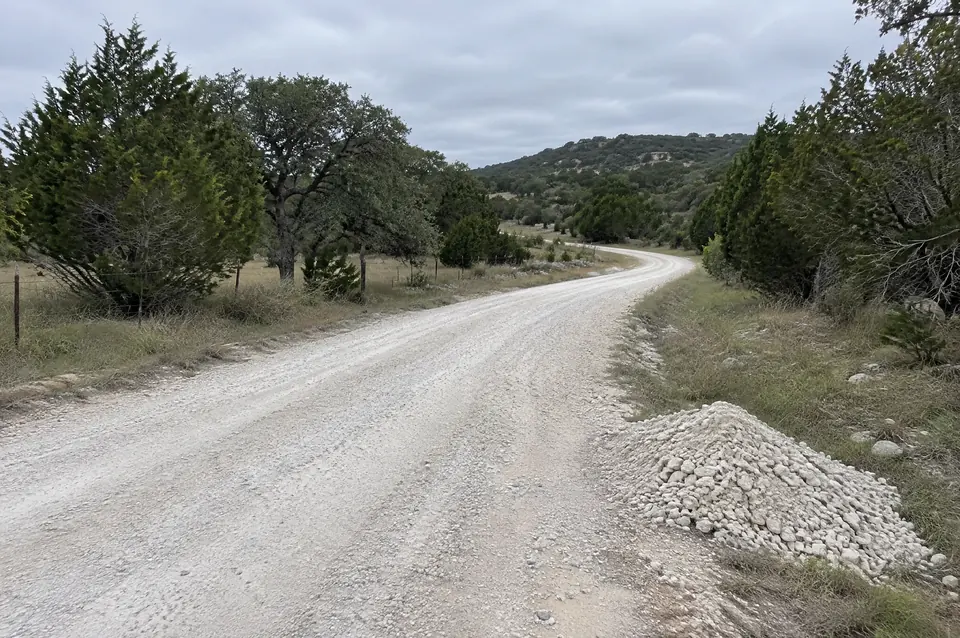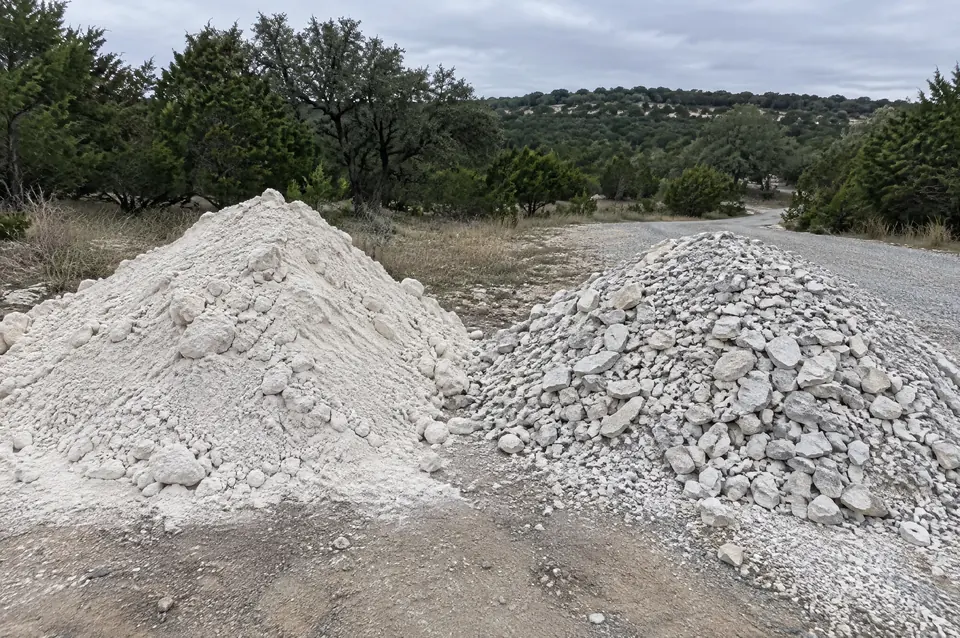

Crushed limestone vs gravel: which belongs on your drive, road or path?
Crushed limestone and rounded gravel look like cousins but behave like opposites. Here is how shape, fines and drainage decide which one goes on your drive, road or path.
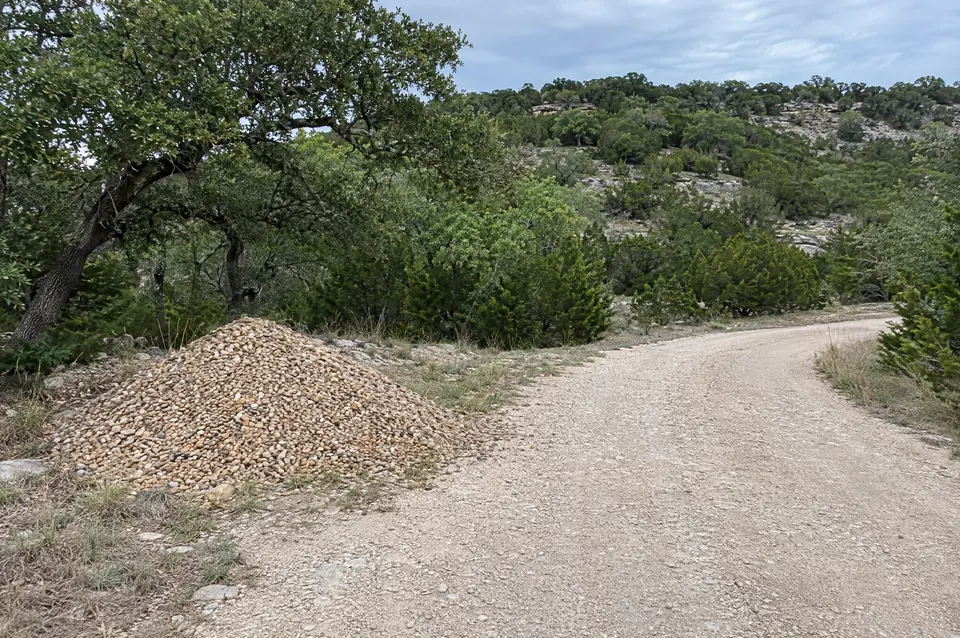
Is crushed limestone better than gravel?
Crushed limestone is better than rounded gravel for driveways, roads and firm walking paths, because its broken, angular pieces lock together and pack hard. TxDOT rates crushed stone base above gravel base for that reason. Rounded pea or river gravel still wins where water has to drain through the rock, or as loose decorative cover.
Crushed limestone vs gravel comes down to shape. Crushed limestone is broken into angular pieces that lock together and pack into a firm drive, road or path, while gravel is rounded by water and stays loose under tires and boots. On Hill Country land, the better of the two is often already lying on the ground, and our on-site rock crushing in Central Texas turns that limestone into base where it sits.
Gravel still earns its place. This comparison covers why shape matters, how each rock handles water, where rounded gravel wins and why limestone is the native choice around Spring Branch.
What is the difference between crushed limestone and gravel?
The difference between crushed limestone and gravel is how each rock got its shape. Crushed limestone is ledge or loose limestone broken by a crusher, so every piece has fresh, rough faces. Gravel, in the everyday sense of pea gravel and river rock, is stone worn smooth by water and then screened to size.
TxDOT's Flexible Base Selection and Information Guide (February 2026) puts the contrast in one line: when the material is not crushed, "particles tend to be rounded with a smoother texture." The FHWA Gravel Roads Construction and Maintenance Guide (2015) describes river gravels as generally "a mix of stone and sand."
Size range separates them too. A trail builder writing for American Trails (2008) notes that gravel and crusher fines differ in that gravel is screened to remove the fines.
Texas makes plenty of both. The U.S. Geological Survey ranks Texas first in the nation for crushed stone and first for construction sand and gravel by tonnage in 2025. Nationally, about 70 percent of crushed stone was limestone and dolomite.
Why does crushed limestone pack firmer than gravel?
Crushed limestone packs firmer than gravel because broken, rough faces wedge against each other, while rounded stones slide past one another. TxDOT's base guide is blunt about it: "Crushed material is preferred." The guide explains that rounded particles do not interlock as well as crushed particles, and that smoother particles may allow slippage where they touch. FHWA adds that fractured stone "resists movement under loads better" and gives a road more strength and stability.
TxDOT's specification follows the same logic. TxDOT Item 247 (2024) defines Type A base as crushed stone from a single quarried source and says, "Do not use gravel or multiple sources." Type B is crushed or uncrushed gravel. Type C is crushed gravel with at least 60 percent of the particles retained on a No. 4 sieve showing two or more crushed faces. The base guide rates Type A (or Type D) as the strongest, most durable base, calls Types B and C marginal base, and notes that gravels are rarely used without some form of stabilization.
Paths follow the same rule as roads. The USDA Forest Service Accessibility Guidebook for Outdoor Recreation and Trails lists materials more likely to give a firm, stable surface, including:
- Crushed rock rather than uncrushed gravel
- Rock with broken faces rather than rounded rocks
- A full spectrum of sizes, including fine material, rather than a single size
For how limestone stacks up against the other white rock on Texas roads, see caliche vs crushed limestone.
Crushed limestone vs gravel, side by side
Crushed limestone and rounded gravel trade strengths, and the differences line up like this:
| Factor | Crushed limestone | Rounded gravel (pea gravel, river rock) |
|---|---|---|
| Shape | Angular, with broken faces | Rounded and smooth |
| How it packs | Interlocks into a firm layer | Slips and stays loose |
| Fines | Full range of sizes down to fines | Usually screened out |
| Water | Sheds off a crowned surface | Drains through open gaps |
| Under tires and boots | Firm once compacted | Rolls and shifts |
| TxDOT base rating | Type A: strongest, most durable | Types B and C: marginal |
| Best uses | Road and drive base, firm paths, pads | Drainage media, play areas, decorative cover |
| On Hill Country land | Often already on site | Trucked in from a supplier |
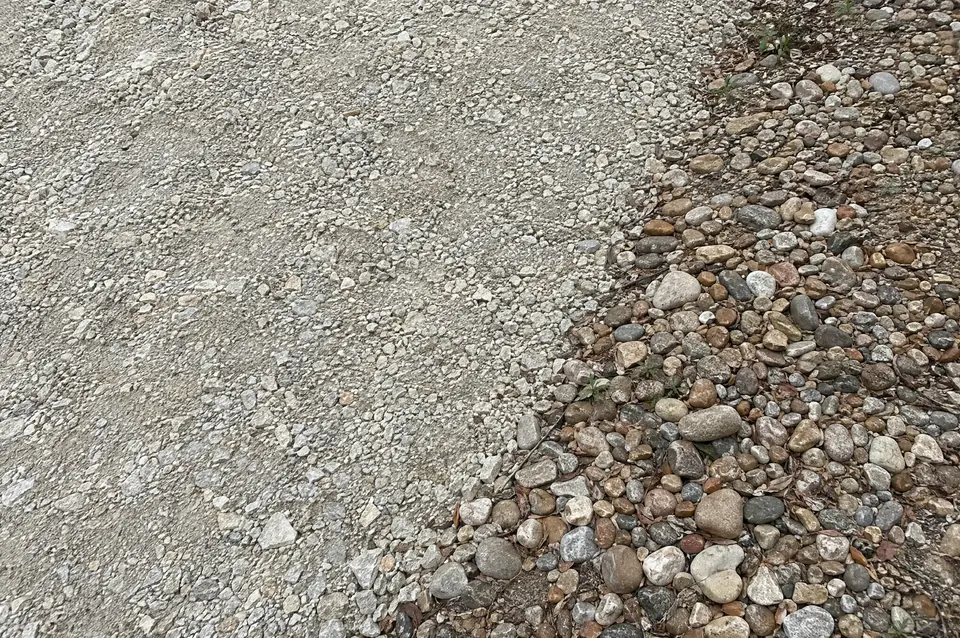
Where does gravel beat crushed limestone?
Gravel beats crushed limestone wherever water has to pass through the rock instead of running off it. Fines are what let crushed limestone pack tight. FHWA's guide says a good gravel road needs sand-sized fine aggregate to fill the voids, plus very fine particles to bind the material. Take the fines away and water flows through. FHWA describes sandy gravel made as building-site fill as "very drainable," good for draining water from under foundations and parking lots, but warns that on a gravel road the same material "will remain loose and unstable."
Texas septic rules show what drainage rock looks like. Under 30 TAC 285.33, media in a standard absorptive drainfield must be "clean, washed and graded" and generally one uniform size, 0.75 to 2.0 inches across. Gravel, rock or crushed stone can qualify, and soft limestone is not allowed. For drainage, clean and single-size matters more than round or angular. This is general information, not legal advice; your septic designer and local permitting office set the media for your system.
Loose, rounded stone also fits where nothing heavy rolls over it. The Consumer Product Safety Commission's playground handbook lists 9 inches of compressed pea gravel as protecting to a 5-foot fall height. Rounded rock works as decorative cover in beds and borders for the same reason it fails on a drive: it moves.
For anything that carries weight, from a stock trailer to a wheelbarrow, angular rock with fines does the job better.
Why crushed limestone fits Hill Country land
Crushed limestone fits Hill Country land because the limestone is already there, often lying on top of the ground. The USDA description of the Eckrant soil series, an extensive soil on ridges across the Edwards Plateau, puts bedrock 4 to 20 inches down and lists 20 percent limestone gravel and 15 percent limestone cobbles in the top 4 inches of its typical profile. The parent material is residuum weathered from limestone, meaning rock broken down in place, not stone carried in by a river.
That surface rock is raw material. Our crew processes existing surface rock into a fine, compactible road base on site, using crushing heads and attachments that break rock down to a fine, consistent grade. 9 Arrow does not sell or haul in gravel. We crush what your land already has, then grade it with proper crown and drainage. 9 Arrow runs a large, dedicated rock crushing machine built to work far deeper than the skid-steer attachments most crews use. As far as we know, no other crew in the Hill Country runs one.
For the truckload math behind crushing versus buying base, see crushing your own rock vs hauling in road base. Our crew works out of Spring Branch, clearing land and building roads across Comal County and the Hill Country.
Turn your limestone into the base
Before you order gravel for a drive, road or path, look at the rock already on your ground. See how our on-site rock crushing for driveways and roads turns Hill Country limestone into base, and how it fits a full access road build.
Sources
- Flexible Base Selection and Information Guide (February 2026), Texas Department of Transportation
- Gravel Roads Construction and Maintenance Guide (2015), Federal Highway Administration
- The Art of Building Crushed Stone Trails (Boone, 2008), American Trails
- Mineral Commodity Summaries 2026: Stone (Crushed), U.S. Geological Survey
- Mineral Commodity Summaries 2026: Sand and Gravel (Construction), U.S. Geological Survey
- Item 247, Flexible Base (2024 Standard Specifications), Texas Department of Transportation
- Accessibility Guidebook for Outdoor Recreation and Trails (1223-2806P-MTDC), USDA Forest Service
- 30 TAC §285.33, Criteria for effluent disposal systems, Cornell Legal Information Institute
- Public Playground Safety Handbook (Publication 325), U.S. Consumer Product Safety Commission
- Eckrant series, Official Soil Series Description, USDA Natural Resources Conservation Service