
Clearing land for a home site, from the first walk to a ready pad
Clearing land for a home site works best in a set order. Here is how to keep the right trees, handle roots under the slab, and plan around septic, rock and 811.
How do you clear land for a home site?
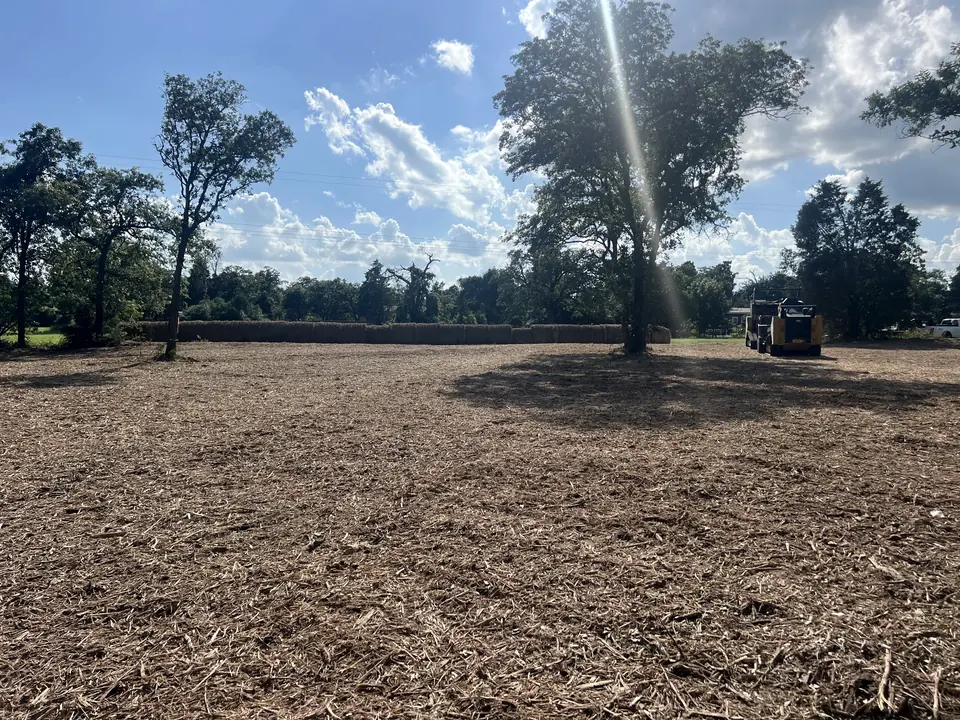
Clearing land for a home site starts with a site walk to flag keeper trees, the house footprint, the driveway line and the septic area. Forestry mulching then clears the brush while leaving soil and roots in place, and only the foundation footprint gets grubbed. Septic evaluation and 811 locates come before any digging.
Clearing land for a home site goes best in a set order: walk and flag, mulch the brush, grub only the foundation footprint, then dig for septic and utilities once the lines are located. Done in that order, the house ends up among healthy trees on stable ground, and nothing gets cut, torn up or dug twice.
John Wheelock came to land clearing from a construction background that includes custom home building, so we plan land clearing for a building site with the builder's next steps in mind. Here is the sequence we follow on Hill Country home sites, from the first walk to a ready pad.
What is the right order for clearing land for a home site?
The right order for clearing land for a home site moves from planning to clearing to digging, so each step protects the next.
- Walk and flag. Mark keeper trees, the house footprint, the driveway line, the likely septic area and any well.
- Start the septic evaluation. Soil and rock decide the system type, and the system can decide where the house sits.
- Locate utilities. Contact Texas811 before any digging, and mark the private lines you know about.
- Mulch the brush. Forestry mulching clears cedar and understory while leaving soil and roots in place.
- Grub the footprint. Pull root balls only where the foundation, and any margin your builder specifies, needs root-free ground.
- Cut the driveway and pad. Shape the access and the pad site to grade.
- Dig and trench. Excavate for septic and propane tanks, and trench for waterlines, conduit and septic lines.
Set the driveway line during the walk, not after the brush is gone. A low-volume roads field guide produced with the USDA Forest Service recommends road grades of 12 percent or less, and the FHWA gravel roads guide calls for a crown of about half an inch per foot to shed water. Where surface rock is in the way, on-site rock crushing can turn it into driveway base.
We handle the clearing, grubbing, pad and driveway work, septic and propane excavation, and trenching for waterlines of 3 inches or smaller and electrical conduit. We do not install wire or make final water and electrical tie-ins. Licensed plumbers and electricians make those connections.
Which trees should you keep on a home site?
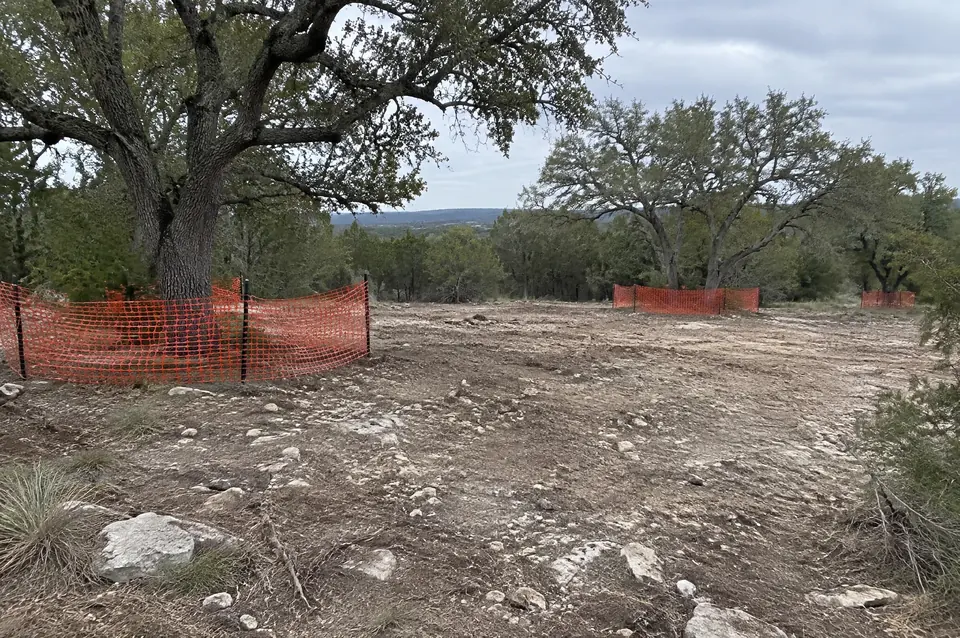
Keep the healthy oaks and shade trees that fit the plan, and protect their roots from machines. The Texas A&M Forest Service recommends a sturdy fence around each tree you are saving, set about one foot from the trunk for each inch of trunk diameter (Protect Tree Roots During Construction). A 20-inch oak gets a fence about 20 feet out. The agency notes, "Construction equipment and vehicles are a common cause of soil compaction." It also advises no trenching or digging inside that zone and no more than two inches of fill in a year.
Oak wilt matters on Hill Country home sites. The Forest Service advises avoiding pruning or wounding oaks from February through June and painting oak wounds immediately. It reports that oak wilt spreads an average of 75 feet per year through root systems, and that losing trees to it can reduce property values by 15 to 20 percent (Texas A&M Forest Service).
Selective clearing, with keeper trees flagged before the machine starts, is the simplest protection. The operator clears cedar and brush around the oaks instead of pushing through them.
Why do roots have to come out under a foundation?
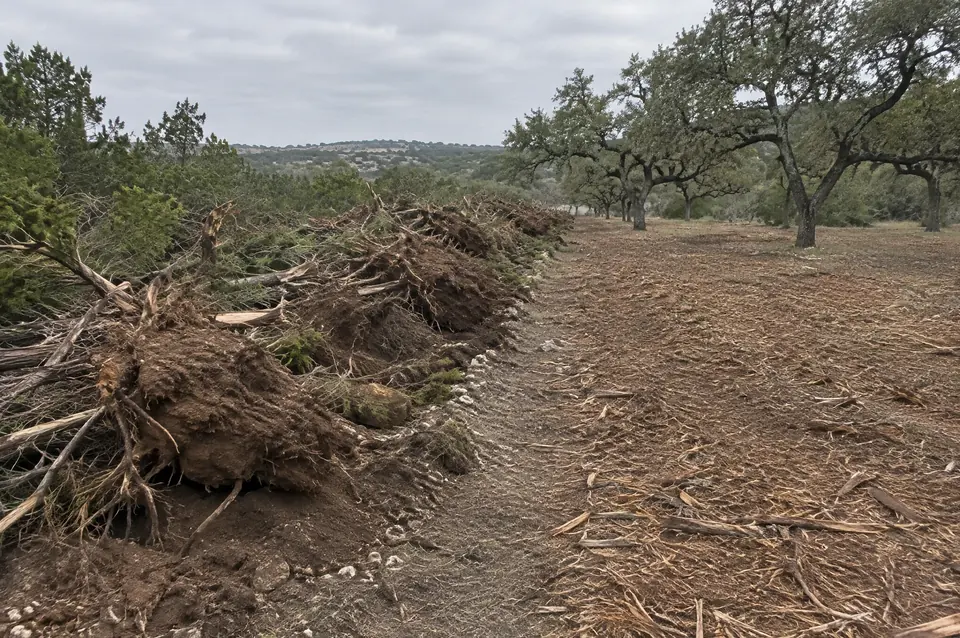
Roots come out under a foundation because the slab needs root-free ground, while everywhere else the roots do more good left in the soil. Forestry mulching grinds trees to ground level and leaves root balls in place, which holds the soil. Under the footprint, we grub root balls out with bulldozers and excavators, and we prefer to mulch them on site instead of piling them.
Grub only what the plan requires. Your builder or engineer sets the pad requirements, so get the footprint and margin in writing before the dozer starts. Grubbing in rocky ground is rough work. Texas A&M AgriLife Extension's guide to brush management methods notes that grubbing in shallow, rocky soils is hard on equipment and can leave the surface "extremely rough." Keeping grubbing to the footprint keeps bare dirt to the spot that has to be bare.
For how the two methods compare across a whole property, see forestry mulching vs bulldozing.
How do septic and rock shape a Hill Country home site?
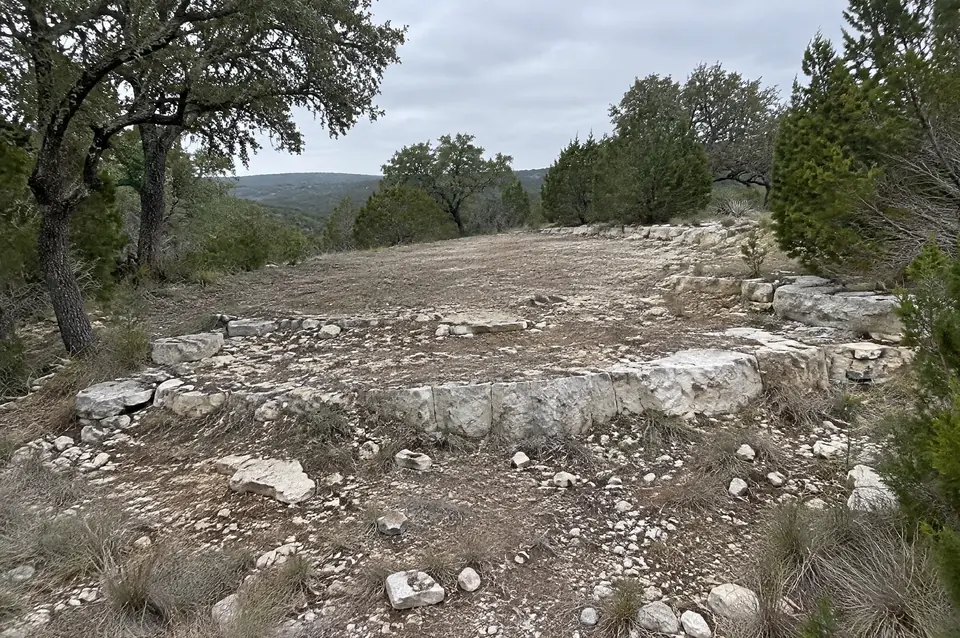
Septic and rock often decide the layout of a Hill Country home site, because a septic system needs suitable soil and much of the Hill Country has little of it. Texas rules require two feet of suitable soil from the bottom of a standard drainfield excavation to a restrictive horizon or groundwater (30 TAC 285.33). One Comal County septic permit logs limestone rock at 12 inches under clay, with an aerobic system and surface irrigation chosen for the lot.
In Comal County, a qualified site evaluator must do a site and soil evaluation, and an authorization to construct must be granted before the system is built (Comal County OSSF permit steps). Start that evaluation early. The drainfield or spray area needs room, and its location can move the house, the driveway or the trees you keep.
Rock shows up in every trench and tank hole. Our crews work in rocky terrain, dig for septic and propane tanks, and excavate up to about 4 feet deep. Our guide to building on rocky land in Texas explains why Hill Country ground fights every dig. We clear and prep home sites across land clearing in Comal County and the surrounding Hill Country.
When do you call 811 on a home site?
Call 811 before any digging on a home site, and make sure your contractor has a ticket. Texas law treats mechanized work that disturbs soil 16 or more inches deep as excavation (Tex. Util. Code 251.002). Notice must be given at least 48 hours and no more than 14 days before work, not counting weekends and holidays (Tex. Util. Code 251.151). Texas811 says the service is free and that contacting 811 is the contractor's responsibility.
811 does not mark everything. Lines that serve only the owner and sit on the owner's property, such as a private well line, private electric runs and septic lines, fall outside the law (Tex. Util. Code 251.003). The Texas811 FAQ notes that private locates come with fees. Walk those lines with your crew, or hire a private locator, before trenching starts.
What rules apply when you clear a home site?
Rules for clearing a home site mostly turn on soil disturbance, not on cutting brush. TCEQ's Edwards Aquifer rules exclude "clearing of vegetation without soil disturbance" from regulated activity. They also exclude a single-family home on a lot larger than five acres, when only one house sits on the lot (30 TAC 213.3). Other soil-disturbing work on the recharge zone can need an approved plan before it starts.
Statewide, TCEQ's construction stormwater permit overview treats clearing, grading and excavating that disturb soil as construction, and permit coverage starts when a site disturbs one acre or more. City tree rules, HOA covenants and deed restrictions can add their own limits.
Check your parcel on TCEQ's Edwards map, ask your county about floodplain and septic rules, and confirm with each agency before work starts. This is general information, not legal advice.
Plan the site before the first tree comes down
A home site is easier to get right on paper than to fix with a dozer. Start with a site walk and a discovery call for land clearing for a building site, and we will lay out the order of work with your builder's plan in hand.
Sources
- Low-Volume Roads Engineering: Best Management Practices Field Guide, Keller and Sherar, USAID with the USDA Forest Service
- Gravel Roads Construction and Maintenance Guide, FHWA, August 2015
- Protect Tree Roots During Construction, Texas A&M Forest Service
- Prevent the spread of oak wilt in Texas, Texas A&M Forest Service, February 2025
- Brush Management Methods (E-44), Texas A&M AgriLife Extension
- 30 TAC 285.33, Criteria for Effluent Disposal Systems, Cornell Legal Information Institute
- OSSF Permit 118219, Comal County Engineer's Office
- Steps to Obtain an OSSF Permit, Comal County
- Texas Utilities Code Section 251.002, Definitions, Texas Public Law
- Texas Utilities Code Section 251.151, Notice of Excavation, Texas Public Law
- Texas Utilities Code Section 251.003, Exclusions, Texas Public Law
- Homeowners, Texas811
- FAQ, Texas811
- 30 TAC 213.3, Edwards Aquifer definitions, Cornell Legal Information Institute
- Stormwater Construction General Permit (TXR150000) Overview, TCEQ, 2023