
How to build ATV trails through cedar, rock and creeks on a Texas ranch
Good ranch ATV trails run in loops, fit the widest machine you own and shed water with rolling dips. Here is how to lay them out, clear them and cross creeks.
How do you build ATV trails on a ranch?
You build ATV trails on a ranch by laying out one-way loops across the slope, clearing a corridor wide enough for your widest machine, and keeping grades and side tilt modest. Then you shed water with outslope and rolling grade dips, harden wet spots with rock, and cross creeks only where the bottom is firm.
Knowing how to build ATV trails on a ranch starts with two questions: what machines will ride them, and where will the water go? Lay the trails out as loops that fit the widest machine you own, keep them off the fall line, and give every stretch a way to shed rain. That is how a ranch trail stays fun to ride instead of turning into a rutted ditch through the cedar.
The heavy work, clearing corridors through cedar, rough and fine grading, drainage and creek crossings, is the same work behind our ranch road and access road building. This guide uses USDA Forest Service design numbers and federal safety data.
How to build ATV trails as loops that fit the land
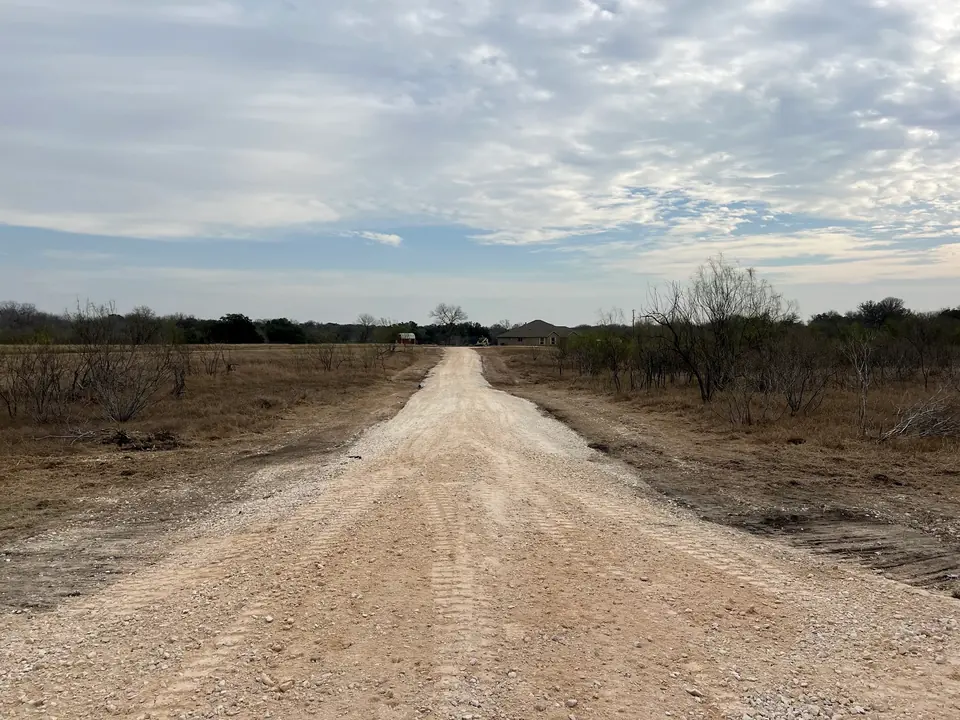
To build ATV trails that fit the land, lay them out as loops that start and end near the barn or house, run one direction and tie into the ranch roads you already have. One-way loops make head-on meetings at blind curves less likely. That matters: the U.S. Consumer Product Safety Commission names overturns and collisions with another vehicle or a stationary object, like a tree, as the most common hazards in off-highway vehicle deaths.
Route each loop the way trail crews route a footpath, with more margin for wheels:
- Follow the contour. The USDA Forest Service trail notebook's half rule keeps the trail grade no more than half the grade of the hillside it crosses.
- Use the ground for turns. The notebook says to look for natural platforms for climbing turns, because they save construction costs and "better fit the trail to the land."
- Stay off wet foot slopes. A Forest Service report on degraded off-highway vehicle trails notes that moving a trail from a foot slope to a side slope may significantly reduce trail wetness.
- Pick control points. Gates, a creek crossing you trust, feeders, blinds, tanks and views.
If walkers will share the loops, plan the gentler grades and firmer surfaces in our guide on how to build a walking trail.
How wide should an ATV trail be?
An ATV trail should be wide enough for the widest machine on the place, plus clearance so riders are not brushing cedar or clipping trunks. Texas Transportation Code Section 551A.001 defines an all-terrain vehicle as not more than 50 inches wide. Measure your side-by-side before you set the corridor.
The Forest Service trail design parameters give a starting point. These ranges run across its ATV trail classes, from rough to well developed:
| Design value for ATV trails | Forest Service range |
|---|---|
| Single-lane tread width | 48 to 72 in |
| Double-lane tread width | 96 to 120 in |
| Clearing width | 60 to 96 in |
| Clearing height | 6 to 10 ft |
| Turn radius | 6 to 12 ft |
For four-wheel drive vehicles more than 50 inches wide, the same handbook lists single-lane tread of 72 to 120 inches. Clear high enough that a roofed side-by-side never meets a low cedar limb.
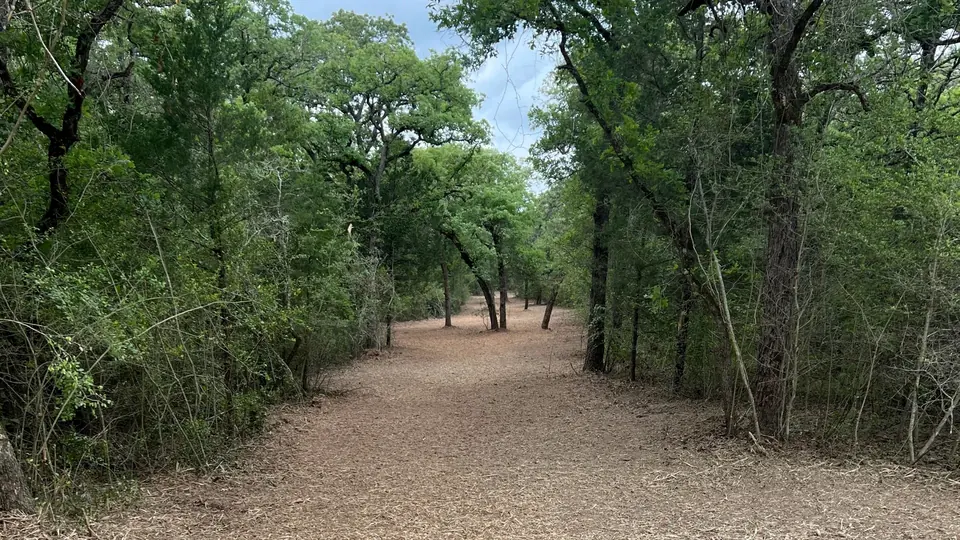
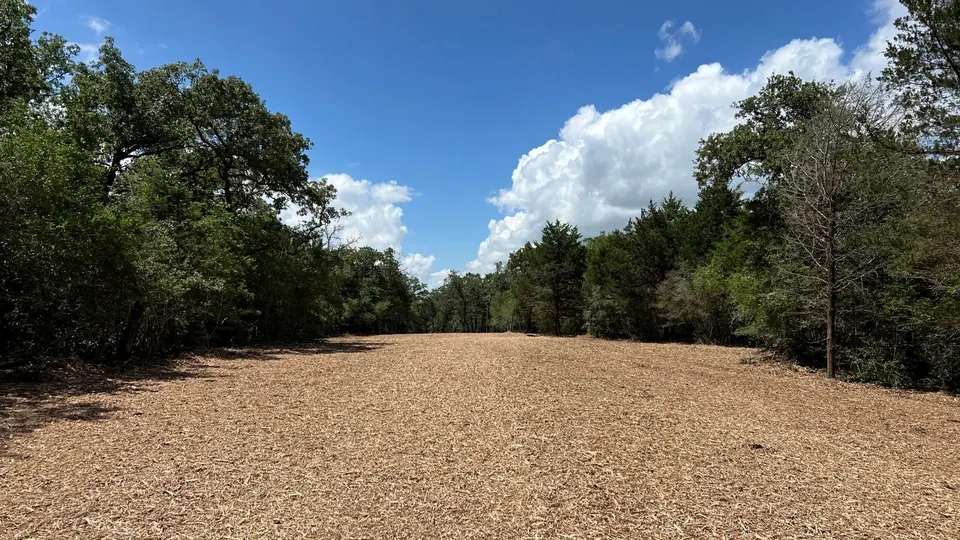
The notebook's corridor advice fits any trail: "Cut trees off at ground level and do not leave pointed stobs." Forestry mulching grinds cedar and brush where they stand, leaves a fine finish that is easy to drive over, and leaves root balls in the ground to hold the soil. On long loops through dense cedar, our GPS survey line clearing can follow your licensed surveyor's CAD line with Trimble receivers on the mulcher. We are not surveyors and do not replace one. Keep corridor work near oaks outside February through June, when Texas A&M Forest Service advises against wounding oaks because of oak wilt.
How steep can an ATV trail be?
An ATV trail can run steeper than a road, but every extra percent of grade makes the trail rougher and harder to hold in place. The Forest Service design parameters set target grades of 3 to 10 percent on the most developed ATV trails, with short pitches up to 15 percent, and 10 to 25 percent on the least developed. Target cross slope, the side-to-side tilt of the tread, runs 3 to 5 percent on the most developed trails, with a maximum of 8 percent.
Side tilt deserves extra care. CPSC's 2025 report on off-highway vehicles, published in May 2026, found overturns were the most common fatality hazard, and that ejection appears to occur in most OHV-related deaths. Keep sidehill stretches gentle, flatten off-camber spots, and cut the trail into the slope instead of riding across a tilted hillside.
Turns can tilt the other way on purpose. The notebook's tread chapter says insloped turns, built with a raised berm, "will improve trail flow and add an element of fun" on off-highway vehicle trails. It also warns they require "a high level of trail-building experience and a good understanding of waterflow."
How do you keep water off an ATV trail?
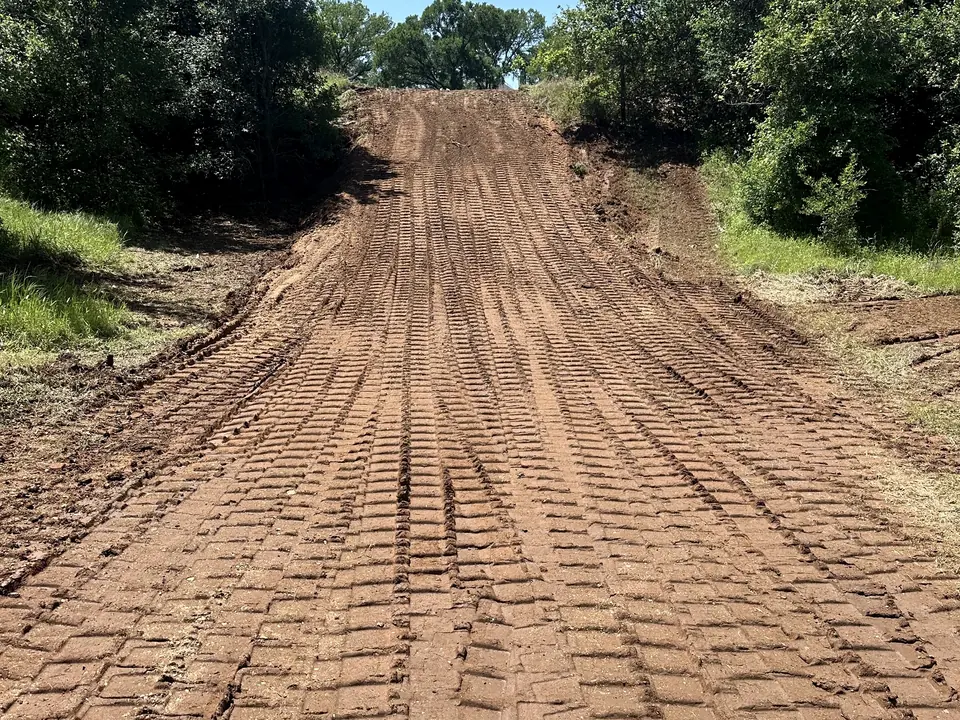
You keep water off an ATV trail with a slight outslope and rolling grade dips, so water crosses the trail instead of running down the tire tracks. The Forest Service notebook describes a rolling grade dip as a knick, a shallow outsloped scoop about 10 feet long, with a ramp about 15 feet long built on its downhill side. It says a rolling grade dip is quicker to build than a waterbar, and "a rolling grade dip works better." Waterbars, it adds, "commonly fail when sediment fills the drain."
A few habits keep a ranch trail draining:
- Put dips on the descent. The notebook says, "Rolling grade dips are pointless at the top of a grade."
- Grade off berms. Soil that builds up along the outside edge forms a barrier that keeps water from sheeting off, so it runs down the tread instead.
- Stay off it when it is soaked. The Forest Service OHV report explains that "soils are most sensitive to impact when they are wet" in its guidance on wet trails. Give a new trail dry days after a big rain.
Roads follow their own dip spacing by grade, which our guide on how to build a ranch road lays out.
How do you handle wet spots and creek crossings on an ATV trail?
Handle wet spots on an ATV trail by moving the trail first and hardening it second. The notebook's wet areas chapter says relocating the problem section of trail "should be considered first." It also warns, "Don't reroute a problem section of trail to another boggy piece of ground."
Where the trail has to cross soft ground, firm rock does the work. The same chapter lists "small, well-graded angular rocks" among the fills for a raised tread, and the Forest Service OHV report says geotextile fabric needs adequate capping, a minimum of 6 inches. On rocky ranches, that rock is often already on the ground. We process existing surface rock on site into a fine, compactible base and handle the rough and fine grading.
Creek crossings take the most planning. The notebook's stream crossing chapter puts fords in wider, shallower parts of a stream, away from bends where water undercuts the approaches, with approaches climbing a short distance above the typical high water line. On motorized trails, rocks or concrete pavers can strengthen the tread and approaches. Do not block passage for fish.
Bigger streams carry a legal line. Texas Parks and Wildlife Code Section 90.002 bars operating a motor vehicle in or on a protected freshwater area. Section 90.001 defines that as the bed, bottom or bank of a navigable river or stream, one with an average width of 30 feet or more, at or below the gradient boundary. The exemptions in Section 90.003 include private road crossings established on or before December 31, 2003, and operation necessary for usual and customary agricultural activities, and crossings must take the most direct feasible route. Ask TPWD or an attorney whether a crossing on your land qualifies. This is general information, not legal advice.
What safety basics belong on a ranch ATV trail?
Ranch ATV trails need the same safety basics CPSC urges for every off-highway vehicle. The 2025 CPSC report counted 2,685 deaths associated with off-highway vehicles from 2020 through 2022, including 1,759 associated with ATVs and 707 with recreational off-highway vehicles. It estimated 109,200 emergency department-treated injuries in 2024.
CPSC's rider tips:
- "Get hands-on training from a qualified instructor."
- Never carry more passengers than there are seats. Most ATVs are built for one rider.
- Riders younger than 16 should drive only age-appropriate youth models.
- Always wear a helmet and other protective gear.
- Stay off paved roads, and skip the alcohol.
Trail design helps too: one-way loops, open sight lines on curves, gentle side tilt and a corridor cleared to full width and height.
Plan your ranch trail system
Walk the loops with our crew before the first cut, and we will talk through corridor width, grades, wet spots and crossings. See our corridor clearing, grading and ranch access road work across Comal County and the Hill Country.
Sources
- Off-highway vehicle safety news release (May 30, 2024), U.S. Consumer Product Safety Commission
- 2025 Report of Deaths and Injuries Involving Off-Highway Vehicles with More than Two Wheels (May 2026), U.S. Consumer Product Safety Commission
- Trail Construction and Maintenance Notebook: Trail Design, USDA Forest Service
- Trail Construction and Maintenance Notebook: Surface Water Control, USDA Forest Service
- Trail Construction and Maintenance Notebook: Trail Corridor, USDA Forest Service
- Trail Construction and Maintenance Notebook: Tread, USDA Forest Service
- Trail Construction and Maintenance Notebook: Trails in Wet Areas, USDA Forest Service
- Trail Construction and Maintenance Notebook: Crossing Streams and Rivers, USDA Forest Service
- Managing Degraded Off-Highway Vehicle Trails, USDA Forest Service
- Forest Service Handbook 2309.18, Trail Development (2016), USDA Forest Service
- Texas Transportation Code § 551A.001, Texas Public Law
- Texas Parks and Wildlife Code § 90.001, Texas Public Law
- Texas Parks and Wildlife Code § 90.002, Texas Public Law
- Texas Parks and Wildlife Code § 90.003, Texas Public Law
- Prevent the spread of oak wilt in Texas (Feb. 5, 2024), Texas A&M Forest Service